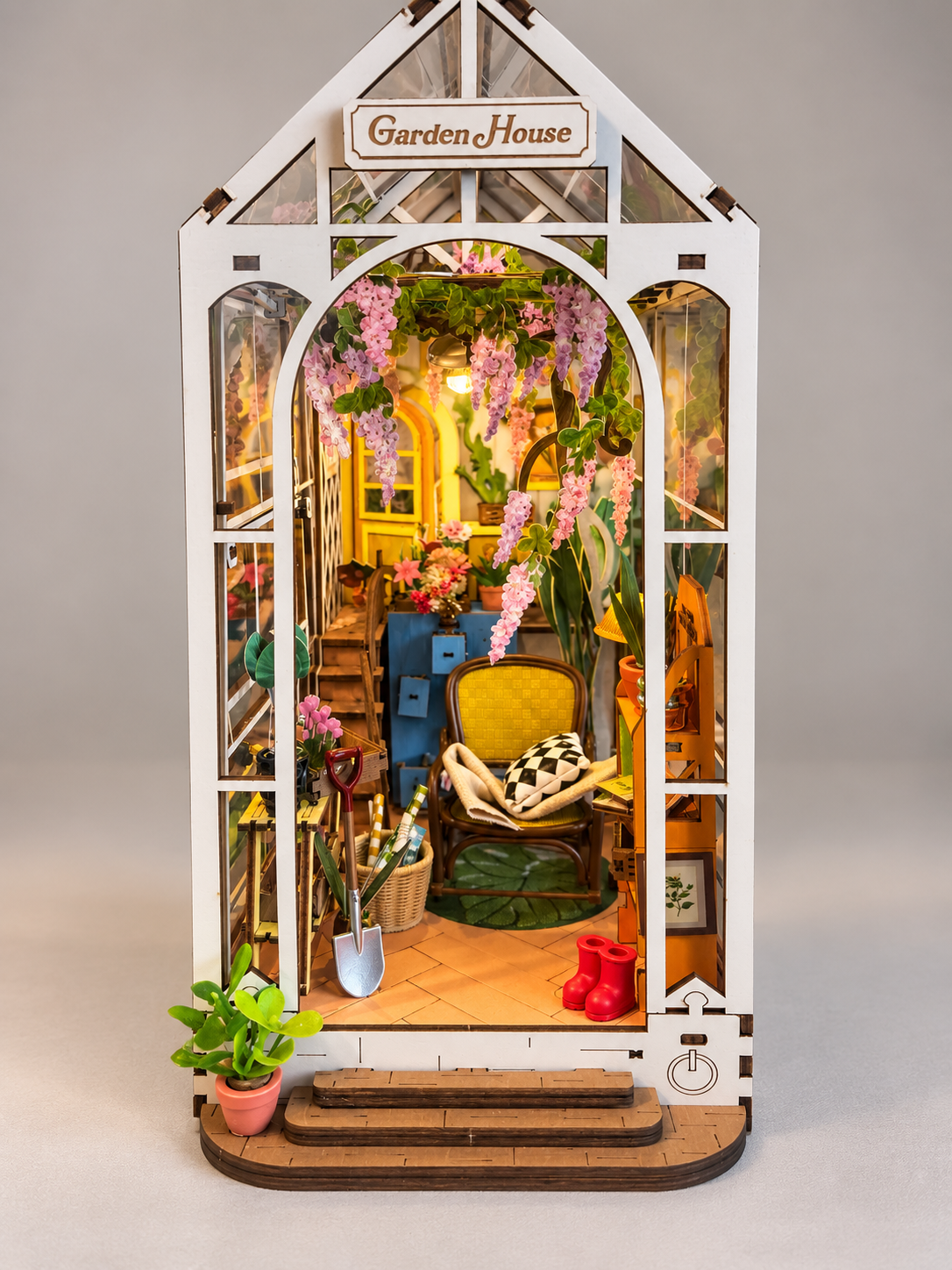
Garden House · Rolife / Robotime · Model TGB06
Built and reviewed by David Richards
Some miniature houses make you want to admire them. Rolife’s Garden House makes you want to move in, claim the rocking chair and politely ask everyone to leave you alone for an hour.
It is a gorgeous little retreat overflowing with flowers, climbing plants, furniture and proper three-dimensional objects. There is an awful lot going on in a very small space — and, for once, only three books to wrap. We will return to that minor miracle later.
I thoroughly enjoyed building it. But somewhere between the beautifully engineered furniture and the rather less beautifully explained wiring, I also compiled a short list of things I would like Rolife to reconsider.

A Garden Retreat — Without the Lawn to Mow
To British eyes, Garden House might resemble an elaborate summerhouse or greenhouse. It also evokes Germany’s Kleingarten or Schrebergarten tradition: small allotment plots where people grow plants and enjoy a green retreat, often with a modest garden cabin. The tradition dates back to the nineteenth century and remains part of urban life. A deutschland.de feature on German allotments describes nearly 900,000 plots and the rules governing their little cabins.
Rolife’s interpretation feels more like a flower-filled hideaway than a working vegetable plot. There are places to sit, greenery everywhere and the promise of a peaceful afternoon. I cannot claim it recreates a particular German garden house, but it certainly captures the appeal of having a little retreat of your own.
Happily, this version requires no weeding. Although, after assembling the plants, you may feel you have done quite enough gardening.
What You Get

Rolife sits at the premium end of mainstream miniature kits, and Garden House shows how much can be built instead of merely represented by printed surfaces. Furniture, pots, plants and architectural details give it a pleasing sense of depth. In our team article on what we’ve learned from building hundreds of book nooks, we discuss how engineering, lighting and tiny details shape the finished experience. Garden House provides a particularly good case study.
First, a Lighting Test. Then a Delicate Marital Observation.
The build begins with the battery compartment. As our pre-build checklist advises, test the lights before building anything around them. Once they work, leave the batteries in and check again as you go.
My wife did not test the lighting on her current build. The lights now do not work, and some disassembly is required.
There are moments in married life when a husband should resist saying, “I did mention that.”
I am trying very hard. 😀
Instructions: Clear, With One Frustrating Omission
The large A4 black-and-white manual is generally clear and unambiguous. Most steps tell you exactly what to do, and the construction sequence is easy to follow.
But there is one baffling omission: proper descriptions of the parts.
A diagram can show you precisely where something goes without making it obvious which of the little objects in front of you it actually is. The plant pots were my particular downfall. I used some in the wrong places and eventually had to swap them around.
When you supply this many small components, a clear parts reference is basic housekeeping. Rolife gets so much of the manual right that this feels particularly avoidable.
Excellent Engineering Meets Freddy Fat-Fingers

The side walls were a pleasure. They slotted into place easily, with the sort of precision that makes you appreciate how much work has gone into the design.
The furniture behaved equally well. Pieces clicked into position without that familiar internal debate: does this need one more push, or am I about to turn a chair into firewood?
That confidence matters. It lets you enjoy the growing scene instead of treating every joint as a potential incident.
The stairs required more attention. Each tread needs to be pushed firmly home to avoid little gaps, which sounds straightforward until Freddy Fat-Fingers arrives to supervise.
That would be me.
Take your time and check each step before moving on. Handle the flexible pieces gently, too: their willingness to bend should not be mistaken for permission to test their limits.
The lampstand inside the house was less cooperative. Getting it to sit at exactly the right angle was surprisingly fiddly, particularly compared with the easy assembly elsewhere.
But let us pause to acknowledge something wonderful: there are only three books to wrap.
Three. Anyone who has spent an evening manufacturing a miniature library will understand why that deserves a mention. 😀
Rolife Supplies Adhesive. I Reach for B7000.

Rolife supplies several types of adhesive strip, and I like the thinking behind them. Less fiddling with a bottle, less waiting for glue to hold, and a potentially cleaner way of assembling the right materials.
On some wooden pieces, they worked very well. On other materials, I was less persuaded.
Consequently, my trusty B7000 spent rather more time on the workbench than the designers may have intended. I am happy to embrace innovation, but I would also like the bits to stay attached.
And then there are the plants.
Flowers. Leaves. Vines. Pots requiring plants. Plants requiring pots. If you dislike miniature foliage, the words “Garden House” really should have provided fair warning.
Many of the cardboard plants slot together with tabs. I left mine as supplied, but this is an obvious opportunity for builders who enjoy customising. Different foliage, extra texture or a little careful reshaping could make the scene more individual.
Rolife deserves credit for the little tool used to roll the paper plants. It helps produce shapes that fit accurately into the pots, and I will be keeping it for future builds. A useful tool hiding inside a kit is always a welcome bonus.
There are also a few adhesive scrolls to roll. Rolife supplies a small wooden piece for that job, although I still prefer my own sophisticated modelling instrument: a cocktail stick.
Occasionally, the simplest tool remains the best.

Windows and Interior Details
The protective film on the Perspex removes easily, and the PVC window installation is explained particularly well. With the main structure accurately cut, the interior comes together without filing, forcing or colourful language.
A Beautiful House Deserves Better Lighting
This is where my enthusiasm dims a little. Unfortunately, so does the house.
Garden House uses only two LEDs, and the instructions do not clearly distinguish between them. I used my intuition to decide which belonged where. Experience helped, but a beginner is entitled to expect the manual to explain that.
The wire-routing diagrams caused more frustration. Some elements appeared to be shown the wrong way around, and I had to look ahead to understand what was intended.
Before committing the cables to their route, read several stages ahead. Work out where each LED and wire must eventually finish, then come back to the current step. It is far easier than discovering you have threaded everything beautifully towards the wrong destination.
This is especially disappointing because so much of the rest of the manual is clear. The electrical section needs the same care as the structural instructions.
The LEDs have bare wire ends that need joining later. That is understandable: thin, unconnected wires can pass through the small holes used to hide them. I prefer tiny heat-shrink tubing on the finished joints instead of the supplied adhesive insulation. Use an appropriate low-heat method and take care around paper, plastic and the model; secure loose wires with the supplied clips or a dab of glue.
If you are considering a lighting upgrade, our beginner’s guide to adding extra LEDs is a useful starting point. The wider troubleshooting guide also covers what to check when a kit’s lights stop working.
[INSERT LIGHTING OR WIRING PHOTO]
The Ceiling Jungle — and a Rocking Chair at Last

Just when you think the gardening might be finished, it moves upstairs.
A considerable amount of foliage goes onto the ceiling. It looks lovely when complete, but adding all those vines and plants is time-consuming. This is an area where I would welcome the next round of design improvements: keep the lush appearance, but make the repeated assembly a little less laborious.
With so many convincing 3D components elsewhere, the paper foliage feels like the part still waiting for its upgrade.
The roof, thankfully, went on without a problem. Then came the final construction: a little plastic rocking chair.
Some kits save their most irritating job for the last page. Garden House gives you a chair. It assembles easily and makes a wonderfully appropriate finish.
After all that planting, I felt I had earned a sit-down myself.
Final Verdict
Garden House TGB06 is a beautiful kit, particularly if you love gardening or the idea of a miniature retreat full of little things to discover. The engineering is excellent, most of the instructions are a pleasure to follow, and the quantity of proper 3D detail is exceptional.
I enjoyed watching it fill up. The furniture, pots, windows and greenery give you a scene worth looking into, rather than simply looking at.
My wish list for Rolife is quite specific: a proper parts reference, clearer wiring diagrams and lighting ambitious enough to show off what we have spent all that time building. I would also love to see what carefully placed mirrors — perhaps an infinity effect — could do for the sense of depth.
Those are possibilities, rather than features supplied with this kit. But the scene feels as though it has more to give.
As it stands, Garden House is a lovely build with a few avoidable frustrations. Give it better lighting and it could be something quite special.
Now, if Rolife could produce that rocking chair in my size, I could sit back and admire it properly.
Leave a Reply