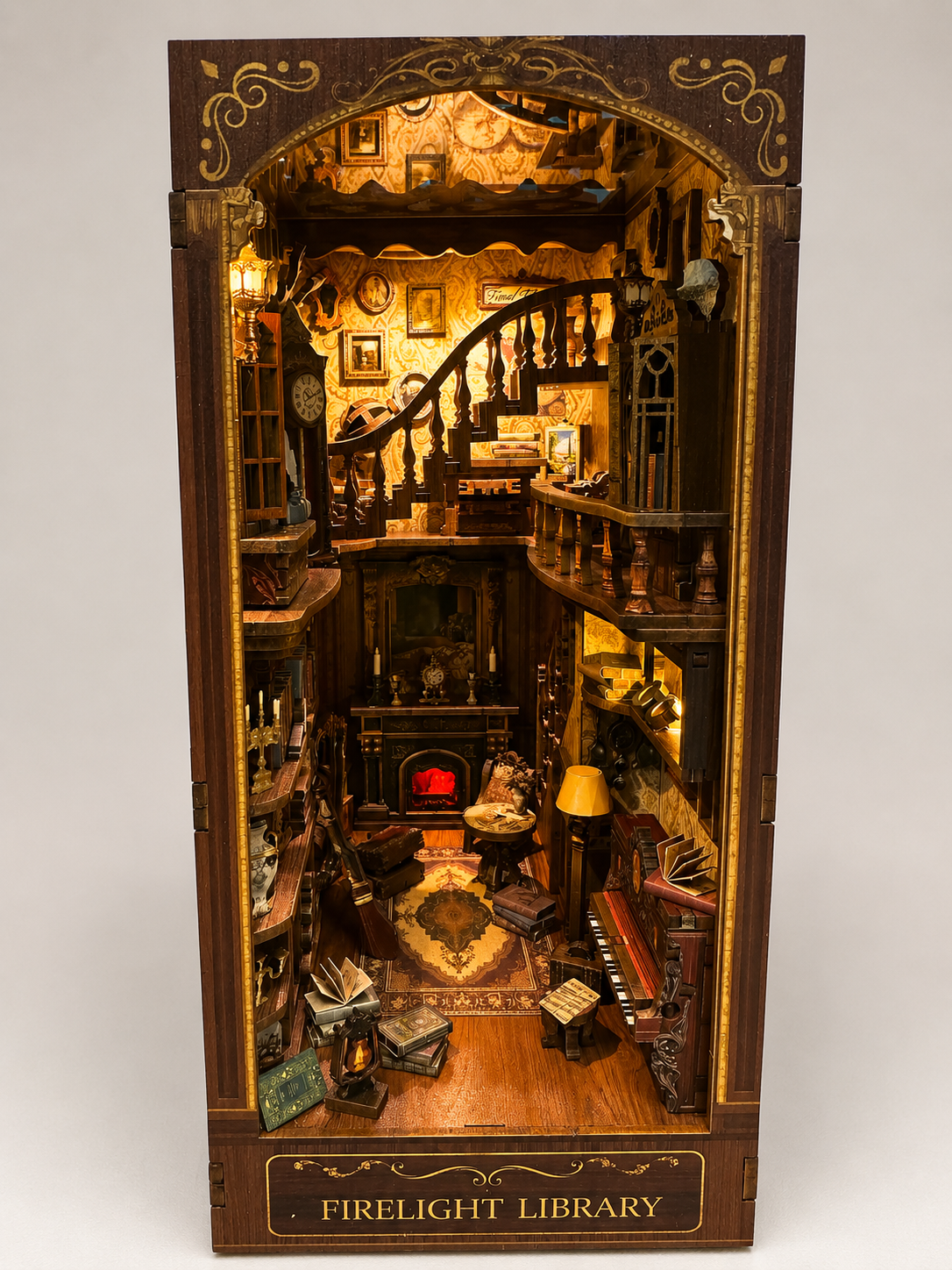
Built & reviewed by D.J. Gibson Build #172
Purchased on Temu
Buy this kit on Amazon UK: Check current price and availability →
As an Amazon Associate, Book Nook Workshop may earn from qualifying purchases at no extra cost to you.
A Classic Book Nook That Still Holds Up
Summary Table

Some book nook kits disappear almost as quickly as they arrive. Others manage to remain on sale for years, surviving countless newer releases and changing trends. Firelight Library by Luuwik belongs firmly in the second category.
Having been on the market for more than two years, this is now quite an old design by book nook standards. That made me particularly curious about how it would compare with the increasingly sophisticated kits appearing in 2026.
I am pleased to say that Firelight Library has aged remarkably well.
It may lack some of the elaborate engineering and highly detailed 3D components found in the newest generation of book nooks, but the underlying design is attractive, the construction is straightforward and the finished library has plenty of character.
First Impressions

Firelight Library is constructed primarily from printed MDF, supplemented by stickers used for decoration, scrolls and numerous book covers.
The instructions are printed in black and white, with symbols used to distinguish between the printed and blank sides of components. Although colour instructions have become increasingly common, I had no problems following these.
The MDF pieces were also very easy to remove from their boards.
Most fitted snugly into position, with glue only required for the relatively small number of pieces that were slightly loose.
Construction uses a mixture of mortise-and-tenon joints and glued multi-layer components. There is also the familiar collection of miniature library accessories: sticker-covered books, folded books made from stickers, decorative scrolls and several individual sticker details.
Anyone who has built a few traditional MDF book nooks will immediately feel at home.
A Three-Level Miniature Library

The real appeal of Firelight Library is the amount that Luuwik has managed to squeeze into the relatively compact scene.
The ground floor contains most of the library’s cabinetry and books. There is also a fireplace, piano with a movable key cover, cupboard beneath the stairs, mirror and staircase leading upwards.
That staircase immediately helps give the model a convincing sense of height and depth rather than simply presenting everything on a single level.
The second floor continues the theme with a grandfather clock and two cabinets, one of which has movable doors.
At the rear is a small working area containing a desk, art easel and globe positioned on top of a stack of books.
Another staircase then climbs to a small third-floor landing, complete with an open doorway at the top.
These different levels are one of the strongest aspects of the design. Your eye naturally travels around the scene discovering different details rather than simply looking straight towards the back wall.
Lighting and Electronics

The lighting system consists of two individual LED bulbs plus an LED circuit board containing two additional lights.
One LED illuminates the fireplace.
The supplied fireplace light is a static white LED, which works perfectly well electrically but doesn’t produce a particularly convincing fire effect.
I therefore replaced it with red and yellow flickering LEDs.
This is a very simple modification, but it transforms the atmosphere of the fireplace. Instead of looking like a brightly illuminated opening in the wall, it now has the flickering glow you would expect from a real fire.
The main LED circuit board sits towards the upper rear of the model and provides more than enough illumination for the library interior.
Another LED is positioned towards the upper-left front of the kit behind a wall lamp, providing additional illumination towards the entrance.
The entire lighting system connects to a touch-sensitive control panel with separate ports for the different wiring sets.
This proved particularly useful after my fireplace modification because the circuitry prevents the static lights from flickering along with the replacement fireplace LEDs.
Power comes from a battery compartment installed in the base, which remains easily accessible once construction is complete.
That is a practical arrangement I much prefer to designs where access to the battery compartment becomes unnecessarily awkward after the model has been assembled.
Dust Covers Included
Firelight Library includes some surprisingly good finishing touches for an older kit.
The top features an attractive ornate cut-out pattern, protected by an acrylic panel forming a dust cover across the upper surface.
There is also a front acrylic dust cover.
The front panel is retained by notches at the top and bottom. This keeps it securely in place, although removing it requires taking off the front faceplate of the book nook first.
It isn’t the most convenient removable dust-cover system I have encountered, but having integrated protection at both the front and top is nevertheless a welcome feature.
Opportunities for Customisation
Firelight Library also provides an excellent starting point for anyone who enjoys modifying their kits.
The predominantly MDF-and-sticker construction means there are several places where flat details could potentially be replaced with more three-dimensional accessories.
Books, ornaments, furniture details and other small objects could all be upgraded if you wanted to take the model further.
The fireplace is perhaps the most obvious example. My simple switch from a static white LED to flickering red and yellow lights immediately made that part of the scene considerably more convincing.
None of these modifications are necessary, however.
The kit works perfectly well straight out of the box.
Does an Older Book Nook Still Compete in 2026?
This was the question I had before starting the build.
Book nook design has developed rapidly. Modern kits increasingly feature moulded components, sophisticated lighting, moving parts, improved electronics and construction systems that require very little glue.
Against those kits, Firelight Library inevitably shows its age in places.
But that doesn’t make it obsolete.
The fundamental qualities that make a book nook enjoyable are all here: a strong theme, good fit, straightforward construction, plenty of visual detail and an atmospheric finished result.
In fact, there is something pleasantly traditional about the build.
It is a reminder that a book nook doesn’t require motors, elaborate electronics or hundreds of moulded components to create an effective miniature world.
The Quirky Details

Look carefully around Firelight Library and there are also a few cute, quirky and slightly mystical details hidden among the shelves and furniture.
I won’t reveal all of them.
Discovering these little touches while building — and then spotting them again when looking into the completed model — is part of the fun.
They prevent the library from becoming simply another collection of miniature bookshelves and give the scene a little personality of its own.
Final Verdict
Considering its age, Luuwik’s Firelight Library holds up surprisingly well.
The engineering is generally accurate, the components fit together nicely and the black-and-white instructions are straightforward despite lacking the polished colour presentation we increasingly see from newer manufacturers.
The lighting is effective, although the supplied static white fireplace LED represents an obvious opportunity for improvement. Adding flickering red and yellow LEDs makes a substantial difference and is a modification I would recommend to experienced builders who are comfortable altering the lighting.
The design itself remains attractive, particularly the three-level arrangement, staircases and densely furnished library interior.
Copyright Book Nook Workshop 2026 – All rights reserved. (D.J. Gibson)
Leave a Reply