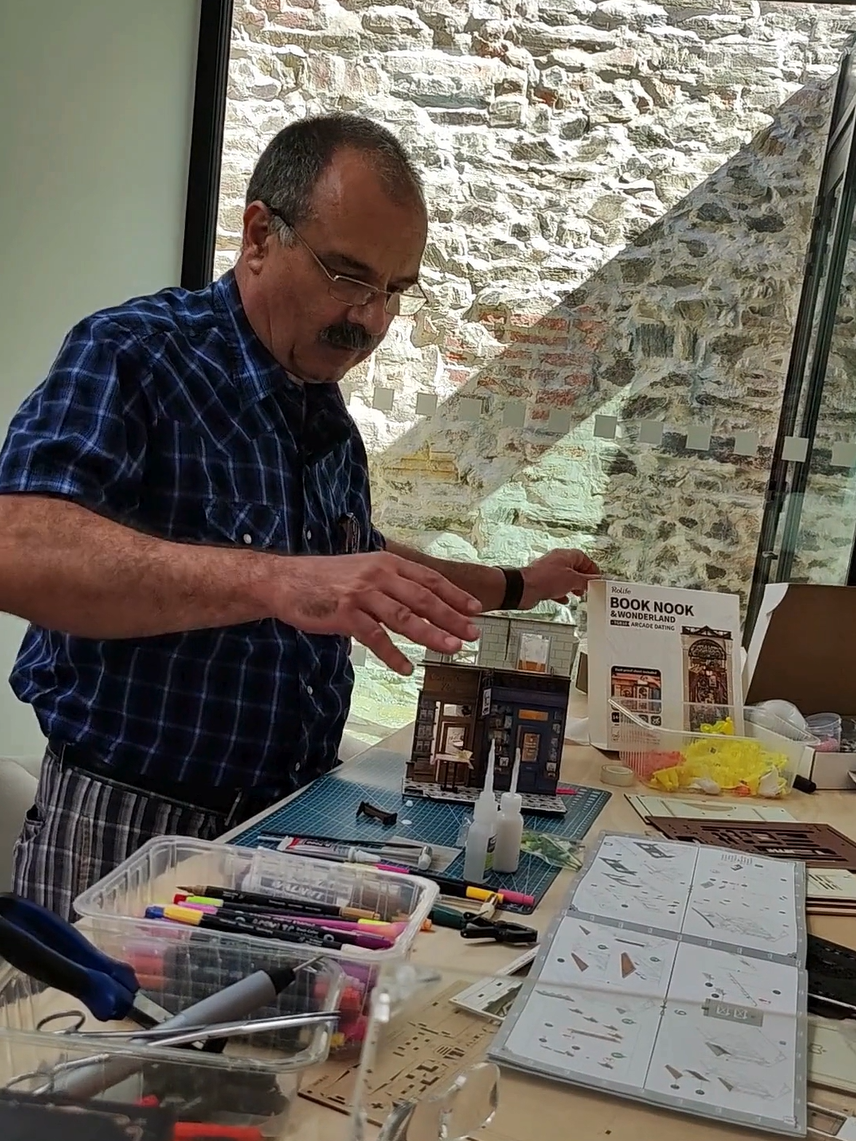
For this edition of Meet the Builder, we talk with Martin Seidler, one of the most active contributors to BookNookWorkshop.com and a builder whose approach to book nooks can perhaps best be summarized in three words:
Understand. Customize. Personalize.
Although Martin only discovered book nooks in February 2026, he certainly didn’t discover modelling then. With around fifty years of modelling experience behind him, an engineering background, a fascination with electronics and lighting, and a tendency to regard an instruction manual as the beginning rather than the end of a project, he quickly developed his own distinctive approach to the hobby.
We talked about how it all started, what makes him choose one kit over another, why understanding the story behind a model matters as much as understanding its construction, the tools and techniques he uses, the manufacturers he admires, the details that drive him crazy, and why a hobby that started with one kit in February has already grown into exhibitions, community projects, relationships with manufacturers—and a stash that may eventually require its own building.
Tell us a little about yourself and your modelling background.
I have been building models for something like fifty years, so book nooks are really only the latest chapter.
I started, like many people of my generation in Czechoslovakia, with paper models. Later came plastic models, dioramas and RC aircraft. I was involved in a modelling club for more than ten years, and modelling in one form or another has followed me through most of my life.
My professional background is technical as well. I am an aerospace engineer by education, specializing in aircraft engines. I started my career as a special-process engineer and later moved through management into the aerospace industries.
That probably explains some of the way I approach models today. I am interested not only in whether something looks good, but also in why it has been designed in a particular way, how it is engineered, how the assembly process works and whether there might be a better solution.
I am also a certified Six Sigma Black Belt and Lean expert. I spent a significant part of my professional career teaching and applying process-improvement methods. So when I build a kit, I inevitably notice things such as process flow, mistake-proofing, unnecessary operations and whether the designer has really thought about the person who will eventually assemble the product.
But fundamentally, modelling has always been something I do because I enjoy creating things with my hands.
How did you first get into book nooks?
Very recently.
I built my first book nook on 6 February 2026. It was the Beyond Library Max from Minicity. Today I know that it probably isn’t the most obvious beginner’s kit, but at the time I didn’t know that, and fortunately it didn’t matter. With my previous modelling experience and familiarity with many different materials, I had no major problems building it.
One thing I remember very clearly is that I already had a brown furniture repair marker at home. From the very first kit, I was filing away the little laser-cut bridges and burrs and colouring the exposed edges with that marker.
So even my first book nook was already being modified.
At that time I didn’t have hundreds of acrylic markers and drawers full of modelling accessories. I basically had one brown marker! But I was already rounding some edges, cleaning parts properly, colouring exposed MDF and experimenting with details such as the sofa cushions.
And I absolutely loved working with the LEDs.
And, as often happens, one thing rather quickly led to another.
Facebook deserves some of the blame. Once you open one advertisement or post about a book nook, Facebook apparently concludes that this is now your only interest in life and starts flooding you with book nooks.
Within perhaps two weeks, I had ordered something like twenty or twenty-five different kits and accessories, mostly through Temu and various other sources.
Shortly afterwards, my wife and I went to a spa. Naturally, I decided that I should take an unbuilt book nook with me.
The kit I took was Seoul Hipjiro. The only reason was, that it was the only next kit after the frst one, which physically arrived before my departure to SPA.
So there I was at the spa, happily working on what was only my second book nook.
Meanwhile, back home, the consequences of my previous two weeks of internet shopping were arriving.
In about four days, something like six or seven different courier deliveries turned up at our house or in the delivery boxes. My daughter and son-in-law were receiving everything for me.
When we came home from the spa, my son-in-law—”the little bastard”—had collected all those boxes and built an enormous pile out of them.
And on top of the pile he had put a small Christmas tree.
It looked as though Christmas had arrived again.
So I returned from the spa quite pleased with myself because I had finished my second book nook, only to discover that I already had a stash of more than twenty kits waiting to be built.
That probably tells you something about how quickly the hobby got out of control.
P.S. My son-in-law is actually one of my best friends, who is supporting my nooking hobby heavily by 3D printing for my almost anything I mention I would perhaps need for my next builds
What is it about book nooks that keeps you coming back?
I think the biggest attraction for me is freedom.
Book nooks sit somewhere between traditional diorama building and completely free modelling.
If you build a serious diorama, there is almost no such thing as a perfect diorama. You are always trying to achieve another level of realism. There is always another tiny detail that could be improved. The wall could be more realistic. The weathering could be more subtle. The vegetation could be finer. The figure could be positioned more naturally.
Nothing is ever quite good enough.
With book nooks, I feel much freer.
I sometimes compare it with figure skating. In the old days, you had the compulsory figures and then the free programme.
For me, a traditional diorama is a little like the compulsory figures. There are rules and expectations about realism and accuracy.
A book nook is the free programme.
Everybody decides for themselves what they want to do with it.
If there is a vehicle in the kit and I feel I can make that vehicle particularly good, I will spend a ridiculous amount of time on it. If something does not come out absolutely perfectly, perhaps I am slightly disappointed, but most likely nobody else will even know that I originally intended something better.
And if something comes out extremely well, I get enormous satisfaction from it.
Nobody can really tell you that your book nook is right or wrong. It is a free discipline.
I absolutely love that liberty.
How do you decide which kits you want to build?
Emotion. Absolutely.
There has to be something about a kit that speaks to me.
It might represent a place I have visited or somewhere I have always liked. It might be connected with a historical event, a person, a story or a cultural theme that interests me. Sometimes it is simply the architecture, the colours, the patterns or the overall composition of the design.
And sometimes I look at a kit and it immediately starts teasing my customization appetite.
I can already see what I could do with it.
I see where I could change the lighting, where I could add something three-dimensional, where sound might work, where the vegetation could be improved or where some small detail could turn the original concept into something much more personal.
That immediate emotional reaction is extremely important to me.
I am definitely not the kind of shopper who buys something simply because it is cheap.
Of course I like a bargain. Who doesn’t? And considering the number of kits I buy, I certainly appreciate a good price.
But a low price alone has never been a reason for me to want a kit.
On the other hand, if I genuinely fall in love with a design, I am capable of spending a rather serious amount of money on it.
Whispering Hollows and Eternal Midnight Paris, the limited editions from Anavrin, are good examples. They were, frankly, ridiculously expensive. From a purely rational value-for-money perspective, I could probably have given myself many reasons not to buy them.
But I loved both designs from the first glance.
And that was basically the end of the discussion.
For me, choosing a book nook is therefore not primarily a calculation of the number of pieces, size, price or technical complexity.
There has to be emotion.
Something has to make me want to enter that little world.
How would you describe your building philosophy?
I would summarize it as:
Understand → Customize → Personalize.
But the word understand is very important here.
I don’t primarily mean understanding how the kit is assembled.
I mean understanding what the kit is actually about.
Before I start serious customization, I want to understand the world that the designer is trying to represent.
If the kit depicts a real building, I want to know something about that building. If it represents a particular city or place, I look at photographs and try to understand its architecture, atmosphere and characteristic details.
If it is connected with a historical event, a particular person, a book, a film, a legend or a cultural tradition, I try to learn as much as reasonably possible about that subject.
I research it.
I look at photographs and videos. I read about the place or story. I look for details that perhaps aren’t immediately obvious from the kit itself.
I think about what sounds belong there, what kind of lighting would be natural, what objects should be present and what little details could make the scene more authentic.
A good example of why understanding comes before customizing was my build of The Spirit of the Magical Ring. I was planning the build and already had plenty of ideas for changing the water scene and adding much more greenery to what I thought was a rather plain landscape supplied with the kit. Then, during a rehearsal with my band, I mentioned my plans to our bass player. There is a nice connection here: when he was about ten years old, he was actually one of the kids in the modelling club I used to run, and he later became a very serious modeller himself. His reaction was immediate: “No, no, no. You can’t do that. There cannot be all that greenery there!” He recognized the scene from The Hobbit and explained what I had missed. This was the scorched land devastated by Smaug. There could certainly be water and greenery lower down around the city, but the landscape behind it needed to look dry, dead and burned. That completely changed my approach. I collected real stones from around our house, used small remnants of our Christmas tree and actually scorched them with a gas lighter, added brown and grey modelling grass and created a much harsher, burned-out landscape. I even added a yellow-orange LED inside Smaug’s mouth to suggest fire. The result was almost the opposite of what I had originally intended — and much better for it. It became a perfect lesson for me: don’t customize a kit simply according to what you think would look attractive. First understand the world and the story it represents, and then customize within that story. In this case, understanding what the kit was really about allowed me to create the scene it was meant to be, rather than the scene I had initially imagined.
That research then gives me ideas for the second stage: Customize.
Rather than simply adding something because it looks nice, I prefer customization that has a reason to be there.
If I can find authentic sounds connected with the place, perhaps I can incorporate them. If the environment should contain a particular type of vegetation, animal, object or architectural detail, perhaps I can add it. If the lighting should have a particular character, I can change it accordingly.
And sometimes I have a personal connection with the subject, which makes the third stage—Personalize—particularly important.
A good example is MiniCity’s Hemingway House.
I had actually visited Hemingway’s house in Key West back in 1993, so I wasn’t approaching it simply as another miniature building. I had my own memories of the place and could draw on photographs and what I remembered from being there. Even details such as the famous cats suddenly have a different meaning when you understand the real place behind the model.
So for me, these three stages are quite distinct:
Understand the subject. Customize the model. Personalize the result.
Of course, I also need to understand the engineering of the kit. I dry-fit parts, study the instructions, look ahead in the assembly sequence and understand the electrical system before permanently putting everything together.
But that is really part of my building technique.
The first Understand in my philosophy means something broader.
Before I start changing the miniature, I want to understand the story it is supposed to tell. But please dont catch my word. Sometimes I customize just because I feel like it may look cool…
Are there any basic details you always pay attention to?
Absolutely.
I hate unfinished edges.
Raw MDF, visible laser burns, burrs and obvious tabs can completely destroy the illusion for me.
I use furniture-repair markers, acrylic markers, metallic markers and whatever else is appropriate. I have an absurd number of them, including a set of around 240 acrylic markers.
Depending on the piece, I will also slightly round or soften an edge rather than leave it looking like something that has just been punched out of a sheet.
And this brings me to something that genuinely pains me when I look at some other builders’ work.
Sometimes somebody posts a model and is understandably very proud of some incredibly demanding customization. They have added complicated electronics, designed beautiful 3D-printed parts or made some other technically sophisticated modification.
And immediately next to it is a completely raw plywood edge with a laser burn on it.
That simply doesn’t work for me.
There needs to be some proportionality and reason.
If you are going to customize, the customization should be consistent with the quality of the whole model.
There is absolutely nothing wrong with building a kit straight from the box and enjoying it exactly as supplied. But if you are going to spend hours adding sophisticated modifications, take care of the basics as well.
What sort of customizations do you enjoy most?
Probably lighting and electronics, although by now I have accumulated materials for almost every kind of customization imaginable. Please note that until I have started book nooks I have had very little if not NO knowledge of LEDs, sound modules, electroninc, etc., beyond the basic facts and priciples. I have learned amost everything during my past 7 months in this hobby.
I have something like two or three thousand LEDs at home—perhaps sixty or seventy different types. Different sizes, colours, colour temperatures, intensities, flashing patterns, strobes and so on.
And it isn’t only LEDs.
I have boxes and boxes of miniature flowers, vines and other greenery; grasses, characters and animals; gravel and pebbles; chains and tiny metal pieces; beads, decorative elements, gold nuggets and Lord knows what else.
There is actually a reason why the collection became so ridiculous.
Once I decided that I was going to take book nook building and customization seriously, I realized that most of these tiny accessories are incredibly inexpensive when bought in bundles from places such as Temu and AliExpress.
At the same time, I knew that the economics of importing lots of small individual items from Chinese marketplaces into Europe were going to become less favourable. So during April and May I went through something of a buying frenzy.
I bought several large sets of acrylic markers, hundreds and hundreds of LEDs and dozens upon dozens of bags of miniature accessories.
It was a relatively serious investment in total, but each individual item was incredibly cheap.
The result is that one of the cabinets in my workshop now looks almost like the spare-parts department of a miniature factory.
Everything is divided into boxes, carefully sorted into categories and properly labelled so that when I need something, I can actually find it.
I think I now have enough material for at least the next hundred builds.
Possibly two hundred. Or realistically many more….
There is also a slightly funny contradiction in the way I spend money on this hobby.
As I mentioned earlier, when I choose the kit itself, I am very emotional. If I fall in love with a design, I am not particularly price-sensitive.
But when it comes to the tiny everyday components I use for customization, I become exactly the opposite.
Then I am absolutely a bargain hunter.
Take specialist miniature electronics, for example. I have great respect for Evan Designs in the United States. They offer very good ready-made miniature lighting and electronic solutions, and for somebody who wants a convenient, proven solution without designing everything themselves, that can make perfect sense.
But I enjoy making these systems myself.
If I buy LEDs and electronic components in bundles from AliExpress and create the solution on my own, my component cost can often be a fraction of the price of buying individual ready-made specialist components—sometimes five times cheaper, sometimes even more.
Perhaps I am slightly strange in that respect.
I can spend a serious amount of money without too much hesitation on a book nook that I fall in love with, and then become extremely pleased with myself because I saved a few euros by buying fifty LEDs instead of one.
But cost isn’t the only reason I do it.
The much bigger advantage is freedom of choice.
When I decide that a particular scene needs another light, I don’t want to ask:
What LED do I have available?
I want to ask:
What light does this scene need?
Do I want warm white or cold white? Yellow, orange, red, blue or green? Do I need 3 mm, 5 mm, a tiny SMD LED or a filament? Steady, slowly breathing, randomly flickering or strobing? How bright should it be?
I can open the cabinet and choose.
That freedom is incredibly valuable because lighting can completely transform a kit.
I have used DigiSpark microcontrollers for programmable effects. I have added sound modules with my own mixed soundtracks. I have used mirrors, water effects, additional touch controls, different lighting modes, servos and solenoids.
And I have one particular obsession.
If there is a fireplace or visible fire in a kit, I absolutely have to put a flickering LED into it.
I can’t help myself.
I normally use combinations of randomly flickering yellow and red LEDs.
Right now, for example, I am finishing Shamrock and Harp Bar from Fifijoy. It has a fireplace, and Fifijoy already provides a slowly breathing yellow LED, similar to the effect they used in Jungle Adventure.
That is nice.
But it isn’t fire.
So naturally I added randomly flickering red and yellow LEDs, and suddenly the whole fireplace looks completely different.
It is a tiny modification, but these are exactly the details that can completely change the atmosphere of a miniature.
What glues do you normally use?
Several, because I don’t believe there is one glue that is best for everything.
For larger flat surfaces, I use Aleene’s Tacky Glue quite a lot.
For small parts and combinations of different materials, B7000 is extremely useful.
I do use cyanoacrylate super glue, but I probably use what I call silicone super glue even more often for certain jobs.
One of its great advantages is capillary action. If something is already assembled and needs fixing, you can place a tiny drop at the joint and it spreads beautifully along the edge.
That makes it excellent for reinforcing completed assemblies without having to take them apart.
I also use UV resin quite extensively. It is excellent for attaching wires, beads, small metal pieces and transparent elements because you can position everything first and then cure it immediately with UV light.
I also use coloured UV resin directly on LEDs. If I want to change the tone of an LED, a small amount of yellow, orange or red transparent resin over the diode can work extremely well.
What tools could you not live without?
There are probably too many to list.
Obviously knives—an X-Acto and ordinary craft knives. Small files. Long pliers. Various clamps.
I use PEAN haemostats in several sizes constantly. They are fantastic for reaching into places where normal fingers or pliers simply cannot get.
For electronics, I have a small cordless soldering iron, solder, flux and third-hand holders.
Good lighting and magnification are essential. I use magnifying headset with headlamp depending on what I am doing. But great quality LED lamp all above my workspace is the basic must
For rotary tools I have a rougher grinder for heavier work and a HOTO fine rotary tool. I also use a HOTO screwdriver/drill.
One slightly unusual tool I absolutely recommend is a music stand.
I put the instruction booklet on it.
It keeps the instructions upright at eye level, away from glue and the chaos on the table, and I can see several pages at once. It is such a simple thing, but it makes building much more comfortable.
And my next major addition is an airbrush. I want to use it particularly for weathering, shading and atmospheric effects.
Which builds are you most proud of?
There are several, and for very different reasons.
One of them is definitely Tonecheer’s Walking Castle.
I was lucky enough to receive the Walking Castle very early, as one of the first builders globally, and Tonecheer was running a competition based on how quickly builders could complete it—from the moment the package was delivered until the finished video was posted online.
I took that competition very seriously.
For about a day and a half, it became an intensive race.
And it was a wonderful contradiction for me, because on one hand I genuinely wanted to be as fast as possible.
On the other hand, I simply wasn’t willing to compromise my normal standards.
So the clock was running and I was still cleaning every burr, colouring the edges, checking the finishing and doing all the things I normally do.
That cost me many hours.
But I wasn’t prepared to finish a model quickly and then look at it afterwards knowing that I had deliberately done something below my normal standard just to save twenty minutes.
Eventually I had the entire Walking Castle finished and working, and I posted the video.
Competition finished.
And then, of course, I immediately sat down again for another sixty or seventy minutes and added 3D greenery.
That was actually almost the only substantial customization I made to it beyond my usual finishing and edge colouring, because the kit itself was already so complete.
I don’t know whether I was actually the fastest builder globally, but I did receive a prize from Tonecheer.
And perhaps more importantly, I think that project was one of the moments that really started the excellent cooperation I have had with Tonecheer ever since. I value that relationship very much.
The Walking Castle itself remains one of the most fantastic kits I have built. The concept is brilliant, the engineering is excellent and the whole thing was simply enormous fun.
Another build I am particularly proud of is MiniCity’s Song of the Sirens. That was a completely different experience because it gave me a lot of freedom to experiment with atmosphere and electronics.
And then there is Hanoi Train Street. I made so many changes to that model—lighting, sound, vegetation and other details—that it became very much my own interpretation rather than simply an assembled kit. I have been always fascinated watching the youtube videous from the trains street. And not the book nook comes covering this topic!
Those tend to be the projects I remember most. Not necessarily the objectively “best” kits, but the ones where either the building experience itself became a story or where I was able to put a lot of myself into the finished result.
Are there particular manufacturers you enjoy building?
Yes, but for different reasons. I don’t think there is one manufacturer that is simply “the best.”
Different brands are strong in very different areas.
Fifijoy is one of my favourites because I love their atmosphere and the variety of subjects they are willing to explore.
They were also the first brand that approached me directly and offered cooperation on reviews and builds, so I am very proud to have been working with them from the very beginning of this part of my book nook journey.
What I particularly appreciate is how receptive they are to feedback. When I comment on one of their builds, whether positively or critically, I have the feeling that they genuinely listen and take the comments seriously.
That makes the cooperation much more meaningful for me, because I don’t want to produce reviews that simply say everything is wonderful. I want the feedback to be useful.
I also like the fact that Fifijoy covers a wide variety of themes and topics. Their catalogue is not locked into one particular visual style or one type of environment.
That also means I don’t always feel that I want to build every Fifijoy kit immediately.
For me, there has to be the right emotional moment for the particular subject.
Sometimes I may have a kit in the stash for quite a while because I am simply not in the mood for that particular atmosphere or theme. But then the right moment comes, the subject suddenly clicks with me, and that is when building it becomes enormous fun.
Their darker, abandoned or mysterious scenes are particularly good customization platforms for me. I built their Abandoned Gothic Church, for example, and then Abandoned Asylum, and both gave me enormous opportunities to add atmosphere, lighting and details. And I cant forgot to mention the Jungle Adventure. It was the first kit I have seriously experimented with lighting modifications and endge improvements and modifications.
Abandoned Asylum is also a very good example of something I would like to see more manufacturers doing with lighting. Some of the lights randomly flicker, almost suggesting an unstable or failing electrical supply. That tiny detail contributes enormously to the feeling of the place.
Tonecheer is another favourite, but almost for the opposite reason.
Tonecheer sometimes gives me a problem:
Their kits are too good.
They are so thoroughly designed and engineered that they often don’t leave me very much to customize.
Of course, I still colour the edges and do my normal finishing and personalization, but in the vast majority of their recent kits there isn’t some obvious engineering weakness crying out to be corrected.
For somebody who wants an absolutely outstanding kit with excellent quality, excellent design and a very polished building experience—and who isn’t a customization maniac like me—Tonecheer is almost an ideal manufacturer.
From my professional perspective, I particularly admire their process design.
As I mentioned, I am a certified Six Sigma Black Belt and Lean expert and spent many years applying and teaching these principles professionally.
When I build a Tonecheer kit, I see Lean and Six Sigma principles everywhere.
The assembly sequence makes sense. The instructions support the process. The components are designed to prevent mistakes. They use what in Lean terminology we call poka-yoke—mistake-proofing.
The builder often physically cannot install something incorrectly, or the design makes the correct solution immediately obvious.
I would genuinely bet that Tonecheer either has or has had somebody with a process-planning or continuous-improvement background involved in their development.
That attention to the building process is one of the reasons I enjoy their kits so much.
MiniCity is another manufacturer I like very much, particularly for architecture. Their kits often provide a very good balance between strong design and enough room for me to do something personal. I am sure, I will become more addicted to this brand with more of their designs built.
CuteBee often has excellent concepts and ideas. I particularly like their willingness to work with very different cultural themes and environments. Many of their kits draw inspiration from Chinese, Japanese and other Asian cultures, but they also explore a much broader range of global cultures, places, events and subjects.
That variety is something I appreciate very much because, again, emotion plays a major role in what I choose to build. Sometimes a particular cultural theme, place or story immediately attracts me.
At the same time, I haven’t yet built enough CuteBee kits to make a really broad judgement of their entire range from the builder’s perspective. My appreciation at this stage is therefore based partly on the kits I have built, but also very strongly on their concepts and designs.
There are quite a few CuteBee kits that interest me, and I am very much looking forward to building more of them in the future.
Rolife/Robotime is interesting because they cover such a broad spectrum. Some of their products are intentionally simpler and aimed at a wider audience, while others can create surprisingly strong results with relatively simple engineering.
Their Sunset Isle is a great example.
It is not an extremely complicated kit, and the original lighting solution is relatively simple, using only a few basic LEDs. Yet the final visual effect is wonderful.
For me, that is a very good reminder that sophisticated electronics are not always necessary. If the lighting is placed intelligently, if the colours and reflections work with the design, and if the scene itself is strong enough, even a small number of simple LEDs can create an excellent atmosphere.
And you also have ROKR within the Robotime family. ROKR is famous for mechanical kits, and models such as Dream Gift Factory and Dream Coffee Factory are phenomenal. The mechanical engineering and craftsmanship are excellent.
I haven’t built enough ROKR kits yet to consider myself particularly experienced with them, but I have several more waiting in the stash and will certainly get to them sooner or later.
AslowSnail, part of SileCraft, is another brand I like very much. I have built several of their kits so far, and all of them have been of an excellent standard.
They are solid, well-designed kits and I have had very positive experiences with them. I definitely have more Aslowsnail and ETKVR kits on my list and am looking forward to building more of them in the near future.
Funpola / Timori is another brand I like very much.
One particularly interesting part of their range is the series of four kits using infinity-mirror effects and passages: Venice Night Starlight, and other kits from that series.
They are great designs. For me, they are relatively straightforward builds, but the engineering is very good and the infinity-mirror effect creates an extraordinary sense of depth from a comparatively simple construction.
I also very much enjoyed their Lord of the Rings kit, but for almost the opposite reason. That one immediately challenged me to do some heavy customization, which naturally made it particularly attractive to me.
So Funpola/Timori can give me both things I enjoy: clever visual engineering that works beautifully almost straight from the kit, and subjects that immediately trigger my customization appetite.
I also like Vorathis. They have some genuinely beautiful kits and interesting designs.
I cant forget Viendor, where I have found some of the ideas extremely interesting. Their concepts can be excellent, even though their manufacturing and engineering approach has historically been different from some of the leading Chinese brands. I truly enjoy wantching Viendor’s development closely and can envision their interesting growth and developmnts in near future
Anavrin has produced some beautiful concepts as well. Their kits are expensive, but most of them re visually very attractive. I have build several of them, have several of them in the stash and I hope I will start getitng more of their kits in near future.
And there are obviously many more.
That is one of the reasons I deliberately try not to build two consecutive kits from the same manufacturer. I like switching between brands because it keeps exposing me to different philosophies of design, manufacturing and assembly.
What would you improve about today’s book nook kits?
The original question asked for one thing, and if I really had to choose only one, I would say give builders more opportunities for optional customization.
I would love to see manufacturers providing additional 3D accessories or even downloadable files for 3D printing.
Characters, animals, plants, furniture, architectural details—things that allow builders to make their model more individual.
We still see too many places where a three-dimensional object is represented by a flat printed piece simply because it is cheaper and easier to manufacture.
I don’t necessarily think every basic kit needs to become more expensive by including dozens of extra components.
Make them optional.
Sell an accessory package. Provide downloadable STL files. Cooperate with the community and allow people to design compatible additions.
That would be fantastic.
But if you broaden the question beyond one single improvement, then lighting would definitely be another major area.
I am a huge fan of complex and functional lighting.
I don’t mean simply putting three warm-white LEDs into a model.
Think about what the lights represent.
Use colours. Use flickering. Use slow breathing effects. Use strobes where appropriate. Create independent lighting zones. Allow different modes.
The randomly flickering lighting in Fifijoy’s Abandoned Asylum is a perfect example. The irregularity suggests a failing electrical supply and immediately changes the atmosphere.
At the moment, I think Tonecheer’s recent electrical architecture is something of a benchmark.
Their combination of USB-C and battery power is extremely practical, and in their more recent kits they have integrated the electrical functions, controls and effects very intelligently.
Walking Castle, Deep Melody, Magic College Frame and other recent Tonecheer models show the direction I would like to see more manufacturers taking.
Give me USB-C when I want permanent power, batteries when I want the model completely independent, and retain the proper controls and lighting functions in both situations.
That is, for me, currently close to the ideal basic electrical solution.
What advice would you give somebody building their first book nook?
First of all, read the instructions before you start.
Then dry-fit.
Dry-fit again.
And only then think about glue.
One of the most common beginner mistakes is seeing a glue symbol in the instructions and immediately gluing something permanently without understanding what will have to happen three stages later.
Test your LEDs before you install them.
Then test them again after important assembly steps.
Nothing is more frustrating than completing a beautiful section and discovering that the LED buried inside it stopped working twenty minutes ago.
And use the community.
Search. Ask questions. Look at photographs of other builds. Read guides and reviews.
One thing I find quite funny is how many people completely ignore that little magnifying-glass search button in Facebook groups.
Before posting a question, try it.
Open the group, click the little magnifying glass and search for the name of your kit or the problem you are trying to solve. You may be surprised by how much information is already there. Somebody may have asked exactly the same question six months ago, and several experienced builders may already have provided detailed answers, photographs and solutions.
Our BookNook Workshop Facebook group has accumulated a lot of useful information, and there are several other excellent book nook groups as well.
That little magnifying glass is an amazingly powerful tool if you actually use it.
And, of course, use BookNookWorkshop.com.
Between the four of us, we have already published plenty of technical articles, guides, reviews and practical advice covering many of the questions builders repeatedly encounter—from glues and lighting to electrical systems, assembly problems and customization techniques.
There is absolutely no shame in learning from somebody who has already made the mistake you are about to make. In fact, one of the great advantages of today’s book nook community is that you often don’t have to make that mistake yourself at all.
Most importantly, though, enjoy the process.
If you want to build everything exactly according to the instructions, do it.
If you want to rebuild half of the model, do that too.
It is your model.
Where do you get inspiration for your customizations?
Almost everywhere.
Real buildings, historic towns, nature, vehicles, industrial scenes, architecture, films, books, history—almost anything can trigger an idea.
When I travel, I automatically start looking at places through the eyes of somebody who might want to reproduce them in miniature.
Recently we travelled through Germany and Alsace and visited places such as Rothenburg ob der Tauber, Colmar, Riquewihr and Kaysersberg.
For a miniature builder, walking through those towns is almost dangerous.
Every second street looks like a potential book nook.
And increasingly, I don’t only think about how I could customize an existing kit. I also find myself thinking about completely new kit concepts.
By now, I have developed roughly a dozen different design concepts and shared them privately with several of the manufacturers I particularly enjoy cooperating with.
Some of those ideas are already being considered or developed further by the brands, which is extremely exciting for me.
It also means I have to be careful about what I disclose publicly.
It would be unfair to describe those concepts here when somebody may already be investing their designers’ and engineers’ time into turning one of them into a real product.
So for the moment, those ideas will have to remain confidential.
But if one day I see a book nook on the market that started as one of those ideas in my head, that will probably be one of the most satisfying moments this hobby has given me.
You have now displayed your collection publicly as well. What has that been like?
That has probably been one of the most rewarding surprises of the whole hobby.
When you build these things at home, you naturally look at them through the eyes of the builder.
You see the edge you could have finished slightly better or the LED you spent three hours installing.
At an exhibition, you suddenly get to watch people who know absolutely nothing about any of that.
At my first exhibition, one particular family came into the room and I still remember them very clearly.
There was a father and mother, probably in their late thirties, perhaps early forties, and their son and daughter, maybe somewhere around ten to twelve or thirteen.
The father walked in and was immediately drawn into it. He started moving from model to model, bending down, looking inside, examining how things worked.
The children did exactly the same thing. The boy was attracted to certain models, the girl to others, and both of them immediately started exploring.
And then there was the mother.
She was a beautiful, very elegantly dressed woman who could almost have been a model herself.
She entered the room like a grand lady.
You could see it in her whole body language. She looked around almost from above, with that slightly detached expression saying:
This is obviously something for my husband and the children. There is nothing here for me.
She slowly walked behind them while they were already completely absorbed in the models.
And then she noticed one.
She stopped.
She looked inside.
Then she moved to another one.
And within a few minutes, that elegant, slightly distant lady had disappeared.
There was suddenly a girl standing in front of the book nooks.
She was bending down, looking through the windows, pointing things out, calling the others over to see details she had discovered.
Watching that transformation was absolutely wonderful.
By the end, all four members of the family were completely engaged, but each of them had found something different that appealed to them. They ended up buying one kit each of them and as far I I know everybodu already finished it and the kids are already working on third or fourth.
That moment explained something to me about book nooks better than any marketing presentation ever could.
They are not really toys for children.
They are not simply models for modellers.
They are not just decorations for adults.
They somehow sit between all of those worlds.
A ten-year-old child can find something magical in them, an experienced modeller can examine the engineering and details, and an elegant woman who enters the room convinced that none of it could possibly interest her can suddenly become a little girl again.
That is something I will remember from my first exhibition for a very long time.
What do you do with all the models once they are finished?
That is becoming a serious logistical question!
If I kept everything I build, eventually my house would be completely flooded with book nooks.
So one of the things I increasingly enjoy is finding the right home for a finished model.
Not simply giving things away randomly, but matching a model to a place where it makes sense.
Recently, for example, I built Tonecheer’s Magic College Frame and came up with the idea of donating it to our local pediatrician’s office.
Tonecheer liked the idea very much and supported the project.
It was a fantastic success.
I later posted a video of the doctors and nurse themselves having fun with the Magic College in the waiting room.
For me, that is exactly where such a model belongs. Children are waiting to see a doctor, perhaps they are nervous, and suddenly there is this magical miniature world there for them to discover.
I also donated Rolife’s Wisdom Stationery Shop to the owner of our local stationery shop. He has it displayed in the shop and customers enjoy it.
During autumn and winter, with support from several manufacturers, I plan to build suitable miniatures for our local kindergarten.
And our town has recently redesigned and reopened its library. I intend to build and donate at least a dozen appropriate book nooks there, perhaps even more.
Those are the kinds of community projects I absolutely love.
And, to be completely practical, they also help me get rid of some models in the nicest possible sense of the phrase.
Otherwise my house really will disappear underneath them.
I also lend parts of my collection to friendly companies.
I have friends who enjoy them, so sometimes a company will have a dozen or even twenty of my book nooks displayed for several weeks or months—often around reception, at the secretary’s desk or in the area where visitors wait before going into meetings.
The feedback from those companies has been unbelievably positive.
People stop and look at them.
They ask questions.
And, quite unexpectedly, they can be excellent icebreakers before difficult meetings.
Instead of two people sitting silently waiting to negotiate something complicated, somebody starts asking, “What is this?” and suddenly they are talking about a miniature street or a tiny illuminated room.
I have also donated several models to friends who own guesthouses, cafés and similar businesses.
Where I can, I leave a little information explaining what book nooks are, where people can find them, how they can build them and where they can learn more.
And it generates an amazing amount of interest.
People contact me asking what they should buy. They send emails. They call. Some even come to my house and look through my stash to choose something or ask me what would suit them.
It can take quite a lot of time because when somebody contacts me, I want to take them seriously and answer personally.
But I genuinely enjoy it.
It has turned the hobby into a form of community work as well.
What is your workspace like?
My main building space is actually in the corner of our living room.
Fortunately, I have a very tolerant wife.
The best way to describe my workspace is probably to imagine a seriously equipped drummer sitting behind a large drum kit.
My main working desk is in the centre, and then everything else surrounds me.
I have several small side tables positioned around the chair, each serving a different purpose and holding whatever tools, materials or components I need for the current build.
There is strong lighting from several directions, magnification when I need it, and my music stand with the instruction booklet positioned where I can read it comfortably without taking up valuable working space on the desk.
I even use the window pane beside me as a temporary storage and sorting area for the panels of parts. I can stack them there in sequence, see what I still have available and take the next panel when I need it.
So once I sit down in the middle of everything, I really do feel a little like a drummer surrounded by his complete drum kit.
Everything has to be reachable without constantly getting up.
Glue here. Markers there. PEANs and pliers within reach. LEDs and electronic components on another table. Parts waiting for assembly somewhere else. Instructions on the music stand next to me. Strong lights coming from the right directions.
And during a serious build, the whole arrangement expands.
My workshop contains the larger stock of materials and the tools for genuinely dirty work, as well as my increasingly ridiculous collection of carefully sorted and labelled boxes containing LEDs, electronic components, greenery, flowers, animals, figures, gravel and all the other customization materials I have accumulated.
But most of the detailed assembly still happens in that corner of the living room.
To somebody walking past, particularly in the middle of an intensive project, it can probably look as though a small miniature factory has exploded around me.
But from my chair in the centre, it makes perfect sense.
Like a drummer, I know exactly which instrument to reach for next.
There must also be something particularly attractive—perhaps even magical—about that exact spot in the middle of my “drum kit.”
Our female cat, Eda, certainly thinks so.
The moment I get up and leave the drummer’s chair unattended, she immediately takes possession of it. Within minutes she is perfectly positioned right in the centre of my workspace, comfortably asleep as though the entire arrangement of tables, lights, tools and book nook parts had actually been designed around her.
And she is usually deeply annoyed when I come back and have the audacity to suggest that I might want my chair again.
So apparently I am not the only one who considers it the best seat in the house.
The difference is that I use it to build book nooks.
Eda uses it for naps. Perhaps she likes it because of smelling my happiness there…
What projects are you looking forward to next?
There are always far too many.
The big technical challenge I am particularly looking forward to is MiniCity’s Phantom of the Opera MAX.
The obvious thing for me is the chandelier.
If you give me the Phantom of the Opera and a chandelier, you cannot seriously expect me to leave the chandelier hanging safely from the ceiling.
It has to fall.
So my plan is to create a genuinely falling chandelier using a micro-solenoid or electromagnet and then synchronize that with lighting, music and sound.
I already know that this will probably turn into one of those projects where I spend an absurd number of hours solving a problem that nobody asked me to solve. The concept is ready, special items ordered, kit in my stash, so lets see what will be the result. My ambitions are high, so usccess is not fully guaranteed.
Finally, what has surprised you most about becoming involved with book nooks?
Probably how quickly it stopped being simply about building models.
I started because I found these little miniature worlds interesting.
Then I started customizing them.
Then I became interested in why one kit was engineered better than another.
Then came reviews, articles, discussions with other builders, communication with manufacturers, exhibitions and community projects.
Then David invited me to participate in the BookNookWorkshop project and that opened whole new horizons.
And somewhere along the way, the book nooks themselves became almost a vehicle for meeting people.
I have met builders from all over the world. I communicate directly with designers and manufacturers. I have people contacting me for advice. I lend models to companies, donate them to doctors, shops, libraries and other places, and then watch people who have never heard the words “book nook” before discover them.
But the thing that keeps me personally interested is still what attracted me in the beginning.
Freedom.
You can take exactly the same kit and give it to ten people, and you can end up with ten different models.
One person will build it perfectly according to the instructions.
Another will weather everything.
Somebody else will add twenty LEDs.
Somebody will put cats everywhere.
And somebody will probably decide that the chandelier needs to fall from the ceiling.
There is no judge.
There are no compulsory figures.
It is the free programme.
And I think that is why I am still having so much fun with it.
There is one more thing I genuinely appreciate about the book nook community: how remarkably friendly it is. Facebook in general can sometimes be a fairly hostile place. People argue, attack each other over trivial things, hide behind anonymity and seem surprisingly willing to turn even an innocent discussion into a conflict. My experience with book nook groups has been almost the opposite. In our BookNookWorkshop.com community, and actually in most of the other book nook groups I follow, people are generally courteous, supportive and genuinely interested in helping each other. Of course there can occasionally be disagreements or an unpleasant comment — we are still human beings — but hate, harassment and personal attacks seem remarkably rare. I sometimes wonder why that is. Perhaps there is something about a creative hobby where people spend hours patiently making tiny books, flowers, furniture and miniature worlds that attracts a different kind of interaction. Whatever the reason, book nook builders seem much less interested in behaving like anonymous Facebook warriors and much more interested in appreciating what somebody else has created, exchanging ideas and helping each other improve. That positive atmosphere is another reason why I enjoy being part of this community so much.
Quick-Fire Round
Coffee or tea while building?
Coffee.
Daytime or late-night builder?
Probably late night, but realistically: anytime. If I find thirty free minutes, I can build for thirty minutes, then go back to work, family, another hobby or whatever else needs doing.
Tweezers or fingers?
Tweezers — but both.
Warm white or cool white lighting?
Warm white.
Dream book nook series?
Four Seasons.
Four related book nooks representing spring, summer, autumn and winter. They could even use essentially the same scene transformed through four completely different seasonal atmospheres.
That is something I would love to see.
Copyright Book Nook Workshop 2026 – All rights reserved. (Martin Seidler)
Leave a Reply