Built and reviewed by Ian Scott Horst
Some book nook brands become favourites. Others inspire something closer to a cult following.
We all develop our preferences in this hobby. Sometimes it is a favourite theme; sometimes it is a manufacturer whose design language simply clicks with us. I love Tonecheer kits, while the more unusual releases from the Chinese brand Muenshuo are nearly always interesting. Other builders will champion MiniCity, Rolife or another trusted name.
Then there are the brands that inspire an almost emotional attachment. Builders welcome every new release, collect the kits and defend the brand with the enthusiasm normally reserved for a football team. For me, with its attention to architectural detail and fascination with overlooked subjects, Viendor falls into that category. For many others, that brand is Anavrin.
Anavrin has a reputation for premium—and sometimes controversial—pricing, yet it also has a legion of loyal fans who eagerly buy both its Asian street scenes and its fantasy or forest-themed kits. I had previously built a couple of Viendor kits dating from the companies’ now-dissolved partnership, but Old Shanghai was my first true Anavrin build.
Having finished it, I understand the devotion rather better.
Old Shanghai at a Glance
Manufacturer: Anavrin
Model: Old Shanghai (ABN07)
Setting: A Shanghai street scene in the 1930s
Piece count: 344
Main materials: Printed MDF, acrylic and plastic window sheets
Lighting: Ten colour-coded LED assemblies, including strips and fairy lights
Power: Two AAA batteries
Controls: Touch switch
Also included: Front and top dust covers, infinity mirror and B-7000 glue
A Street Scene from 1930s Shanghai
I bought Old Shanghai some time ago, and ever since then it had glared at me from its place in the stash. On returning from a trip, I finally decided that its time had come.
I had long suspected that this might be the high-rent cousin of the fiddly Oriental Tales kit I built a few weeks earlier, minus most of the doll’s-house-style props. Now that I have completed both, I am convinced that one influenced the other. Conceptually, they are remarkably similar—right down to the rickshaw at the front.
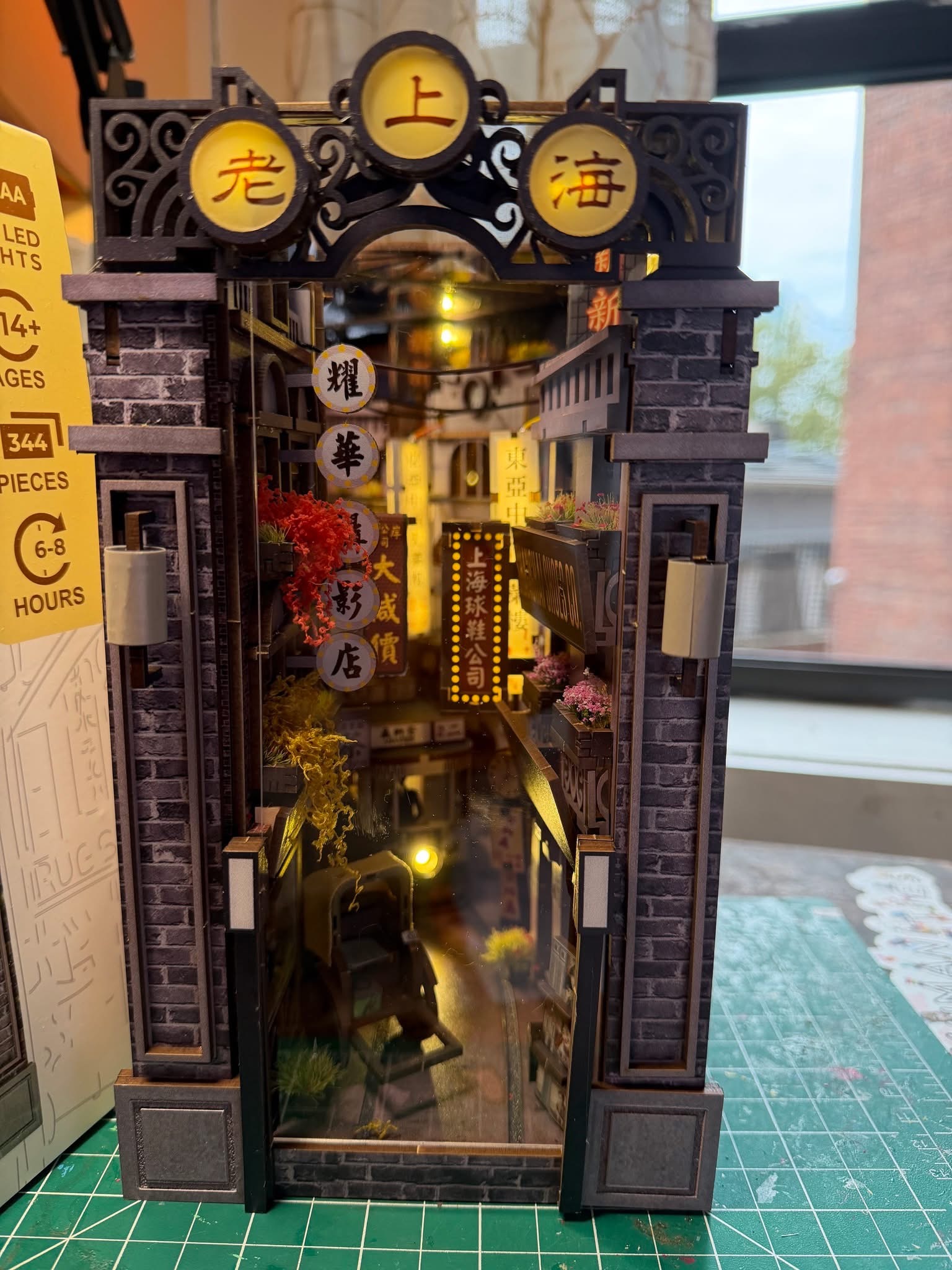
The scene depicts an old Shanghai street lined with shopfronts, including a photographic studio and shoe shop. A streetcar runs through its centre beneath overhead power lines, illuminated signs crowd the narrow space and carefully placed plants soften the urban architecture.
Like the best kits from Viendor and the former Book Nook Global partnership, the emphasis is on atmosphere rather than miniature clutter. Old Shanghai captures a lost moment in a city that has changed beyond recognition since the period it portrays.
What Is Inside the Box?
This is a substantial kit. Its 344 pieces are spread across 13 excellent-quality MDF boards with a distinctive finish and feel. The box also contains an acrylic panel, a sheet of clear plastic windows, electrical components, artificial plants, a real cloth rickshaw cover, a small tube of B-7000 adhesive and a remarkably patient 80-page instruction manual.

The graphics are detailed and impeccably printed. The colour palette is deliberately muted, which suits a 1930s urban setting, and the laser cutting remains sharp even around the smallest and most delicate components.
I chose not to colour the exposed MDF edges. Anavrin has anticipated some of the most visible problem areas and provides small stickers to disguise them, so the finished scene never feels unfinished.
A Complex but Calm Build
At 344 pieces, Old Shanghai is not a quick project. I worked on it steadily over a day and an evening, but despite the complexity it was an almost entirely trouble-free experience.
The engineering is excellent. Parts fit accurately and often lock into position with a satisfying snap. I was surprised by the number of pieces that are designed to be glued, particularly from a brand associated with precise tab-and-slot construction, but the adhesive work is logical and never feels like compensation for poor tolerances.
There are a few mildly fiddly elements, including the cloth canopy on the rickshaw and the artificial greenery, but nothing approaches the frustration of some prop-heavy miniature-house kits. The architectural structures come together cleanly, and the final outer box assembles without force.
The kit is also generous with spare parts, including duplicates of both accordion-cut components. I did not need any of them, but their inclusion is reassuring when the finer pieces are being removed from the boards.

Ambitious Lighting That Actually Works
Old Shanghai contains a great deal of lighting. The shop signs glow, the building interiors are illuminated, the streetcar lights up, the book nook sign has its own fairy lights and additional LEDs provide pools of atmospheric light throughout the street.
The system uses ten preassembled and mercifully colour-coded lighting sections, combining individual diodes, LED strips and fairy lights. Much of it is installed towards the end of the build, which could easily have created a hopeless tangle of wire. Instead, the process works smoothly because each wire is a sensible length for its intended position.
The wiring needs to be taped down carefully and the result looks rather messy from behind, but it is well concealed once the rear panels are fitted. If you remain patient and secure each section as you go, the final box closes without drama.

Power comes from a two-AAA battery box hidden behind a rear hatch, and the lights are operated by a touch switch. That arrangement is neater and more convenient than a permanently connected USB cable.
The Infinity Mirror Is a Highlight
The infinity mirror is especially convincing. Rather than simply reflecting the same artwork backwards, Anavrin has printed the reverse of several graphic elements in mirror image. Their reflections therefore appear the right way round, strengthening the illusion that the street continues far beyond the physical depth of the box.

It is a small design decision, but exactly the sort of decision that separates an atmospheric premium kit from one that merely contains expensive components.
Other thoughtful touches include side cut-outs revealing correspondence between star-crossed lovers, dust covers across both the front and top, and a shadowy streetcar driver—the only visible human presence in the scene. The restraint works. The street feels inhabited without becoming crowded by figures.
Instructions: Clear, but Too Dark
The 80-page manual is generally clear, methodical and straightforward. It breaks a complicated construction into manageable stages and gives the build a calm rhythm.
Its main weakness is the dark photography. On several pages, it is difficult to tell whether a component should be positioned printed-side up or down. An icon system distinguishing printed and unprinted faces—something other manufacturers already use—would remove the uncertainty immediately.
This is a surprisingly common problem in book nook instructions. Enlarging or brightening a photograph does not help when the relevant detail simply has not been captured clearly enough.
A Few Frustrations
There were only a handful of issues worth reporting:
The box-sign fairy lights: These are fiddly to position neatly and make the removable front dust cover awkward to install. That is why some of the finished photographs show more glare than I would normally accept; I usually remove a front cover for photography.
The wiring: Taping down so many cables is inevitably untidy, although none of it is visible in the completed model.
The acrylic panel: The instructions say to remove a protective film that I could not find. Instead, the printed image layer felt loose, leaving me wondering whether the film had been applied to the wrong side.
The instruction photography: Some dark images make component orientation harder to judge than it needs to be.
None of these problems seriously damaged the build experience, and all were outweighed by the accuracy of the engineering and the strength of the finished design.
Is the Anavrin Old Shanghai Book Nook Worth the Money?
This is the unavoidable question with Anavrin. As we found when examining the rising cost of book nook kits, the brand sits firmly in the premium end of the market.
For this particular kit, I think the answer is yes. Old Shanghai offers an unusual historical subject, detailed architecture, excellent cutting, ambitious but well-planned lighting and one of the most effective infinity mirrors I have encountered. It feels like a complete design rather than a collection of fashionable features.
Value remains personal, of course. I find some of Anavrin’s other urban alley designs a little too industrial and visually repetitive for my taste. If forest fantasy were my main interest, I would probably be much more tempted by several of its recent releases.
Anavrin also runs frequent discounts, so it is sensible to compare its own website with the current Amazon listing rather than assuming either will always be cheaper. The kit remains expensive, but the effective price may vary considerably.
Old Shanghai Book Nook Ratings

Old Shanghai Book Nook: Final Verdict
I am probably not going to join the Anavrin cult completely, mostly because of the price and because rare Chinese kits remain a higher priority for my collection. But after building Old Shanghai, I understand why the cult exists.
This is a detailed, well-engineered and deeply atmospheric book nook. It asks for patience rather than advanced skill, rewards careful wire management and produces a finished scene with genuine depth and character.
I have one more Anavrin kit waiting in the stash, so consistency will be the next test. For now, Old Shanghai has made an excellent first impression.

If you are considering another Anavrin street scene, you may also want to read our Kyoto Gion review. For a different example of architecture-led storytelling, see The Abandoned Submarine by Viendor.
Old Shanghai Build Gallery


Leave a Reply