
When I started researching this article, I thought it would be relatively straightforward.
We have reviewed 121 book nooks at Book Nook Workshop. The plan was simple: establish when the kits were released, put them into chronological order and see whether newer kits scored better than older ones.
Several days and one increasingly ridiculous spreadsheet later, the answer was much less convenient.
We cannot prove that newer book nook kits are automatically better. And, just as importantly, we cannot prove that beta testing is the reason one kit succeeds while another does not.
That does not make the investigation a failure. In fact, it led us to a much more useful question: if experience alone does not guarantee that a manufacturer’s next kit will be better, what can manufacturers do to prevent avoidable problems reaching customers?
Welcome to the Book Nook Dating Game
Trying to establish an accurate release date for a Chinese book nook can be surprisingly difficult.
A kit may appear on Amazon in 2026 but have been available elsewhere considerably earlier. A retailer may describe an existing product as new. The same kit may subsequently appear under another brand name. Product listings disappear and reappear.
And then there is the small matter of identifying who actually made the thing in the first place.
Our previous investigation found a complicated network of manufacturers, brands, OEM factories, distributors and retailers. Our guide to book nook model numbers and manufacturers shows just how tangled those relationships can become, while our Book Nook Industry Report looks at the wider industry.
Manufacturer catalogues, model numbers and websites allowed us to establish a reasonable sequence for many kits, but not sufficiently precise release dates across the whole dataset to support a statistically meaningful industry-wide claim.
What Our 121 Reviews Can — and Cannot — Tell Us
Our review database is extremely useful for comparing individual builds and spotting recurring problems. It is not a controlled scientific study of the entire book nook industry.
Even where we have reasonable release sequences, our scores do not show a clean upward line. Excellent older kits exist. Disappointing new kits exist. A manufacturer can produce an outstanding kit and follow it with a weaker one.
Cutebee: Improvement Is Not a Straight Line
Cutebee provides a useful example because we can establish a relatively high-confidence sequence for a substantial part of its catalogue. Among kits we have reviewed, Bookshop Memories scored 61/100, Green Life Bookshop 80/100 and the later Corner Coffee Shop 70/100.
That alone demonstrates why we should not say that every new generation is automatically better than the last.
Rolife: Higher Expectations, Not a Perfect Progression
Rolife has been around long enough for its book nooks to span several generations of design. Our reviewed kits range from the high 60s and 70s into the 90s, including Sunset Isle at 98/100.
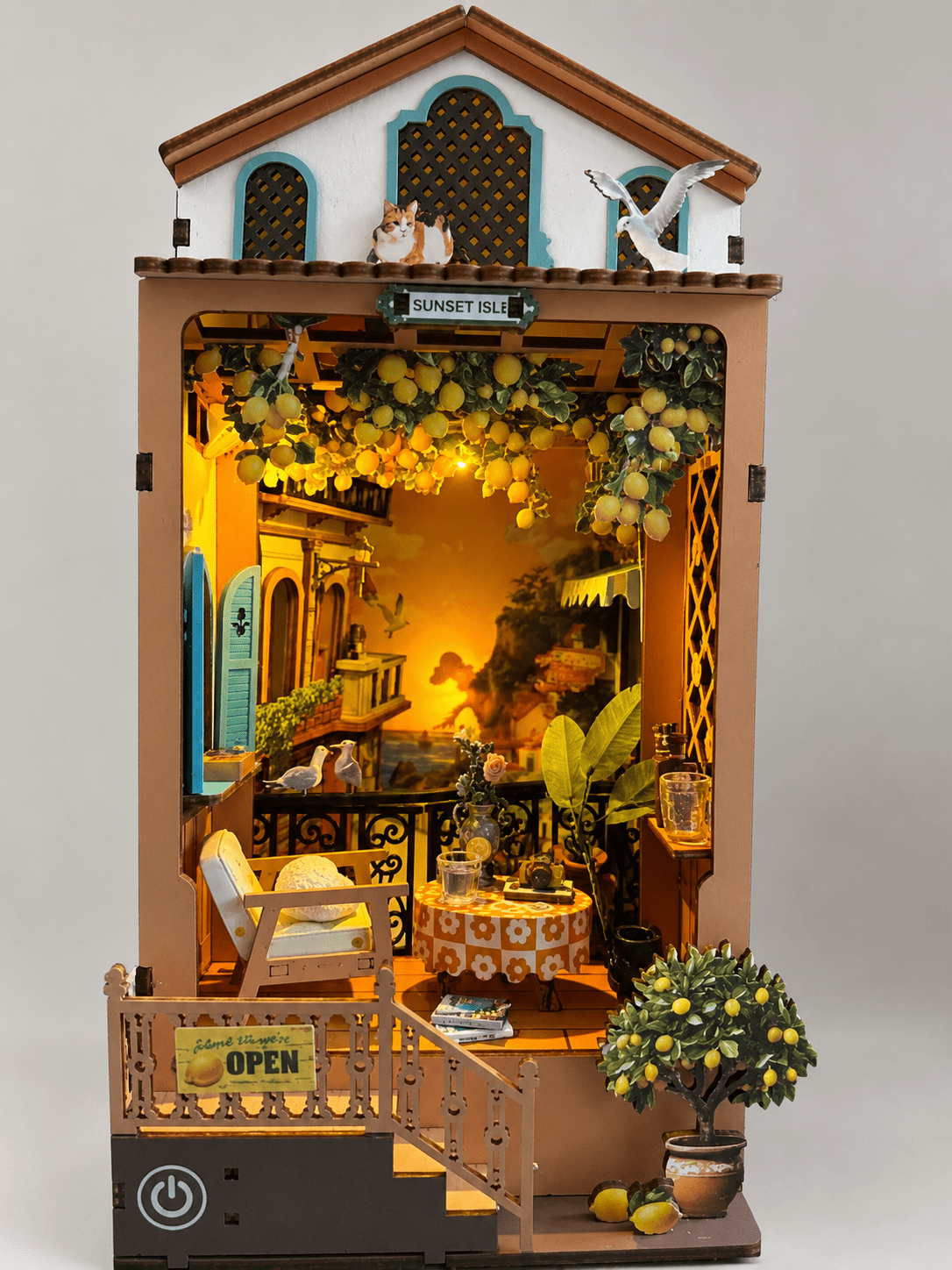
That is evidence of what modern kit design can achieve, but it is not evidence that every new Rolife kit will outperform every older one.
Sile Crafts: Why Simple Graphs Can Mislead
Sile Crafts — whose products appear through brands including ETKVR, TOYQI, DROICC and ASLOWSNAIL — also demonstrates the danger of oversimplification. Our reviewed products cover a wide range of experiences. The Ancient Bar shows what the manufacturer can achieve when engineering and instructions come together well.
Different designers, complexity levels, budgets and product teams all affect the finished kit. Manufacturer experience matters, but it does not guarantee consistency.
So Where Does Beta Testing Fit?
This is where we need to be precise. We do not currently have reliable industry-wide information showing which manufacturers beta test every kit, what each company calls beta testing, at what stage testing occurs, who performs it, or whether feedback results in production changes.
We therefore cannot look at a low-scoring kit and conclude that it was not beta tested. Nor can we look at an excellent kit and claim that beta testing made it excellent.
What we can say with confidence, based on the problems our reviewers repeatedly encounter, is that independent pre-release building has the potential to identify many avoidable problems before customers discover them.
The Designer Has One Huge Disadvantage
The designer knows how the kit works.
They know which tab goes into which slot. They know which way around the staircase faces. They know that a wire needs to be threaded through a tiny hole three stages before the light is installed. They know what the dark photograph in Step 37 is supposed to show.
The customer knows none of those things.
The person who designs a book nook already knows how it is supposed to go together. An independent test builder does not. That is precisely why their experience is valuable.
What Should a Real Pre-Release Test Find?
Give a production-intent prototype and its proposed instructions to an experienced builder who has not been shown how it works. Ask them to build it exactly as a customer would.
That builder can identify badly fitting parts, unclear diagrams, invisible slots, components installed in an illogical order, inaccessible battery compartments, cables that are too short, weak connections, excessive light leakage, fragile tabs and instructions that make perfect sense to the designer but not to anybody else.
The most valuable feedback may simply be: “I have absolutely no idea what you want me to do here.”
That is not criticism for the sake of criticism. It is product development.
Some Manufacturers Are Already Building Feedback Loops
We know from our direct dealings with manufacturers that forms of builder feedback already exist, although we should be careful not to pretend every company uses the same formal process.
Rolife and Cutebee have programmes that can put products into builders’ hands and generate feedback and real-world build experience around release. Viendor has involved experienced builders in testing and feedback. These approaches are not necessarily identical, and we do not yet have enough information to compare them scientifically, but they demonstrate that manufacturers recognise the value of hearing from people outside the design team.
Feedback Does Not Have to Be Formal Beta Testing
Not every useful feedback process needs to carry the label beta testing. Manufacturers can learn a great deal simply by asking experienced builders for detailed comments after a build — not just whether they liked the finished kit, but where the instructions were unclear, whether the step order made sense, how well parts were marked, whether glue guidance was sufficient, and whether the lighting and wiring instructions worked in practice.
That kind of structured builder feedback can create a valuable development loop. It may arrive too late to change the kit already on sale, but it can still improve revised instructions, later production runs and, importantly, the manufacturer’s next design.
Beta Testing Does Not Guarantee a Good Kit
Even a thorough testing programme cannot guarantee a perfect product. A manufacturer can receive excellent feedback and decide not to act on some of it. A suggested change may require altering a laser-cut board, rewriting a manual, changing a mould or replacing thousands of components that have already been ordered.
Testing is therefore not magic. It is a feedback mechanism, and its value depends upon the quality of the test and what happens after the feedback arrives.
The Industry Is Making Testing More Important
Modern book nooks are becoming increasingly ambitious. Moving trains, rotating rooms, hidden mechanisms, multiple lighting circuits, transparent printed acrylic, motors and sound create far more potential failure points than a simple static street scene.

Our Deep Melody review is another example of how far integrated lighting, sound, movement and engineered assembly can now go.
Innovation makes good testing more important, not less.
Are Book Nooks Getting Better?
The fairest answer from our current evidence is: sometimes, and in some important respects — but our 121 reviews do not prove a simple industry-wide progression.
What has undoubtedly changed is what builders expect. Poor-fitting components are less easily excused. Dark or ambiguous instructions attract criticism. Primitive electronics feel increasingly dated. Builders expect better printing, better tolerances, better lighting and better thought-out assembly.
Manufacturers clearly learn and develop. But experience by itself cannot prevent every design mistake.
Perhaps the Better Question Is: How Do We Stop Avoidable Mistakes?
That is where this investigation eventually led me.
Rather than trying to prove that beta testing causes higher review scores, I think there is a much stronger argument for encouraging manufacturers to put production-intent kits into the hands of experienced independent builders before mass release.
Do not teach them how to build it. Give them the proposed manual. Let them struggle. Ask them to document every point where they become confused, every piece that does not fit, every wire that will not reach and every step they would change.
Then, crucially, give the designers time to act on that feedback before thousands of boxes leave the factory.
The goal is not to obtain an early five-star review. The goal is to find the one instruction, component or assembly sequence that would otherwise generate hundreds of frustrated customers.
Perhaps that is the real lesson from our spreadsheet. We started by trying to measure whether manufacturers had become better at making book nooks. We ended up asking whether the industry could become better at listening to the people who build them.
That is something worth investigating further. Our next step should be to ask the major manufacturers the same questions: how do you test a new kit before release, who builds it independently, at what stage do they see it, and what happens to their feedback?
Leave a Reply