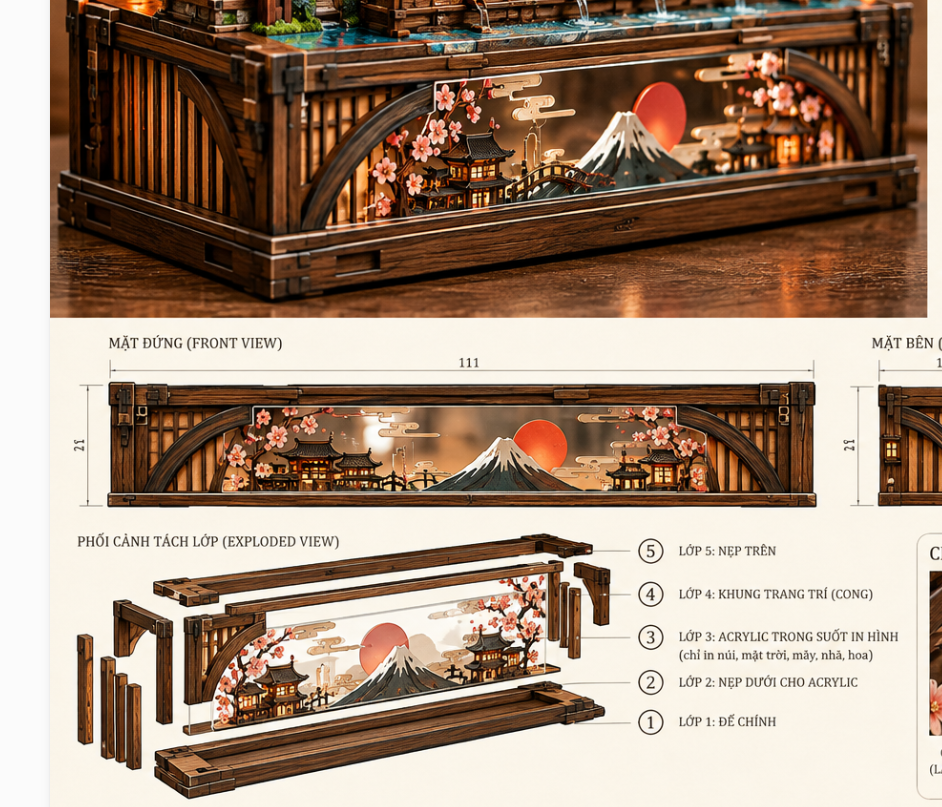
Viendor Prepares Its Next Generation of Book Nooks
Stories Behind the Brands by Martin Seidler
“There isn’t exactly a university degree that teaches you how to design a book nook!”
That observation from Hoang captures something of the challenge facing Viendor. Creating these little worlds takes an unusual combination of artistic imagination, engineering judgement and patience. Then comes the business of turning a promising design into thousands of boxes whose contents must fit together on somebody else’s workbench.
When I returned to our conversation for Stories Behind the Brands, I wanted to understand the changes taking place at Viendor. A move in manufacturing, a change of material and a new Ginzan Onsen were all part of the picture. As we talked, a more personal story emerged too: a designer trying to make room for ambitious ideas while running a business that needs to grow.
The plans are substantial. Much of Viendor’s production is moving from Vietnam to China, existing kits are being reworked, and its best-known design is returning in two seasons. But some of the most interesting changes are much smaller: a connector that cannot go in backwards, an arrow that prevents a mistake, or a replacement part that keeps an older project alive.

More room to design
Viendor has been doing a great deal itself: designing kits, manufacturing them and selling them. Hoang now wants the company to concentrate more of its attention on design and sales, with specialist partners handling production.
Larger scale manufacturing is moving to a partner in China. Design, sales and customer service will remain in Vietnam, alongside a small in-house lab for development, engineering and prototypes. A local manufacturing partner will continue serving the Vietnamese market.
The reasoning starts with factory economics. Hoang explained that several brands operating separate small factories each carry their own equipment and overhead costs. A specialist factory serving multiple brands can spread those costs over more products, invest in machinery, develop expertise and buy materials more effectively. He sees this as an opportunity to improve quality while keeping kits accessible.
Viendor approached Chinese factories specializing in wooden DIY products, including manufacturers that Hoang says already work with established brands. It is now working with its partner to align production standards and develop prototypes. There is no confirmed timetable for the first batch; samples must meet Viendor’s requirements before production proceeds.
There is also a less obvious benefit. Once design is no longer physically tied to the factory, the search for designers can extend beyond Hanoi to other cities and potentially other countries. Finding people with the right mix of artistic and technical skills is difficult enough without limiting the search geographically.
I wondered whether moving production might also change the character of the kits. Hoang was clear on that point: Viendor retains full control of its designs. The intention is to give those designs better manufacturing support while preserving the style that made people choose them in the first place.
The small matter of making everything fit
For anyone who builds these kits, manufacturing becomes very personal at the moment a tiny tab meets a slightly smaller slot. A beautiful design can lose some of its appeal when every second joint needs persuasion.
This is one reason Viendor is gradually moving from plywood to MDF for new Chinese production runs. Hoang said the plywood used previously could vary in thickness by as much as 10 percent. That variation makes consistent fit difficult: the same connector design can be loose in one sheet and excessively tight in another.
Viendor expects the chosen MDF to offer flatter sheets and more predictable thickness. It is heavier, but Hoang sees that consistency as a useful foundation for a better assembly experience.
Of course, thickness is only one concern. Fine components must survive being removed from sheets and handled during the build. Viendor is therefore running multiple rounds of testing to settle on suitable MDF specifications. The aim is a part that releases easily, can be handled confidently and fits securely without excessive force.
“We want the parts to fit securely without requiring excessive force, while still being easy to remove from the sheets and handle during assembly.”
That work means revisiting almost all the connectors, including those in older designs that will stay in the catalogue. Instructions, assembly guidance and part numbering are being revised too. A direct build comparison between an original plywood kit and its new MDF edition will be particularly interesting once the finished products are available.
Helping the builder before a mistake happens
Some improvements are refreshingly simple. Viendor is adding directional arrows to parts that might otherwise be confused or installed the wrong way round. Anyone who has discovered a reversed component several steps too late will understand the attraction.
But Hoang’s team is also looking beyond clearer markings. Wherever practical, parts are being designed to work correctly regardless of their orientation. Where orientation does matter, another approach is to shape the connection so that incorrect assembly is physically impossible.
“The goal is to prevent mistakes through the design itself, rather than relying entirely on instructions.”
That is a useful distinction for a complex kit. Builders can enjoy a demanding project without having to spend their time resolving avoidable ambiguity. Better design can preserve the satisfaction of a detailed build while removing some of its frustration.
I also raised the value of experienced builders testing prototypes before mass production. Hoang welcomed the principle enthusiastically. A designer knows what a part is supposed to do; a builder opening the box for the first time provides a different and valuable perspective.
“Having experienced builders test our kits before mass production is a great way to identify potential problems, especially things that might seem obvious to our designers but could be confusing or frustrating for someone assembling the kit for the first time.”
He did not set out a formal testing programme or recruitment process, but his response leaves little doubt about the value he places on that feedback. Finding a confusing step during a prototype build gives the team a chance to fix it before the same problem reaches many more workbenches.
Ginzan Onsen gets another season
All of this becomes particularly interesting when we reach Ginzan Onsen, the design Hoang describes as Viendor’s most successful. It has also developed a curious role as an introduction to the brand.
“Somehow, customers keep choosing it as their very first Viendor kit, even though it’s an extremely difficult build!”
The original took seven months to design. After four years on the market, the team has spent another four months developing its replacement, drawing on what Hoang describes as tens of thousands of customer comments and messages. That is a considerable amount of experience to bring back to one miniature street.
The new edition will have redesigned mechanisms intended to be easier to assemble, a thoroughly upgraded appearance and more parts than the original. Easier assembly, in this case, does not mean a brief project. Hoang is still aiming at builders who enjoy settling into something substantial.
There will be Winter and Spring editions, released together. Their core design and construction will remain largely the same, with the main differences in colours and decoration. Each season will also have some exclusive parts and details, so the distinction goes beyond simply changing the colour scheme.
For builders, that offers a choice of atmosphere; for collectors, perhaps a reason to clear a little more shelf space.
The team is aiming to finish development before Christmas 2026. Hoang acknowledges that this is ambitious, and it remains a development target rather than a confirmed launch or delivery date. Pricing is still undecided while the design and part count continue to evolve.
When the new edition launches, the original Ginzan Onsen will retire after four years on the market. It is a substantial handover for a kit that has introduced so many customers to Viendor.
A new edition should be easy to recognize
Ginzan Onsen will also be the first model for which Viendor presents a detailed explanation of the changes between editions. The company plans to document improvements on its website and in marketplace product descriptions, helping customers understand what has changed and what they are buying.
Nearly all existing designs are expected to move to Chinese production, incorporating improvements along the way. Some older models will be retired, although the final list has not been decided.

Clear identification matters when different editions may be circulating through different sellers. Hoang is considering edition numbers, revision dates or packaging labels as a way to make that distinction easier. The precise system has yet to be settled.
For owners of older kits, I had another practical question: what happens when somebody needs a plywood replacement part after the catalogue has moved to MDF?
Hoang’s answer was reassuring. With manufacturing arrangements in both Vietnam and China, Viendor expects to remain able to produce parts compatible with the older plywood editions. He said there is practically no time limit on that capability.
“We intend to continue supporting our older kits for as long as customers need replacement parts.”
That is an important statement of intent. A manufacturing transition should not leave someone with an unfinished older kit and no way to replace the piece that broke.
Getting the next generation into builders’ hands
For now, the transition does involve a wait. Hoang said Viendor has almost no inventory left in Vietnam. Customers with orders affected by the changeover are being offered a choice of waiting for the first Chinese production batch or accepting a refund.
The immediate work is on prototypes and production standards. Hoang expects the first batch to move forward relatively quickly once samples are approved, but is keeping the quality requirements ahead of a firm date.
There is a more definite plan for American availability. Viendor intends to add Amazon US, with orders fulfilled from Amazon warehouses in the United States. Those customers will receive kits from domestic inventory rather than having each order sent individually from China.
For other international orders, Hoang also expects shipping from China to offer advantages over the previous arrangements from Vietnam, although destination specific delivery estimates have not been announced. He hopes the manufacturing changes will also make it easier to work with retailers worldwide. Seeing Viendor kits on local shop shelves is an ambition he is actively pursuing.
On prices, the principle remains accessibility. Hoang says that if Viendor has an opportunity to reduce prices, it will do so. That does not establish a price for the new Ginzan Onsen or the revised catalogue, but it explains the thinking behind the effort to produce more efficiently.
The designer still has ideas
With so much effort going into manufacturing and existing designs, I asked whether there was still room for entirely new kits. Apparently, the design team has not been waiting for the factory arrangements to settle down. Several projects are under development, although Hoang cannot yet say which will be finished before 2027. Moving mechanical features will remain part of Viendor’s future.
His answer about the company’s ambitions brought us back to the person behind those projects.
“To be honest, as a designer, I’d love to focus on truly distinctive creations—even if that meant releasing just one to three new models a year, as long as they were exceptional.”
Running a business brings another set of demands. Hoang sees continued growth, and a larger international presence, as increasingly necessary to keep the company competitive. He is still looking for the balance between that pressure and the design work he most enjoys.
That helps explain why this transition involves much more than choosing a different factory. It is an attempt to give Viendor a way to grow while making space for the detailed, distinctive projects its designer wants to create.
For builders, the result will be judged at the workbench: how a part comes out of its sheet, whether the next connection fits, and whether the instructions make a difficult mechanism understandable. Those are the moments in which the new production arrangements will have to prove their worth.
Ginzan Onsen will be a particularly revealing test. A design that has already drawn so many builders to Viendor is being rebuilt with four years of their feedback behind it. I am looking forward to seeing what that experience looks like when it finally arrives in a box.

Leave a Reply