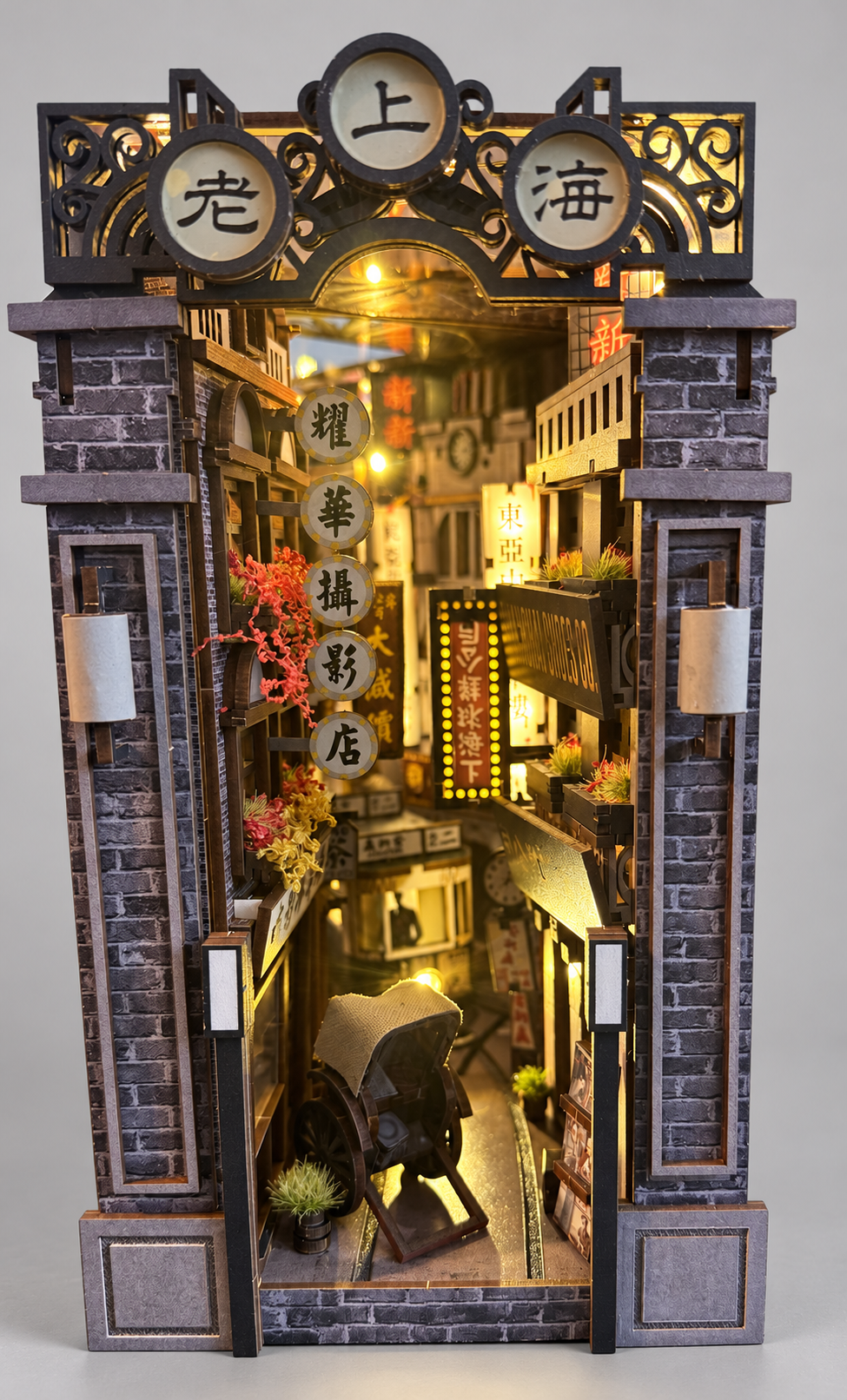
Built & reviewed by David Richards
I had been resisting buying an Anavrin kit on principle because of the price. However, a member of the team gave me a 20% discount code, so I thought: why not? Would my first experience of this premium manufacturer justify the cost? Unfortunately for my resolve, it was excellent. I awarded Old Shanghai “The Golden Buzzer”, with a rare score from me of 100%.

The inspiration: Shanghai’s golden age
Anavrin’s instruction booklet explains that Old Shanghai is inspired by the city’s bustling streets in the early 1900s, when it became known as the “Paris of the East”. The designers describe a vibrant mixture of Chinese architecture and Western façades, tramways, rickshaws, jazz clubs, neon signs and busy shopping streets.
The booklet specifically calls attention to the rickshaw, a vintage tram-stop sign beneath an archway, a weathered jazz-club poster and colourful shop signs. These aren’t just background decoration: they’re intended to bring a particular period of Shanghai’s cultural history to life.
I find this especially interesting in light of the two letters hidden in the model. Mei’s invitation to the Paramount jazz evening and Wei’s unexpected departure for Paris fit the atmosphere Anavrin describes. The link between the city’s nickname, “Paris of the East”, and Wei’s scholarship to Paris is an intriguing possibility, although the booklet doesn’t explicitly confirm that it was intentional.


What is included in the kit

Immediately the quality of the product is apparent from the contents. The acrylic pieces which make up a lot of the signs are wonderful. The other noticeable difference is the smell, completely different from any other kit I have made.
- Lighting set with 12 different lights consisting of LEDs, strip & fairy lights
- Mirror
- Electrical cables
- Dowel
- Fabric
- Cloth signboard
- Flowers & foliage
- 2 dust covers
- Post card between boy & girl
- 14 wood sheets
- 1 Acrylic sheet
Building Old Shanghai: stage 1, the left-hand buildings


I began with the base and the buildings on the left-hand side. This was where the quality of the kit really became apparent: the printing was beautifully detailed, the pieces fitted perfectly and the basic assembly was very straightforward. Glue was used quite extensively for the fixtures and fittings, so this was more than simply clicking a few walls together, but it was an enjoyable start.
Yaohua Photography Studio
The first shopfront carries the sign 耀華攝影店, meaning Yaohua Photography Studio. Yaohua evokes brilliance or splendour, while the remaining characters mean photography shop. The little pictures supplied for the studio were a lovely finishing touch. Understanding the lettering made this feel like a real business in a neighbourhood, rather than just a decorative façade.
The 21-part rickshaw

The rickshaw is one of the main characters in the scene. It consists of 21 pieces, including a yellow fabric roof, and sits with a plant in front of the first building. The fabric was a small but telling example of Anavrin’s quality: when I cut it, it did not fray, something I often encounter with cloth supplied in other kits.
My building tip: either glue the rickshaw firmly in position and allow it to set, or leave fitting it until later as you have to continually turn the model on its side to fit walls and it kept on falling out.
The second left-hand building sits further back, so it has fewer features and is less visible from the front. Even here, the cloth sign hanging from the wall was excellent quality.
The red-and-gold sale sign

One tiny advertisement particularly caught my eye. The clearest characters on the red-and-gold sign are 大減價, meaning “big price reduction” or “massive sale”. Smaller lettering appears to include 有限公司 (“limited company”) and 吉祥 (“good fortune”), although some characters are too small to identify confidently. I loved this little piece of period-style commercial detail.
Stage 2: the shoe shop and magazine rack
The right-hand side began with the shoe shop. It was wonderfully ornate, with plenty of little details to add, but nothing in this section was especially challenging. Tiny shoes on shelves and an advertisement for elegant women’s heeled ankle boots gave the shop its own personality.
The large red lettering appears to read 蘭之戀, roughly “Orchid Romance”, perhaps a fictional brand name. The smaller print is difficult to decipher at this scale, so I would not claim a precise translation. It was another detail that helped evoke the fashion and shopping life of old Shanghai.


The little magazine rack was one of my favourite discoveries, complete with newspapers and glamorous portraits. The upper newspaper appears to carry the title 上海新報, or “Shanghai News”, while the lower one resembles 新聞報 (“News Newspaper”), also the name of a historical Shanghai newspaper. The portraits recall the illustrated advertising and entertainment culture associated with the city’s early twentieth-century heyday. I cannot verify that these reproduce particular historical editions, but the effect was delightful.
The 16-part tram: a fiddly roof and a satisfying click

The tram is the second main character in the build and the point at which I fitted the first lights. It consists of 16 parts, with one particularly fiddly step: attaching the roof. Five tabs have to line up, including those around the curved front, and getting everything into position took patience.
I used my crafting knife to gently nudge the pieces into alignment until I finally heard that very satisfying last click. This was an alignment challenge rather than a general problem with the fit of the kit, but it was certainly a moment to slow down.
Neon signs, rear buildings and final assembly
A neon sign was assembled and fixed to the side of the shoe shop, adding another layer to the busy street. The building at the back right felt almost superfluous from the front because so little of it could be seen, but it still had its own construction details: the two dowel sticks formed columns, and two lights were fitted to the building.
Another fiddly assembly involved fitting seven spindles between a floor and a roof. I am still not entirely sure what this little structure represents, but I can say that it needed very careful alignment. If it starts becoming frustrating, my advice is to take a break and return with fresh eyes.

After the remaining signs, I fitted the back mirror, with the battery compartment behind it, and added the remaining lights on the left-hand side. The front ornaments completed the entrance, including the Chinese lettering for “Old Shanghai”. By this point, all those separate shopfronts, signs and small fittings had come together into a wonderfully detailed street.
Lighting and wiring: excellent instructions

The bundle of wires and connections could certainly look intimidating to a beginner, and the lighting may be the part that gives some builders pause. Having completed the build, though, I thought the lighting instructions were brilliant: clear, detailed and easy to follow. In practice, the work was much more manageable than the initial tangle of cables suggested.
Despite the number of lights, only two connections went into the battery box: one for the touch sensor and one for the lights. The supply is 4.5V rather than the more usual 3V, a detail that makes sense to me given the amount of lighting in the scene. Taking the instructions one step at a time was the key to keeping this part of the build straightforward.
Mei and Wei’s postcards: a street with a story
The two postcards were among my favourite details in Old Shanghai. Included with the kit and positioned around the rickshaw and tram, they tell a bittersweet story. Their Chinese writing is visible through cutouts in both side walls; the postcards are not embedded in the walls. It is a clever way to make their correspondence part of the finished model.
Mei’s invitation
The first postcard, marked for placement on the rickshaw, is addressed to Wei. Mei invites him to a jazz evening at the Paramount, Shanghai’s celebrated ballroom, hoping they can share a lovely night together. The reverse carries a handwritten Chinese version of the invitation, with a slightly more poetic tone.

Wei’s farewell
The second postcard, intended for placement below the tram, is addressed to Mei. Wei has received a scholarship to Paris. It should be happy news, but he must leave that very night, without a chance to say goodbye. He apologises for his sudden departure and asks her forgiveness.
Mei is looking forward to an evening at the Paramount while Wei is preparing to leave Shanghai. We do not know whether she receives his farewell in time, or whether she waits for him at the ballroom. That unanswered question gives the finished street a human story and rewards anyone who takes the time to look closely.
Final verdict: my Golden Buzzer for Anavrin Old Shanghai


This was an amazing build. The excellent fit, detailed printing, good-quality fabric and exceptionally clear lighting instructions made it a pleasure to assemble. The Chinese wording, old photographs and tiny shop details were just as memorable as the larger centrepieces. Discovering what the signs said made the street feel alive.
There were fiddly moments, particularly the tram roof and the seven-spindle assembly, but they did not take away from the overall experience. I would recommend Old Shanghai to an experienced beginner: the quality and instructions offer plenty of support, provided you are comfortable using glue, taking your time with small parts and following the lighting steps carefully. The wiring may still faze some people at first glance.
I began this Anavrin Old Shanghai book nook review wondering whether a premium kit could justify its price. For me, this one delivered. It earned my Golden Buzzer and a rare 100% score, and it has left me very tempted to pop onto the Anavrin site again.
Leave a Reply