A Christmas Kit That Could Have Been So Much More
Built and reviewed by David Richards Build number: the wife doesn’t need to know.
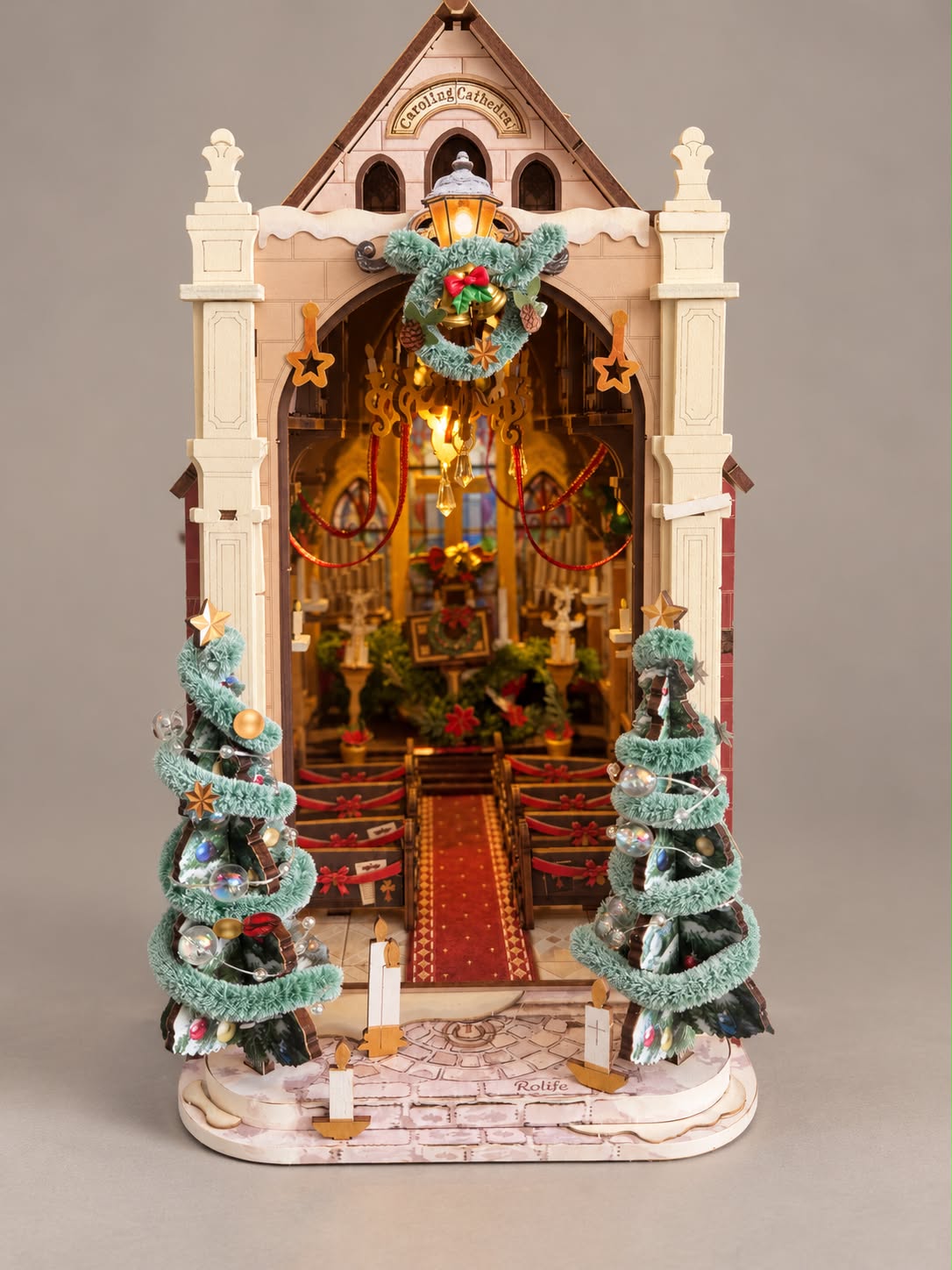
A Cathedral at Christmas should be resplendent. I pictured glowing stained-glass windows, wonderful fairy lights, carols and a generous covering of snow. This was an opportunity to create something that would become the centrepiece of a Christmas display.
Unfortunately, Rolife’s Caroling Cathedral did not deliver the experience I had imagined.
Before going any further, I am a Robotime brand ambassador. That relationship does not prevent me from criticising a kit when I believe it deserves criticism. Book Nook Workshop’s independence depends on giving an honest account of the building experience, including the frustrating parts.
There are things to admire here, particularly the stained-glass windows, clear instructions and an impressive chandelier. However, I finished feeling that Rolife had missed an opportunity to turn a promising idea into something exceptional.
Summary Table

First Impressions: A Cathedral Needs Presence

My first disappointment was the size.
For me, a Christmas Cathedral needs enough scale to convey the splendour of the building. I had a similar reaction to Fifijoy’s Endless Manor: the subject called for more room than the kit allowed.
That is a personal preference, of course. A smaller model may suit someone with limited display space. Nevertheless, I wanted this cathedral to have presence, with room for the architecture, lighting and seasonal details to shine.
Christmas kit recommendations are a frequent topic in our Facebook group, particularly at this time of year. I had hoped this would be one I could recommend enthusiastically.
What Is Included?

The kit uses a mixture of wooden boards, PVC windows, stickers, plastic components and Christmas decorations.
Once again no inventory list from Rolife which is extremely annoying.
One useful feature is the choice between a traditional Cathedral and a Christmas version. You need to decide which you want to build and follow the appropriate instructions, as the choice affects several stages of construction and decoration.
Instructions: One of the Strongest Parts
The instructions are very good, with clear diagrams and descriptions in multiple languages.
The main point to watch is the distinction between the two versions. Take time to identify the route you are following before adding decorations or committing to a particular arrangement.
My frustrations with this kit generally came from the materials and construction choices. The instructions themselves were one of its strengths.
Adhesives and Stickers: A Recurring Frustration

Rolife supplies adhesive strips, but I prefer using glue, so I left those untouched.
The decorative stickers were another matter. These form a substantial part of the finish, and I repeatedly struggled to get them to stay attached. Even adding glue did not reliably stop them lifting.
That matters because the finish is what you see when the building is complete. A carefully assembled structure loses some of its appeal when decorative coverings start peeling away from the columns and other components.
It also leaves me less confident about passing the finished model on to someone who expects everything to be perfect.
Building the Side Walls

Construction begins with the side walls, where the PVC stained-glass windows provide an attractive architectural detail.
There is also plenty of sticker application, and getting everything aligned neatly takes care. The stickers around the columns were particularly frustrating. I could position them, press them down and add glue, only to find them lifting again.
This was where my annoyance began. I was spending time trying to secure the finish rather than enjoying the assembly.
Choosing the Christmas Decorations
As the walls develop, the traditional and Christmas versions begin to diverge. Rolife suggests positions for the decorative stickers, although there is room to arrange some of these to suit your own taste.
I found wrapping the red ribbon around the greenery and threading it through the pillars especially awkward. My attempt looked untidy, and eventually I removed the ribbon.
Someone with more patience or a better technique may achieve a lovely result. In my build, leaving it off produced a finish I preferred.
The Base, Pews and Carpet

With both side walls completed, the next stage is the cathedral base and its rows of pews.
The carpet sticker for the steps became another test of patience. After around six attempts to make it sit and stay as I wanted, I scrunched it up and decided the cathedral could manage without it.
A small piece of suitable fabric would have been much more satisfying here. It would also have added texture to an interior that relies heavily on printed decoration.
I was not keen on the B-sheet Christmas decorations fitted to the backs of the pews either. To my eye, they looked flimsy and detracted from the overall appearance. I would have preferred a more substantial treatment.
The same adhesion problems continued around other parts of the interior, making this feel like a recurring issue rather than an isolated awkward component.
Columns, Curves and Greenery

Some of the columns are plastic. I could not see an obvious benefit to that choice in the finished model.
The curved B32 component is particularly tricky to fit correctly. It needs patience, careful positioning and time to settle into place.
The P16 moss was another messy stage. It seemed determined to attach itself to my fingers and spread scraps around the workshop. I would welcome a tidier, easier-to-handle material for this part of the build.
There are then numerous decorations to assemble, depending on which version you have chosen. Individually, these are manageable, but the accumulated fiddling began to take the enjoyment out of the process for me.
Lighting: An Opportunity Missed

The kit has just two lights.
For a cathedral dressed for Christmas, that felt modest. There are Christmas trees, an organ and architectural details that could have benefited from a more ambitious lighting scheme.
I wanted the lighting to help create the atmosphere: to draw attention to the interior and give the seasonal decorations some sparkle. This was one area where I felt the concept offered much more potential.
Testing the Lights
Normally, I test a lighting kit before starting construction.
Here, Rolife’s bare-wire arrangement made that less convenient. Testing would have involved temporarily securing several wires together, so I skipped my usual check.
That was a risk on my part. Fortunately, the lights worked when I connected them towards the end of the build.
The wiring instructions were good, but I would have appreciated an easier way to carry out that initial test.
The Chandelier: Fiddly but Impressive

The chandelier was the only assembly where I broke a component.
Fitting all the candle arms was challenging, and threading the crystal beads gave Freddy Fat Fingers quite a workout. This is a stage best approached slowly, with a clear workspace and a decent reserve of patience.
Once completed, though, the chandelier is magnificent. It was one of the few parts that gave me the sense of grandeur I had hoped for throughout the cathedral.
I left off some of its additional Christmas decorations because, to my eye, the result was becoming too busy. The chandelier already had enough detail to stand on its own.
The Bell Tower and Final Assembly
The bell tower was the hardest structural section for me. I found the alignment awkward and would recommend using glue throughout this assembly.
The walls, roof sections and bases then come together to form the main structure, followed by further Christmas decorations. By this point, I was getting seriously bored with the repeated decorative work.
The B-sheet pieces representing snow also became a source of irritation. I will return to those in my final assessment, as they contributed to my disappointment with the Christmas finish.
The trees and remaining decorations are added towards the end, completing the seasonal scene.
Final Verdict: A Missed Opportunity?
My overriding feeling is that Rolife could have made much more of this idea.
There are successful elements. The instructions are excellent, the stained-glass windows are attractive, and the finished chandelier is a highlight. However, the small scale, persistent sticker problems, fiddly decorations and limited lighting repeatedly weakened the experience for me.
I would have welcomed a larger, more ambitious cathedral with materials and lighting that matched the splendour of the subject. I believe there is an audience of serious builders who would consider paying more for that. I will add extra photos when the snow paste arrives.
Leave a Reply