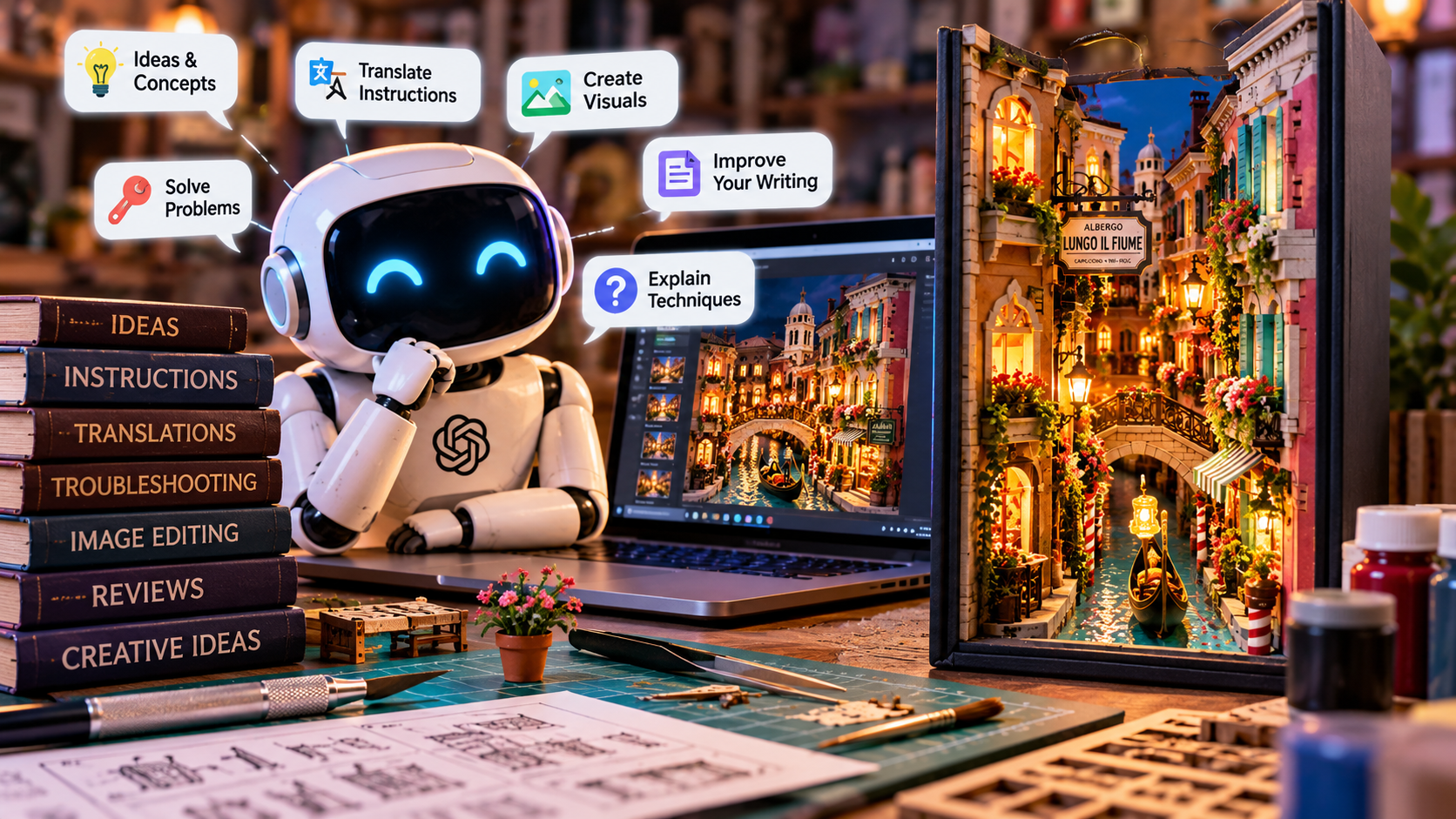
“Is AI always bad news when it comes to book nooks? Read on to see…“
Written by John A. MacInnes – September 28, 2026
Introduction:
There was a time when building a book nook meant three things: a pile of MDF, a bottle of PVA glue and a rapidly increasing suspicion that the manufacturer had deliberately included one piece that didn’t belong anywhere.
Things have changed.
Artificial intelligence has arrived at the workbench.
And, depending on how you use it, that can either be remarkably useful or result in an extremely confident explanation of something that is complete and utter bollocks.
So, what exactly can AI and chatbots actually do for the book nook builder?
More importantly, what shouldn’t you trust them to do?
Let’s have a look.
First things first: AI and chatbots aren’t the same thing:
The terms AI and chatbot are often thrown around as though they mean exactly the same thing.
They don’t.
Artificial intelligence is the broad technology. A chatbot is one way of interacting with an AI system, usually by typing questions or instructions and receiving a response.
Then there are AI image generators, image-editing systems, translation tools, writing assistants and a whole collection of other AI-powered applications.
For the purposes of the book nook world, that’s actually quite useful because there are several completely different ways AI can help.
And they aren’t all equally reliable
So, where can a chatbot actually help?

Let’s start with the obvious one.
You’ve reached step 37.
There is a piece in your hand.
It looks vaguely like the illustration in the instructions, except it doesn’t actually fit where the illustration says it should fit.
We’ve all been there.
This is where a chatbot can be surprisingly useful.
You can describe the problem, show it a photograph of the piece and the relevant instruction, and ask it to work through the possibilities.
It might suggest that you’ve used the wrong piece, that something has been fitted in reverse, that a previous component isn’t sitting correctly or that the manufacturer’s illustration isn’t particularly helpful.
It can also explain things that may be completely obvious to an experienced builder but rather less obvious to someone tackling their first kit.
What does this glue do?
Why won’t my LED light?
What does this symbol in the wiring diagram mean?
How do I make a realistic water effect?
What’s the difference between PVA and B-7000?
How do I paint MDF without making it look like I’ve painted MDF?
These are exactly the sort of questions a chatbot can be good at answering.
It can also help translate instructions, particularly when you’re working with kits where the English translation occasionally appears to have taken a rather scenic route through Google Translate before arriving in your instruction manual.
AI can be particularly useful when instructions are confusing:
This is an area where I think AI has genuine potential for book nook builders.
Take a complicated instruction sheet.
Rather than simply asking:
“What does this mean?”
you can ask the AI to explain the step in plain English.
Better still, you can provide photographs of the relevant pieces and ask it to explain how they relate to the illustration.
That doesn’t mean the answer will automatically be correct.
That’s important.
AI can look at a photograph, make an assumption and then present that assumption with the confidence of someone who has just spent 30 years designing book nooks.
It may, in fact, have spent the last 30 seconds doing something completely different.
So treat the answer as assistance, not gospel.
Then there’s AI image generation:

Ask an image generator to create a Venetian canal and it will happily produce one.
Ask it to reproduce your actual book nook accurately and you may discover that your carefully constructed three-storey building has mysteriously acquired four floors, the gondola has developed an extra oar and the door you’ve spent half an hour fitting has moved approximately six feet to the left.
AI is remarkably good at producing something that looks plausible.
Plausible isn’t the same as accurate.
And that isn’t just a problem when you’re trying to visualise your next modification.
It is becoming a much bigger problem on the internet.
AI-generated imagery can now make something that doesn’t actually exist look remarkably convincing. A company can appear to have a range of beautifully photographed book nook kits, complete with impressive packaging, finished models and atmospheric lifestyle photographs, without necessarily having the genuine products, facilities or even the manufacturing operation that the website suggests.
And that’s where things get rather more serious.
We’ve all become accustomed to seeing photographs online and assuming that, broadly speaking, what we’re looking at actually exists. After all, a photograph never lies, right?. Wrong. In the hands of AI it certainly can and does. That assumption becomes considerably less safe when images can be generated or manipulated to create an entirely convincing impression of a product.
A photograph of a beautiful book nook doesn’t necessarily prove that somebody has actually manufactured that book nook.
A photograph of a box containing a kit doesn’t necessarily prove that the box exists.
And a website displaying dozens of apparently finished products doesn’t necessarily mean there is a genuine manufacturer sitting behind it producing those kits.
I’ve recently come across an example myself where a company appeared to be presenting itself as a genuine manufacturer of book nook kits. At first glance, everything looked perfectly convincing. There were the products, the photographs and all the usual elements you’d expect to see from an established manufacturer.
But once I started doing the due diligence — checking the information rather than simply accepting what the website was telling me — the picture changed very quickly.
There were enough inconsistencies and unanswered questions for me to have serious doubts about whether the company and the supposedly genuine kits were actually what they claimed to be.
That doesn’t mean every suspicious-looking website is automatically a scam, and it is important not to make accusations without evidence.
But it does demonstrate just how important due diligence has become.
And this is where AI creates a particularly awkward problem for the book nook community.
The better the technology becomes at producing convincing images, the harder it becomes to use the photograph itself as evidence that something is genuine.
So if you come across a spectacular-looking new book nook from a manufacturer you’ve never heard of, don’t simply look at the pictures and reach for your credit card.
Look for independent reviews.
Check whether the manufacturer has a genuine presence outside its own website.
Look for established retailers carrying the products.
Search for photographs from actual builders rather than relying solely on the company’s promotional images.
Check whether the product appears anywhere else, particularly under different manufacturer names.
Look at the company’s history and contact information.
And, perhaps most importantly, ask yourself whether there is actually enough independent evidence to establish that the product exists in the form being advertised.
AI has made creating a convincing picture remarkably easy.
Proving that the thing in the picture actually exists is still considerably harder.
That is something every book nook buyer needs to bear in mind.
Because when it comes to AI-generated imagery, the old saying that “seeing is believing” is beginning to look rather outdated.
In the book nook world, seeing may now simply mean that somebody was very good at writing a prompt.
AI image editing is a different proposition:
There is another area where AI can be useful: improving or modifying photographs.
You might want to remove an untidy background from a photograph of your finished model, improve lighting, crop an image for social media or create a cleaner promotional image.
All perfectly reasonable uses.
But there’s a danger here too.
If you’ve spent six hours building a model and then ask an AI system to “improve” the photograph, you need to make sure it hasn’t improved your model at the same time.
Because AI doesn’t necessarily understand that the slightly wonky flower arrangement you painstakingly glued to the balcony is supposed to be there.
It may decide that the flower would look better somewhere else.
Or that the window needs improving.
Or that your actual model would benefit from a completely different roof.
At which point you’re no longer looking at a photograph of your finished kit.
You’re looking at an AI interpretation of it.
For a reviewer, that distinction matters enormously.
AI and the book nook reviewer:

This is probably where I get the most practical use from AI myself.
It can be an excellent editorial assistant.
Give it a collection of build notes and it can help organise them.
Give it a long review and it can identify repeated points.
Ask it whether a section flows properly and it can suggest changes.
It can help produce:
- review introductions
- shorter versions of reviews
- social-media posts
- SEO descriptions
- headlines
- captions
- article ideas
- comparison tables
- explanations of technical problems
It can also tell you when you’ve used the phrase “however” approximately 47 times in the same article.
Not that I have ever done that, being a newspaper editor, I hope. But we can be ‘wordy’ which needs to be kept in check.
Do I use it myself – Not regularly, as I much prefer to be in charge of my work. I will use it to check on grammar and typos, and I don’t see that as ‘cheating’.
Book Nook Workshop is taking it a step further:

There is another development currently being tested at Book Nook Workshop which takes this idea considerably further.
BNW is currently testing a specialist chatbot system that allows subscribers to ask questions about book nook kits and receive answers based on information gathered from the Book Nook Workshop website and its team.
And this isn’t simply a case of asking a general AI chatbot:
“What do you know about this book nook?”
The information being used by the system has been built from more than 180 reviews carried out by professional builders working with Book Nook Workshop.
That makes the idea rather different.
Those reviews contain the sort of information that doesn’t necessarily appear in a manufacturer’s product description.
How well the pieces actually fit.
Whether the instructions are easy to follow.
Where builders encountered problems.
How the lighting performs.
What the finished kit is really like to build.
What works particularly well and, just as importantly, what doesn’t.
In other words, it is information gathered from people who have actually had the kit sitting on their workbench.
The idea is that a subscriber could ask a question about a particular kit and the chatbot could search through that accumulated BNW knowledge to provide an answer.
Want to know whether a particular kit has complicated wiring?
Ask it.
Wondering whether the instructions are likely to cause problems?
Ask it.
Want to know what experienced builders thought about the quality of the components or the difficulty of the build?
Ask it.
And potentially, rather than having to trawl through dozens of individual reviews looking for the answer, the system can bring that information together.
That is where I think AI becomes particularly interesting for the book nook community.
The AI itself isn’t the specialist.
The knowledge we’ve fed into it is.
There is a very important distinction between the two.
A general chatbot has access to an enormous amount of information, but that doesn’t necessarily mean it has any genuine experience of building a particular book nook.
A specialist BNW chatbot, on the other hand, is being built around a very specific body of information — the collective experience recorded in more than 180 professional reviews.
And that could eventually turn it into something rather more useful than simply another chatbot.
It could become something approaching a digital Book Nook Workshop expert sitting on your desktop.
Of course, we’re still testing it.
And that is important to say.
AI systems can still misunderstand questions, interpret information incorrectly or produce an answer that sounds convincing but isn’t quite what the underlying material actually says.
So the BNW system has to be tested, challenged and refined.
Which, when you think about it, is probably exactly how it should be.
After all, if we’re going to tell book nook builders that they can trust an AI system to answer questions about their next kit, we’d better be absolutely sure it knows what it’s talking about.
And that means asking it difficult questions.
Lots of them.
I suspect we’re going to have some fun doing that.
But AI hasn’t actually built the kit:

This is perhaps the most important point of all.
AI hasn’t sat at your workbench.
It hasn’t spent 20 minutes trying to determine which way round a tiny piece of MDF is supposed to go.
It hasn’t accidentally glued its sleeve to the table.
It hasn’t dropped a component onto the carpet.
It hasn’t discovered that the apparently straightforward wiring diagram was written by someone who has clearly never had to connect the wires themselves.
And it certainly hasn’t spent six hours building the kit.
You have.
That means AI can help you describe your experience, but it cannot replace the experience itself.
For a review site such as Book Nook Workshop, that’s an important distinction.
The opinion belongs to the builder.
The observations belong to the builder.
The photographs belong to the builder.
AI can help turn all of that into a better article.
It shouldn’t manufacture the experience – EVER!
The biggest problem with AI?:

Confidence.
Not accuracy.
Confidence.
Ask a chatbot something it knows and you can get a useful answer.
Ask it something it doesn’t know and there is a danger that it will still give you an answer.
And it may sound extremely convincing.
That’s one of the strangest things about using AI.
A human saying “I don’t know” is generally quite reassuring.
An AI saying “I’m not entirely certain, but…” can sometimes be followed by three paragraphs of beautifully constructed nonsense.
So there is one rule I would recommend every book nook builder remembers:
“Confident doesn’t mean correct.”
Check important information.
Check measurements.
Check wiring.
Check instructions.
Check anything that could result in you gluing the wrong bloody piece to the wrong bloody place.
So, should book nook builders use AI?

Absolutely.
But use it as another tool.
A good builder has a workbench full of tools. Tweezers, knives, files, glue, paints, magnifiers and all the other paraphernalia that gradually takes over the house.
AI can be another one.
Use it to help solve problems.
Use it to explain things.
Use it to generate ideas.
Use it to help with writing.
Use it to translate.
Use it to visualise what might be possible.
Use specialist systems such as the one currently being tested by Book Nook Workshop to make use of information gathered from actual builders and reviews.
But don’t hand over your brain at the same time.
The best results come when the builder remains in charge.
AI can suggest.
AI can explain.
AI can create.
AI can occasionally save you a considerable amount of time.
But it can’t build the bloody book nook for you.
And perhaps that’s just as well.
Because if it could, what on earth would we have left to argue with the instructions about?
John’s verdict:

AI isn’t the future of book nook building, and never will be. It cannot replace common sense and good judgement.
But, it is already here.
And like every other tool, its usefulness depends on the person using it, whether it’s a scalpel, tweezers or a computer.
Used intelligently, it can be a damn good assistant.
Used unquestioningly, it can be a flaming nuisance.
The trick is knowing the difference. Tread carefully my friends.
Copyright Book Nook Workshop 2026 – All rights reserved. (J A. MacInnes.)
Leave a Reply