Built and reviewed by Dee Derr
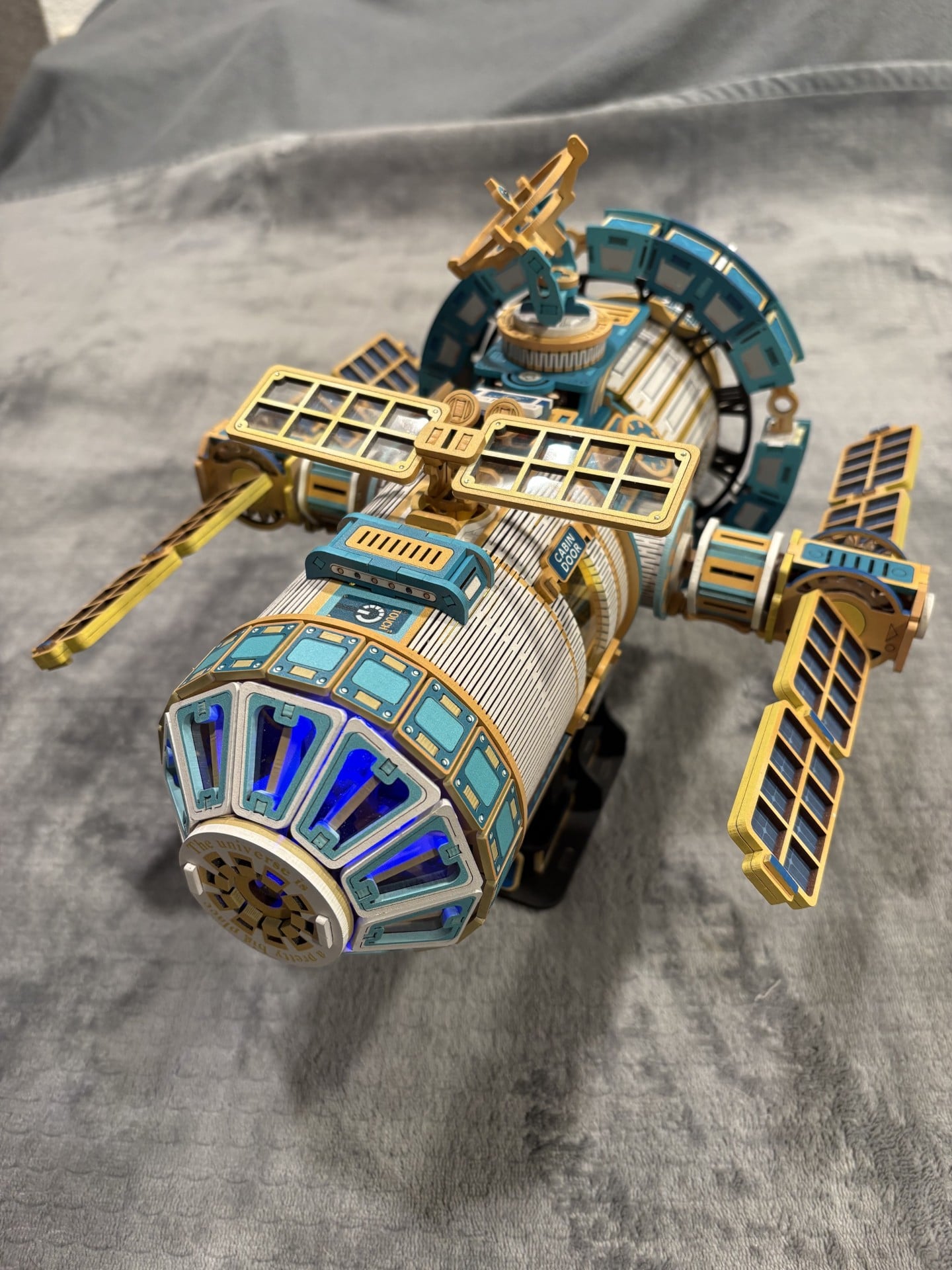
With 511 pieces and a collection of gears moving in different directions, Celestigon Station was a kit I admired before I felt ready to build it. I bought it in January 2026, opened the box and decided that a little more experience would do me good. Nine months later, I was ready to take it on—and I found myself looking forward to each day’s building session.
This is a large, motorised wooden model rather than a conventional book nook. The completed kit measures 330 × 270 × 245 mm. Its moving mechanisms, lighting and music make it an appealing project for someone who enjoys the engineering as much as the finished display.
Dee’s scores

At a glance
Kit: Celestigon Station • Amazon-listed brand: PANZIYU • Model number: JTMX-003/004 • Pieces: 511 • Listed difficulty: four stars • Power: three AA 1.5 V batteries, not included • Lights: two warm white bulbs and one blue bulb.
I could not find a manufacturer named on either the box or instruction booklet; PANZIYU is the brand shown in my Amazon purchase history. The model is listed as JTMX-003/004, so it is worth checking the specific version on a listing before ordering.
Was it enjoyable to build?
Absolutely. I spent roughly six hours a day on the project over six or seven days. That suggests around 36–42 hours of hands-on work, although I did not keep an exact log. At least a full day went into painting the exposed raw-wood edges. Some pieces were large, and my acrylic pens needed several coats to cover them properly. It added time, but I think the finished appearance justified it. It also made my mild OCD very happy!
The wood is thick, and the pieces came away from the boards easily with gentle pressure. Most of the assembly uses tabs and slots or mortise-and-tenon joints, with several types of screws used for the motor and touch switch. I used glue only on the paper details attached to the four rotating solar-array panels. The instructions did not call for it, but a little glue kept the paper in position while I assembled the frames.
There is also a sheet of precut clear plastic parts. You will need scissors or a craft knife to cut the small tabs that hold those pieces in the sheet. And be prepared to find bits of paraffin wax everywhere: the kit comes with a ginormous block, and I seemed to be covered in it for three days.
Instructions, fit and the moving parts

The instructions are clear and well illustrated. At critical stages, particularly when fitting components that must move in the correct direction, detailed pictures and arrows show their orientation. With this many linked gears, that care in the manual matters.
Most pieces fitted properly. A few moving components were very snug, apparently to keep the mechanism aligned. Rather than force them and risk damage, I lightly worked the tabs or slots with a needle rasp or sandpaper until they fitted without excessive pressure.
I did break one delicate accordion-style piece while stretching it around a circular disc to fit its tabs into the slots. I repaired it by gluing a thin piece of cardboard from a toilet roll to the back for support, then gluing the break together. It is the piece I marked in red in my photo.
The finished gears and moving parts run smoothly and reliably, without hitching, hesitation or catching. Despite all that movement, the motor noise is so slight that I barely notice it.
A missing bag of screws
One small bag of screws was missing from my kit: the W3 round-head screws, listed in the manual as size 1.4 × 3. I discovered this after the Amazon return window had closed. Fortunately, the size was printed in the accessories list, so ordering inexpensive replacements was quicker and easier than trying to contact the seller. Everything else was present and accounted for.
I still recommend checking every screw packet against the accessories list when you first open the box. A missing packet is much easier to resolve before it interrupts the build.
Lights, movement and music

For such a large and mechanically complex model, the wiring was refreshingly straightforward. The three bulbs, speaker, battery box and motor plug into a wiring harness; the main task is positioning each component securely and connecting it correctly.
The touch control cycles through the functions. The first tap turns on the lights, the second adds motorised movement, the third adds music, and the fourth switches everything off. The functions do not operate independently. Three AA 1.5 V batteries are required and are not supplied.
I especially like the music, and the speaker’s sound quality is excellent. The electronics worked very well overall. My one wish is for a little more light: three bulbs feel sparse in a model this size, and some exterior lighting would be lovely. With so many moving parts, though, I can see why routing additional lights outside the structure would be difficult.
Who should build Celestigon Station?
I would not give this to a first-time builder. The assembly is not impossibly difficult, but the size, number of parts and interlocking mechanisms could overwhelm someone who has never handled a moving model. I would suggest building several smaller mechanical kits first, then coming back to this one with confidence.
For an experienced builder, however, this is a challenging, fun and satisfying project. The instructions and materials are excellent, and seeing all those gears work together at the end is a real reward. I do not usually like adding people or characters to my builds, but the two small astronauts here won me over.
My verdict
Even with the missing screws, I would highly recommend Celestigon Station to someone who enjoys a substantial mechanical build. I would happily buy from the same company and build this kit again. The only design option I would love to see is a choice of colour schemes. As it stands, the finished movement, quiet motor and excellent sound make it worth the time I spent on it.
Dee bought Celestigon Station on Amazon. View the listing she purchased. Product details and availability may change; check the listing and model number before buying.


Leave a Reply