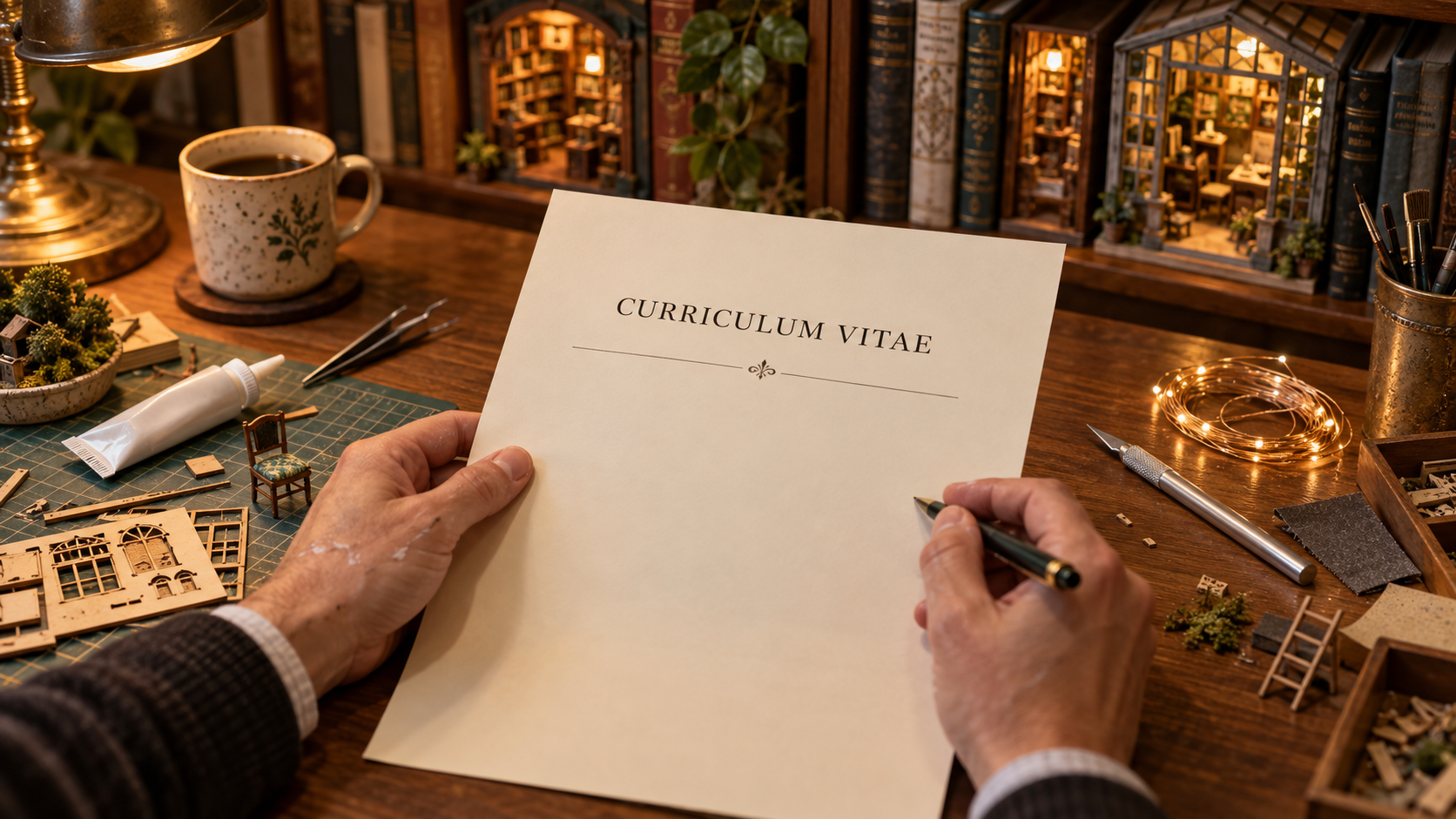
There comes a point in every hobby when you realise you have accidentally acquired a completely new set of professional skills. Book nooking is no exception. So, if years of building miniature libraries, Japanese streets, castles, submarines and detective offices had to be condensed into a proper CV, it might look something like this…
THE TYPICAL RÉSUMÉ OF A BOOK NOOKER
Curriculum Vitae
Name: [Redacted for fear of partner discovering recent purchases]
Occupation: Apparently retired / employed / otherwise busy, yet somehow able to spend 14 hours constructing a miniature Japanese noodle shop
Current Position: Senior Book Nook Construction Engineer
Location: Usually at the dining table
Availability: Immediately, assuming the B-7000 has dried
CAREER PROGRESSION

Stage 1 — First Kit Builder
Completed one perfectly respectable miniature scene and announced: “I might do another one at some point.”
Stage 2 — Enthusiast
Purchased proper tweezers, discovered B-7000 and began using the phrase “dry fit” in ordinary conversation.
Stage 3 — Collector
Stopped measuring the collection in individual kits and began measuring it in shelves.
Stage 4 — Reviewer / Technical Consultant
Can no longer simply enjoy a miniature bakery. Must assess its engineering, lighting, instructions, value and whether the tiny croissants are historically convincing.
Stage 5 — Head of Domestic Logistics
Coordinates parcels, storage, construction schedules and alternative delivery locations with the precision of a multinational supply chain.
Current career ambition: Chief Shelf Capacity Officer.
EMPLOYMENT HISTORY
Senior Book Nook Construction Engineer
Employer: Self-employed, despite nobody remembering an interview
Location: Dining table / spare room / wherever the cutting mat currently lives
Dates: From first kit to present
- Delivered complex miniature infrastructure programmes to demanding personal deadlines.
- Managed cross-functional teams consisting of two hands, several cocktail sticks and one increasingly blunt craft knife.
- Recovered multiple projects following glue incidents, reversed walls and late discovery of unused component A17.
- Maintained excellent stakeholder relations through selective disclosure of purchase price.
Junior Miniature Assembly Operative
Duration: Approximately one kit.
Responsibilities included following instructions in the correct order, using far too much glue and believing the stated build time.
Person With Spare Shelf Space
Dates: Previous life — exact dates unknown.
Position ended unexpectedly and is not expected to become available again.
PROFESSIONAL PROFILE
Highly experienced miniature construction professional with a proven track record in assembling buildings that nobody can actually enter.
Skilled in MDF engineering, plywood damage limitation, miniature electrical installation, furniture assembly, paper folding, plant-pot manufacture and the strategic application of glue to components that the instructions confidently claimed did not require glue.
Possesses exceptional problem-solving abilities developed through years of staring at tiny wooden components while repeatedly saying: “Where the hell does this bit go?”
Experienced in managing complex projects involving 300+ components, incomprehensible diagrams and LED wiring apparently designed by someone who assumes human beings possess six fingers on each hand.
Demonstrates outstanding perseverance and is capable of spending 45 minutes constructing a chair measuring 18mm high.
EDUCATION & QUALIFICATIONS

- BSc (Hons) Applied B-7000 — specialising in emergency structural repairs and removing glue strings from finished models.
- Postgraduate Certificate in LED Fault Diagnosis — awarded after successfully remembering to test the lights before final assembly.
- NVQ Level 4 in Finding Dropped Components — practical assessment completed barefoot on a carpet.
- Diploma in International Instruction Interpretation — fluent in arrows, dotted lines and diagrams showing three steps at once.
- MSc Advanced Shelf Negotiation — dissertation awaiting partner approval.
Professional memberships: Fellow of the Institute of People Who Keep Tiny Leftover Pieces “Just in Case”.
CORE COMPETENCIES
Miniature Construction
Extensive experience assembling libraries, Japanese streets, detective offices, garden houses, Gothic buildings, railway stations, magic shops, bakeries, castles, submarines, spaceships and entire European cities.
Has never constructed an actual extension to own house.
MDF Engineering — Expert Level
Able to identify the precise amount of pressure required to push two MDF components together. Unfortunately still occasionally applies approximately 3% more pressure than required.
Result: SNAP.
Followed by: “Oh, for God’s sake.”
Followed by: B-7000.
Plywood Handling — Intermediate / Developing
Understands that plywood components require considerably more care than MDF. This understanding was acquired approximately four seconds after breaking the first plywood component.
- Remove component carefully.
- Sand gently.
- Dry fit.
- Admire successful fit.
- Forget to glue it.
- Continue building.
- Turn model upside down three hours later.
- Watch six pieces fall off.
PROFESSIONAL SKILLS & ENDORSEMENTS
Dry Fitting — 99+ endorsements from components that would otherwise have snapped.
MDF Pressure Management — 47 endorsements; three withdrawn following recent incidents.
Precision Adhesive Application — endorsed by every cocktail stick in the house.
LED Installation — endorsed by four lights; one remains unresponsive.
Stakeholder Management — one endorsement pending from partner.
Supply Chain Strategy — endorsed by the post office, Amazon and several family members who have accepted suspiciously shaped parcels.
Attention to Detail — endorsed by self. Component installed backwards.
ADHESIVE TECHNOLOGY
B-7000 — Advanced Practitioner
Can deploy B-7000 for structural repairs, furniture, walls, decorative pieces, emergency reconstruction, components that should have fitted, components that did fit until five minutes ago, and repairs caused by own fingers.
B-7000 is no longer considered an adhesive. It is considered a colleague.
Superglue
Used only when absolutely necessary. Previous experience includes successfully bonding wood to wood, plastic to wood, metal to MDF, finger to component, and finger to other finger.
ELECTRICAL ENGINEERING
Experienced installer of sophisticated miniature lighting systems.
Professional pre-build procedure:
Step 1: Insert batteries.
Step 2: Test lighting.
Step 3: Confirm everything works.
Step 4: Build model.
Previous procedure:
Step 1: Spend 12 hours building model.
Step 2: Insert batteries.
Step 3: Discover lights don’t work.
Step 4: Reconsider major life choices.
Particular expertise in LED strips, touch sensors, battery boxes, cable routing, hiding wires and trying to work out which identical white cable goes where.
Strong preference for battery-powered systems with a proper switch. Views USB-only lighting as evidence that civilisation may be moving backwards.
QUALITY ASSURANCE
Highly experienced in dry fitting. Every component is carefully tested before permanent assembly. Except the ones that aren’t. Those are normally the important ones.
INSTRUCTION MANUAL INTERPRETATION
Can interpret A4 manuals, A5 manuals, colour photographs, black-and-white diagrams, exploded diagrams, numbered components, unnumbered components and instructions apparently photographed from approximately 400 metres away.
Fluent in the international language of miniature-kit instructions: “Insert A17 into B23.”
Also capable of identifying that A17 should actually have been installed eleven pages earlier.
SPECIALIST EQUIPMENT
Experienced user of tweezers, craft knife, sandpaper, metal ruler, cutting mat, mini clamps, needle-nose pliers, B-7000, magnifying glass and torch.
And the most important specialist tool in miniature construction: a cocktail stick covered in glue.
PROJECT MANAGEMENT
Experienced in projects ranging from Estimated build time: 6 hours to Actual build time: Entire weekend.
Friday evening: “I’ll just make a start.”
Saturday morning: “I’m actually making good progress.”
Saturday evening: “I’m nearly finished.”
Sunday afternoon: “Why am I making 14 miniature books?”
PROCUREMENT & SUPPLY CHAIN
Extensive experience sourcing kits from manufacturers and retailers worldwide.
Stage 1 — Discovery: “Oh, that’s nice.”
Stage 2 — Research: “I’ll just see how much it costs.”
Stage 3 — Justification: “Well, technically I don’t have one like this.”
Stage 4 — Logistics: “Can you deliver it to the post office?”
Advanced practitioners may also employ alternative distribution centres including their children’s houses.
FINANCIAL MANAGEMENT
Highly experienced in specialist book nook accounting principles.
Review kits don’t count.
Kits bought in a sale don’t count.
Kits received as presents definitely don’t count.
Unbuilt kits aren’t part of the collection because they’re technically inventory.
Replacement kits don’t count because another one is leaving.
Has successfully demonstrated that a collection containing 27 kits can, under accepted Book Nooker Accounting Standards, contain approximately nine kits.
INVENTORY MANAGEMENT
Experienced practitioner of the internationally recognised ONE-IN / ONE-OUT POLICY.
When collection capacity has been reached, new acquisitions require an existing model to be transferred, sold or relegated. Selection criteria include design, build quality, lighting, sentimental value, rarity, whether something newer looks better and whether partner remembers when it arrived.
Particularly valuable models may receive Protected Status and cannot be relegated under any circumstances. Unfortunately, approximately 80% of the collection currently has Protected Status. Negotiations continue.
STAKEHOLDER MANAGEMENT
Extensive experience managing the most important stakeholder in any serious miniature construction programme: THE PARTNER.
Key competencies include negotiating shelf space, explaining incoming parcels, defending existing shelf space, requesting additional shelf space, explaining why a new shelf would actually improve the room, explaining why this particular kit is “different”, explaining why a free review kit doesn’t count and pretending not to notice raised eyebrows.
Has successfully progressed from “I’m only going to build a couple.” to “I think eleven plus two substitutes is perfectly reasonable.”
HEALTH & SAFETY
Excellent safety record.
Days since last incident: 0
Most recent incidents include minor splinter, craft knife near miss, glue on fingers, MDF component launched across room, tiny bead lost in carpet and standing on tiny bead previously lost in carpet.
No serious injuries reported. Pride occasionally damaged.
PROBLEM-SOLVING EXPERIENCE
Typical technical challenge: Component does not fit.
- Check instructions.
- Check component number.
- Sand component.
- Try again.
- Sand slightly more.
- Rotate component.
- Try again.
- Apply unreasonable pressure.
- Stop just before breaking it.
- Examine instructions again.
- Discover component is upside down.
CONTINUOUS PROFESSIONAL DEVELOPMENT
Maintains up-to-date knowledge of emerging miniature technologies including touch-sensitive lighting, printed acrylic, pre-assembled furniture, moving mechanisms, infinity mirrors, improved laser cutting, increasing use of 3D components, better battery systems and kits based on real-world locations.
Strongly supports innovation. Primarily because innovation provides an excellent justification for buying another kit.
PERSONAL ATTRIBUTES
Patience: 9/10 — Until Step 47.
Attention to Detail: 10/10 — Except when installing something backwards.
Manual Dexterity: 8/10 — Self-assessed.
Ability to Find Dropped Components: 3/10
Ability to Find Dropped Components After Giving Up Looking: 10/10 — Usually achieved by standing on them.
LANGUAGES
English: Fluent
Book Nook Instruction Manual: Advanced
Partner: Working proficiency
Manufacturer Customer Service: Intermediate
LED Wiring Diagram: Conversational
KEY ACHIEVEMENTS
Successfully completed multiple miniature construction projects without requiring planning permission.
Constructed hundreds of pieces of furniture without once being invited to join the Guild of Master Craftsmen.
Developed the ability to identify B-7000 by smell from approximately three rooms away.
Can distinguish MDF from plywood almost instantly.
Can estimate whether a book nook will fit on an existing shelf to within approximately 2mm. Cannot explain why this same spatial awareness disappears completely when purchasing another kit.
CAREER OBJECTIVE
To continue developing expertise in miniature architecture while maintaining a manageable collection.
Current five-year strategic objective: Build fewer kits.
Progress against objective: Red.
Corrective action: None currently planned.
REFERENCES
Available upon request.
Although partner has asked not to be contacted regarding number of kits owned, amount spent, number currently in transit, location of unbuilt kits or whether another parcel arrived yesterday.
PERSONAL STATEMENT
I am a dedicated and enthusiastic Book Nooker seeking opportunities to construct increasingly elaborate miniature worlds while convincing everyone around me that this remains a perfectly normal hobby.
I work well independently, particularly when nobody is asking how much the latest kit cost.
I thrive under pressure, especially the pressure required to push two laser-cut MDF pieces together.
Most importantly, I understand the fundamental principle upon which the entire hobby is built:
There is always room for one more.
Even when there very clearly isn’t.
Leave a Reply