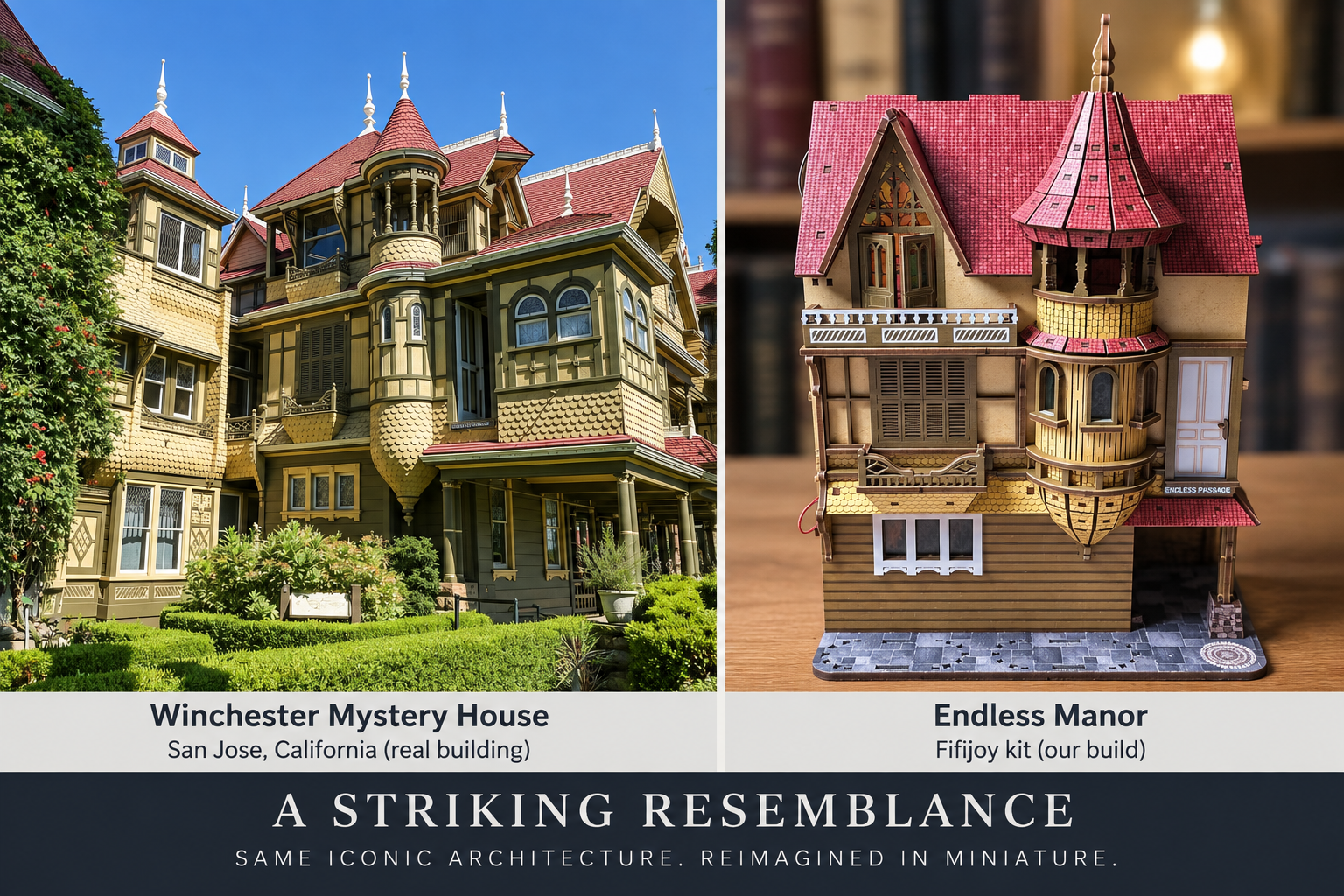
Sometimes a book nook is exactly what it says on the box. A library is a library. A Victorian street is a Victorian street. A fantasy mansion is simply a fantasy mansion.
Then you see something that makes you look twice.
That happened with Endless Manor. At first glance it appears to be an eccentric Victorian house packed with deliberately strange architectural details. But put it beside photographs of California’s Winchester Mystery House and the source becomes clear. D.J. Gibson, who built Endless Manor as Build #177 for Book Nook Workshop, has no hesitation about the identification: this is the Winchester Mystery House in San Jose, California, reimagined as a miniature kit.
It isn’t just the exterior. Once you start looking inside the kit, the similarities keep coming.
Before the Book Nook: Who Was Sarah Winchester?
To understand why the details in Endless Manor are so intriguing, it helps to know the extraordinary story of the woman behind the real house.
Sarah Lockwood Pardee Winchester was born in New Haven, Connecticut, in 1839. In 1862 she married William Wirt Winchester, heir to the Winchester Repeating Arms Company. Their only child, Annie Pardee Winchester, was born in 1866 but died when she was only five-and-a-half weeks old. William later became seriously ill with tuberculosis and died in 1881 at the age of 43. Sarah inherited a huge fortune — reportedly around $20 million as well as nearly half of the Winchester company stock. The official Winchester Mystery House timeline provides a useful chronology of Sarah’s life and the development of the property.
After losing both her child and her husband, Sarah left New England for California. In 1886 she bought a relatively ordinary eight-room farmhouse near San Jose. What happened to that farmhouse over the next 36 years is what turned Sarah Winchester into a legend.
Thirty-Six Years of Building
From 1886 until Sarah’s death in 1922, the house was repeatedly enlarged, altered and reconfigured. According to the official history of the Winchester Mystery House, the original farmhouse eventually became a 24,000-square-foot mansion containing around 160 rooms, 10,000 windows, 2,000 doors, 47 stairways and fireplaces, 52 skylights, 17 chimneys, 13 bathrooms and six kitchens.
There was no conventional master plan. Rooms were added, altered or abandoned; passages took unexpected turns; architectural ideas accumulated on top of earlier ones. The result was not simply a very large Victorian house but a labyrinth — exactly the quality that makes Winchester so visually distinctive and makes the Endless Manor comparison so interesting.
The Ghost Story — and the History Behind It
This is also where history and legend become difficult to separate. The famous story says Sarah consulted a medium after the deaths of her daughter and husband and was told that her family was being haunted by the spirits of people killed by Winchester rifles. In the most familiar version of the tale, she was instructed to move west and continue building so that the spirits could never reach her — or, in other versions, to provide a home for them.
It is a wonderful ghost story, but it should not automatically be treated as established fact. Sarah left no known diary explaining her motives, and the Winchester Mystery House itself acknowledges that we simply do not know why she built as she did. Its historical timeline records that newspaper stories claiming she was building to avoid death were circulating as early as 1895, but Sarah never publicly explained herself. For readers who want to go deeper into the gap between the woman and the legend, Smithsonian Magazine’s examination of Sarah Winchester and her house is well worth reading.
That distinction matters here. Endless Manor appears to draw not only on the architecture of Winchester but also on the story of Winchester — the séance room, strange openings, impossible routes and the atmosphere of a house whose reputation has become inseparable from mystery. Whether Sarah herself believed all the supernatural stories attributed to her is a different question.
A House Damaged, Changed and Still Standing
At its height the mansion rose to seven storeys. The 1906 San Francisco earthquake badly damaged it, and parts of the upper structure were subsequently removed. Sarah nevertheless continued working on the property until her death on 5 September 1922. The house opened to the public the following year and has since become one of California’s most unusual historic attractions. The U.S. National Park Service entry for Winchester House records its architectural significance and National Register status.
So when we describe Endless Manor as resembling Winchester, we are not comparing it with an invented haunted-house cliché. We are comparing it with a real building created over decades by a real woman whose personal tragedies, wealth, architectural experimentation and later mythology became tangled together into one of America’s strangest houses.
Start With the Outside
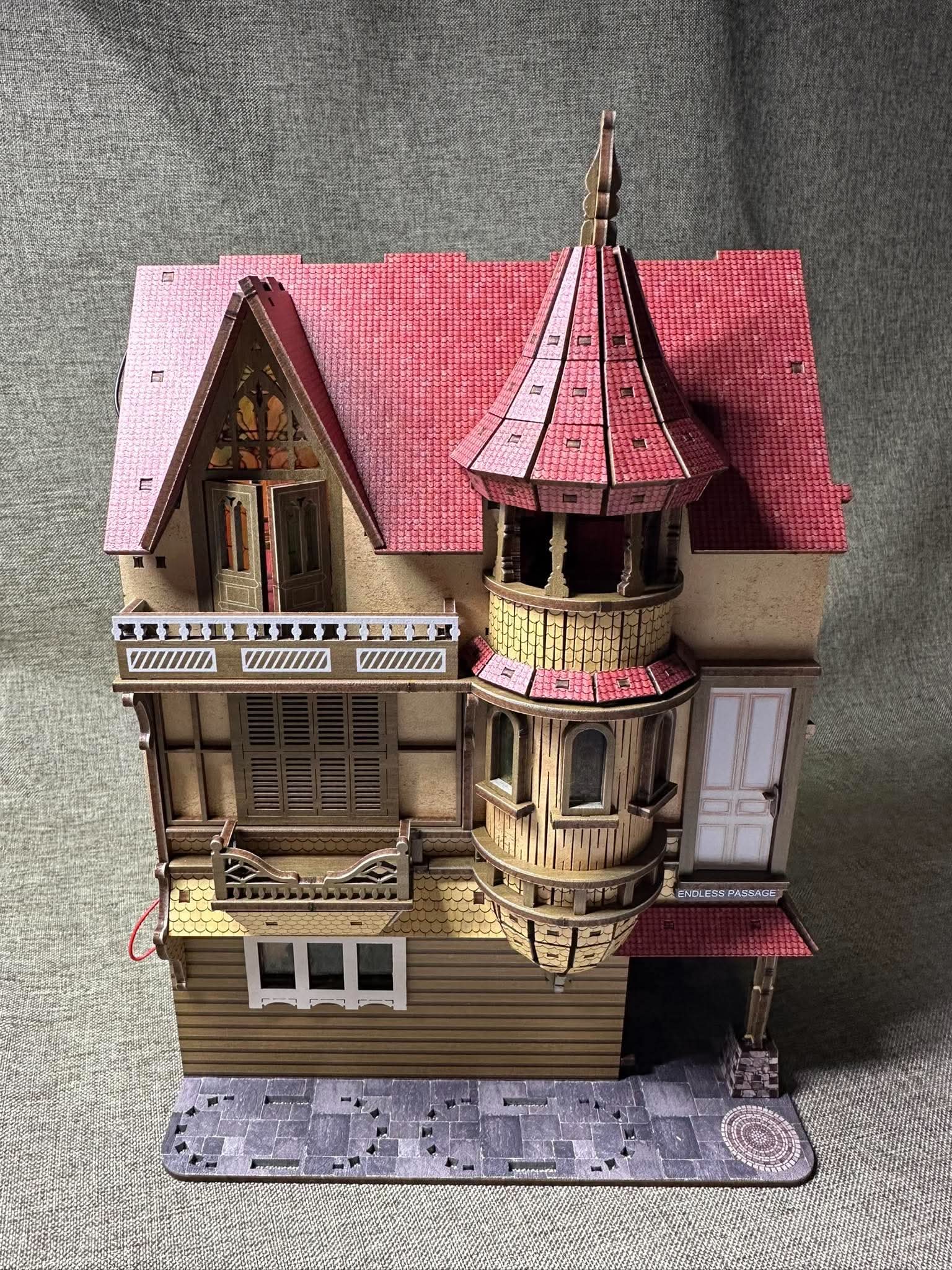
The first clue is the building itself. Endless Manor has the same sort of sprawling, irregular Victorian appearance that makes the Winchester Mystery House instantly recognisable: projecting sections, balconies, towers, changing rooflines and an almost deliberate lack of symmetry.
That alone would prove very little. Victorian architecture provides plenty of material for miniature designers. But one particularly famous Winchester feature appears to have been worked into the design: the Door to Nowhere. D.J. identifies the front of Endless Manor specifically as a view of the side of the Winchester Mystery House, including this infamous doorway and its roughly 15-foot drop into the garden.
At Winchester, the exterior door opening onto a sheer drop has become one of the visual symbols of the house. Endless Manor uses this extraordinary idea as part of its own façade. Suddenly the resemblance becomes more specific than simply “Victorian mansion”.
Then Look Inside
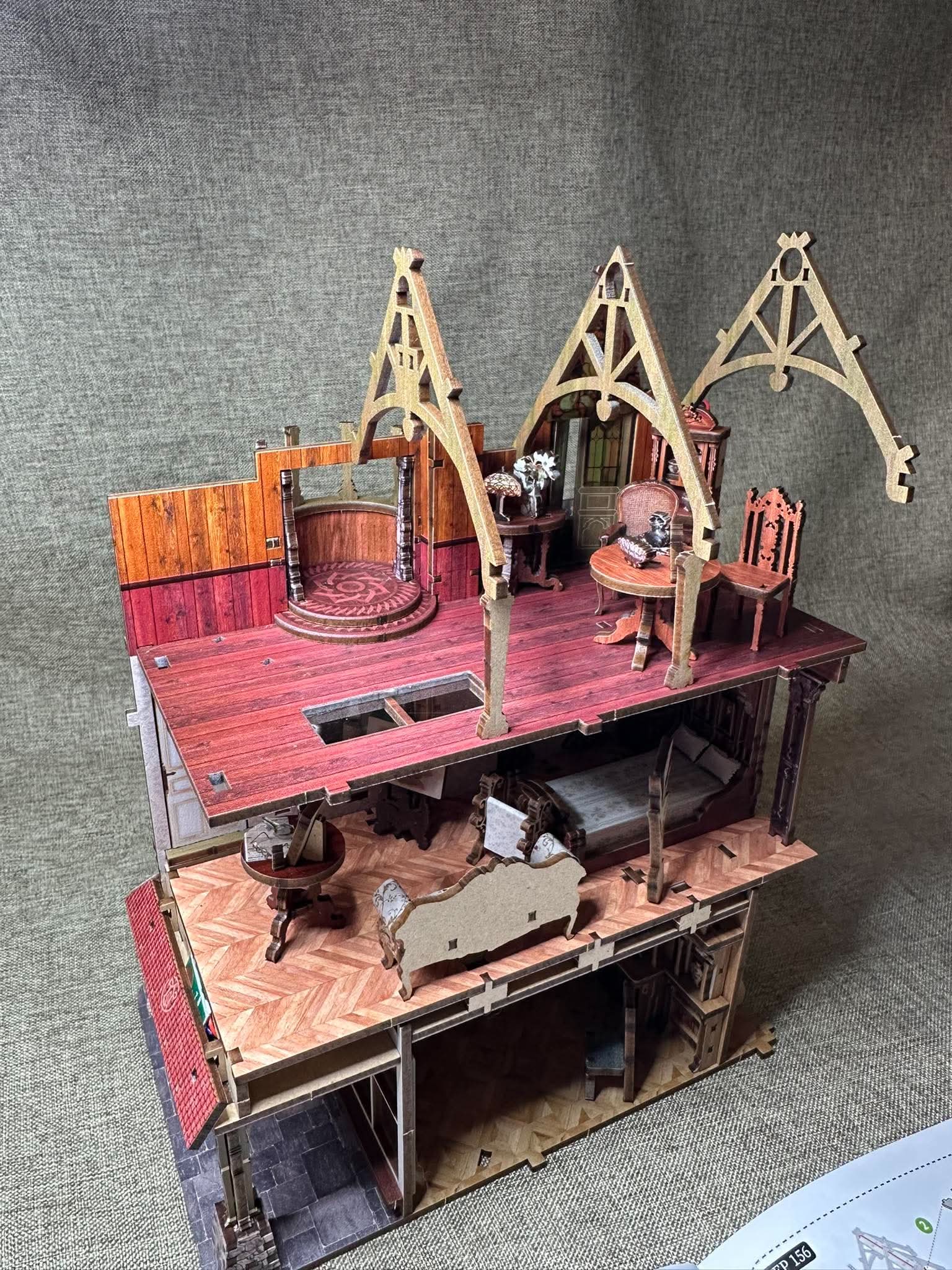
This is where the comparison becomes much more compelling. Endless Manor does not merely borrow the atmosphere of a strange Victorian home. Several of its interior scenes appear to correspond with identifiable features and rooms at Winchester.
The Grand Ballroom
D.J. identifies the first floor as a faithful recreation of Winchester’s Grand Ballroom, complete with fireplace and organ. In isolation that could still be dismissed as conventional Victorian interior design. In the context of everything else in the kit, however, it becomes another piece of the puzzle.
Sarah Winchester’s Bedroom — Right Down to the Portraits
The second floor is even more explicit. D.J. identifies it as a faithful recreation of Sarah Winchester’s bedroom, complete with William Winchester’s photograph on the wall and Sarah’s photograph on the table. The kit even includes tiny wire-rimmed glasses among the bedroom details.
D.J.’s build confirms those identifications, making this a particularly revealing design choice. A designer creating an imaginary haunted Victorian manor has no obvious reason to reproduce those particular portraits in those particular surroundings. They make far more sense if photographs of the Winchester house were being used as reference material.
The Séance Room
Endless Manor then places a séance room in the attic area on its third floor. The association between Sarah Winchester, spiritualism and the séance room is one of the best-known elements of the Winchester story, so its appearance in a fictional mansion already raises an eyebrow.
There is an important qualification. D.J.’s review confirms that the kit does not recreate Winchester’s actual séance room. Instead, the third-floor attic — storage space in the real house — has been reimagined as the Séance Room, an example of the artistic licence used to compress Winchester’s story into the model. That suggests something more interesting than a simple scale model: a designer selecting memorable elements from the real house and recombining them into a new miniature.
The Window in the Floor
Then comes perhaps the most wonderfully unnecessary detail of all: a window in the floor. It is exactly the sort of architectural oddity associated with the Winchester Mystery House. It contributes nothing that a generic miniature Victorian mansion actually needs. Yet there it is.
D.J. also points out what the kit leaves out: the infamous stairs to nowhere and winding stairwells, the Witches Cap — described in his review as one of the house’s most haunted spots — and the actual Séance Room. He even suggests that there may be enough Winchester material for a larger MAX-style kit or additional companion kits.
Identification, Inspiration and Artistic Licence
D.J.’s build review removes much of the ambiguity here. He identifies Endless Manor directly as a miniature homage to the Winchester Mystery House, and the individual details explain why. Victorian houses have ballrooms and bedrooms. Haunted-house fiction uses séances. Unusual doors are hardly unique. But the question changes when they all occur in the same model.
- an exterior strongly reminiscent of Winchester;
- a Door to Nowhere;
- a Grand Ballroom-like interior;
- a bedroom apparently based on Sarah Winchester’s;
- what appear to be photographs of Sarah and William;
- a séance room;
- and a window in the floor.
Taken together, that is a remarkably specific collection of details.
We cannot know the designer’s process simply by comparing photographs, and we are not suggesting any copyright or other legal issue. But as an identification of the building represented by the model, D.J.’s position is unequivocal: Endless Manor is an impressive homage to the Winchester Mystery House. The kit compresses and rearranges elements of the real property rather than reproducing the entire house room-for-room.
A Reimagined Winchester Rather Than a Replica
In some ways that is more interesting than a straightforward miniature replica. The designer appears to have taken the visual identity and famous eccentricities of a real building, compressed them into the dimensions of a miniature kit, moved some elements around and created something that can stand alone as a fictional place.
Endless Manor therefore sits somewhere between architectural model and fantasy book nook. If you do not know Winchester, it works perfectly well as an imaginary eccentric mansion. Once you recognise Winchester, however, you start seeing references everywhere.
And That Led Us to a Bigger Question
After spotting the Winchester connection, we started looking again at other kits we have built. That is when we realised something: real places are already much more firmly embedded in this hobby than we had appreciated.
MiniCity provides the clearest contrast because there is no mystery at all. Its Architectural Series openly turns famous buildings into miniature displays. D.J. Gibson has built and reviewed all four for Book Nook Workshop.
MiniCity: When the Real Place Is the Point
Notre-Dame Basilica of Montreal uses stained glass, vaulted architecture, columns and a layered interior to evoke the famous Canadian landmark. Read our review →

Pantheon – Chamber of Gods is explicitly presented as a miniature interpretation of the Pantheon rather than a generic classical building. Read our review →

Duomo di Milano makes its source explicit in the name, translating the character of Milan’s cathedral into miniature form. Read our review →

St. Charles Church, Vienna is especially useful because our original review includes a photograph of the actual church and explicitly describes the finished kit as a homage to part of it. Read our review →

MiniCity and Endless Manor therefore represent two quite different approaches. In one, the real building is proudly identified and is part of the product’s appeal. In the other, the possible source is hidden behind a fictional name and only becomes apparent when somebody recognises the clues.
What About the Kits in Between?
There is also a middle ground: kits that invoke a genuine place without necessarily reproducing a particular building. Notting Hill Stories, for example, immediately gives its imagined scene a real geographical identity. Parisian cafés, Japanese streets and Victorian shops can similarly borrow the visual language of real locations without being models of one address.
So perhaps there is a spectrum: generic fantasy scenes; scenes inspired by a real city or district; acknowledged models of real architecture; and kits like Endless Manor that may be reimagining a very specific place without saying so.
Perhaps Real Places Aren’t Just the Future of Book Nooks
Only a few days ago we asked whether real places could be the future of book nooks. We suggested places such as historic English cities, Ponte Vecchio and other recognisable landmarks as an exciting direction for designers.
Endless Manor has made us reconsider the premise. Perhaps real places are not simply the future. They are already part of the hobby — sometimes openly, sometimes loosely, and perhaps sometimes hiding in plain sight.
Now We Want You to Play Detective
With hundreds of book nook kits already available, it seems very unlikely that Winchester is the only real-world inspiration we have failed to recognise.
Have you spotted one? Is there a kit that looks suspiciously like a real building, street, shop, library, railway station or other location? Perhaps you recognised it immediately. Perhaps you only noticed after visiting the real place.
Send us the kit name and the place you think inspired it. If possible, include a photograph or link so we can compare them.
There may be an entire real-world atlas hidden on our bookshelves. We have apparently just started looking for it.
Leave a Reply