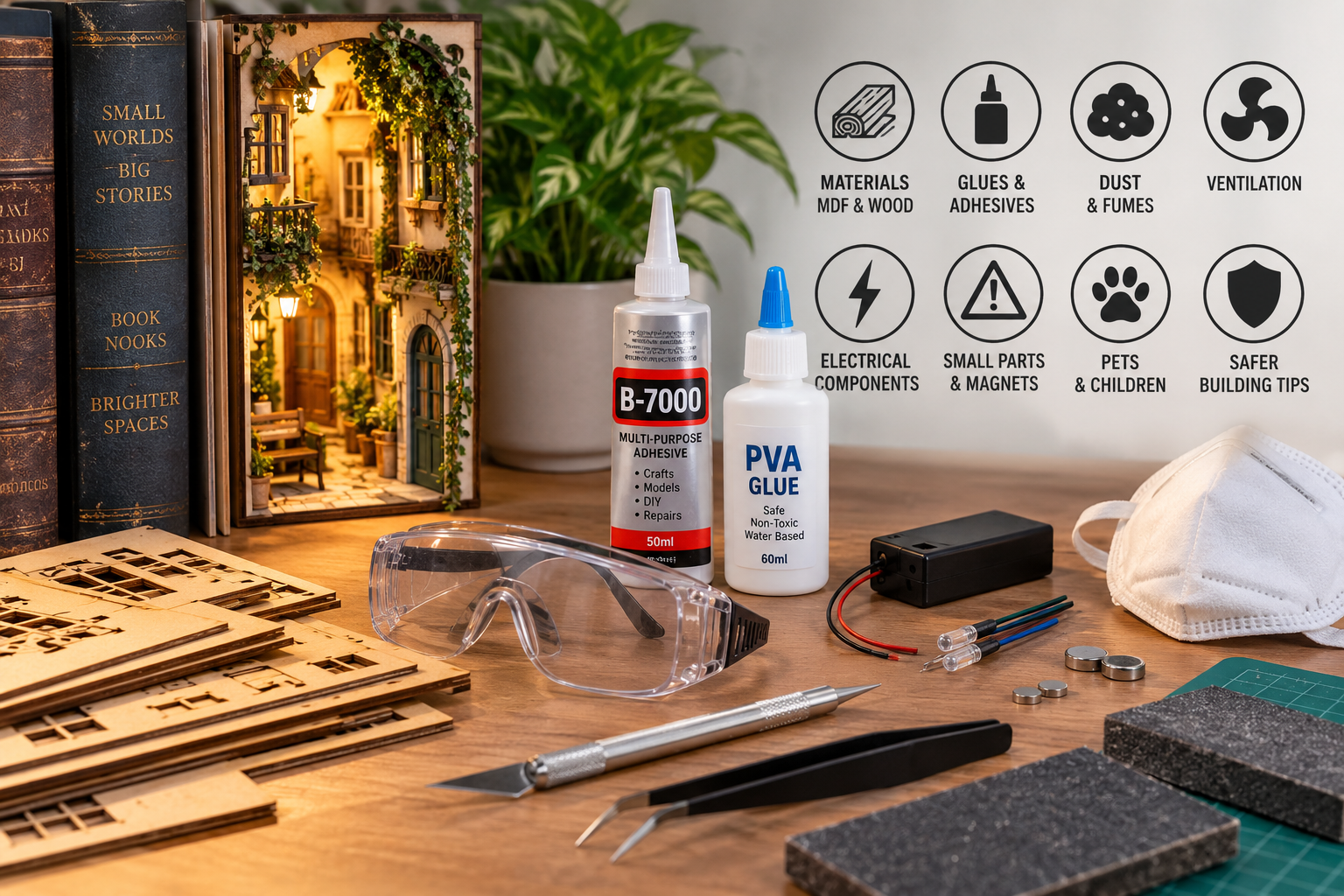
Every so often a question appears in a book nook group that sounds alarming: Does MDF contain formaldehyde? Is that smell from my new kit dangerous? Is B-7000 glue toxic? Should I be wearing a mask?
They are reasonable questions. Book nooks are craft products, and building one can involve engineered wood, plywood, adhesives, paint or printing, electrical components, batteries, sharp tools and a surprising amount of sanding.
But there is an equally important point to make at the outset: the existence of a chemical in a material does not by itself tell us the level of risk from building a book nook. Exposure, concentration, duration, ventilation and the particular product all matter.
This guide is therefore intended to separate sensible precautions from internet panic. It is not medical advice, and we cannot certify the materials in an individual kit. What we can do is look at the evidence and suggest some straightforward habits that make miniature building safer.
The Short Version: Seven Sensible Habits
- Build in a reasonably well-ventilated room, particularly when using solvent-based glue.
- If a newly opened kit has a strong chemical or burnt smell, unpack it and allow it to air before spending hours working over it.
- Minimise dust when sanding MDF, plywood and other wood products; do not deliberately blow fine dust around the room.
- Follow the label and safety information for whatever adhesive you actually have rather than assuming every tube called B-7000 has the same formulation.
- Wash glue from skin promptly and avoid eye contact and deliberately breathing vapours.
- Keep blades, loose magnets, small components and batteries away from young children and pets.
- Stop and move to fresh air if a product is causing significant eye, nose, throat or breathing irritation.
The Big Question: What About Formaldehyde?
This is probably the subject most likely to worry builders because the word formaldehyde immediately sounds frightening.
MDF — medium-density fibreboard — is made from wood fibres bonded together with resin. Depending on the board and resin system, formaldehyde can be associated with composite wood products. Formaldehyde is a hazardous substance and should not simply be dismissed as harmless.
However, that does not mean that owning or assembling something made from MDF is equivalent to receiving a dangerous dose of formaldehyde.
The UK Health and Safety Executive’s detailed guidance on MDF explains that all wood naturally emits some formaldehyde and that MDF emissions depend on the board and its manufacture. HSE notes that the majority of European manufacturers produce low-emission boards and that formaldehyde released from E1 boards is below the relevant E1 limit. It also points out that boards manufactured outside Europe may be produced to different emission standards.
That final point is particularly relevant to book nooks. Kits are manufactured internationally, and as consumers we often have no practical way of identifying the exact grade or source of every sheet of engineered wood in the box.
Regulation Exists — But It Varies by Market
Composite wood is not an unregulated free-for-all. In the United States, for example, the Environmental Protection Agency’s TSCA Title VI formaldehyde standards cover hardwood plywood, MDF and particleboard, including relevant finished goods. The system includes emission limits, testing, certification and labelling requirements.
The difficulty for a hobbyist is that a small kit may not tell you enough about the original panel material to establish which standard it was manufactured to. That is an argument for better material transparency from kit manufacturers, not for assuming that every MDF kit is dangerous.
Is the Smell When You Open a Kit Formaldehyde?
Not necessarily — and this is an important distinction.
A new book nook can contain laser-cut wood, printed surfaces, coatings, plastics, packaging and adhesive. Several materials can contribute to the characteristic smell when a sealed box is first opened. Laser-cut wood can also retain a distinctly burnt or smoky odour.
Your nose cannot identify a chemical or measure its concentration. A strong smell is therefore not proof of dangerous formaldehyde exposure, just as the absence of a smell cannot certify a product as chemically safe.
Our practical approach is simple. If a kit smells strongly when opened, don’t sit with your face over the box for several hours. Spread the pieces out somewhere well ventilated and let them air. If the smell causes persistent irritation, headache, dizziness or breathing problems, stop using the product, get into fresh air and seek appropriate medical advice if symptoms are significant or persist.
The Bigger Everyday Issue May Be Dust
Ironically, while builders worry about an unopened sheet of MDF, they may then spend twenty minutes filing and sanding it without thinking about the dust.
HSE treats wood dust as a health hazard. Its woodworking guidance notes that hardwood and softwood dust can cause respiratory problems and that machining or sanding MDF creates a mixture that can include wood dust and formaldehyde associated with the board. HSE’s wood-dust guidance is aimed mainly at occupational exposure, where quantities are vastly greater than normal book-nook building, but the principle is useful: don’t breathe unnecessary fine dust.
For the tiny amount of sanding involved in most modern kits, this does not mean turning your craft table into an industrial workshop. Sand only when necessary, work somewhere ventilated, keep your face away from the dust and clean the residue rather than blowing it into the air. If you are doing extensive sanding, cutting or modifying of MDF, more robust dust control becomes sensible.
What About B-7000 Glue?
This deserves special attention because B-7000 and similar clear flexible adhesives are extremely common in miniature crafts — and builders frequently comment on their smell.
The first problem is that “B-7000” should not be treated as if it guarantees one universal formulation from one manufacturer. Products using the B-7000 name are sold by different suppliers, and safety documentation found for B-7000-labelled adhesives is not consistent enough for us to tell a reader what is in every tube supplied with every kit.
That uncertainty matters more than the smell itself. One retailer providing a B-7000 safety document labels its product as capable of causing skin and serious eye irritation and respiratory irritation. A separate technical sheet for Zhanlida B-7000 identifies cyclohexane as its main solvent. Other B-7000 safety documentation available online lists different solvent mixtures. In other words, read the information for the actual product in your hand whenever it is available.
For that reason, we would not describe B-7000 generically as either “non-toxic” or “toxic”. Both statements are too simplistic. It is more useful to treat an unidentified B-7000-style adhesive as a solvent-based craft glue unless its manufacturer documentation tells you otherwise.
Using B-7000 More Sensibly
- Use it with good room ventilation.
- Use only the amount you need and replace the cap when finished.
- Do not deliberately inhale the vapour to investigate the smell.
- Avoid eye contact and prolonged skin contact.
- Keep it away from flames and other ignition sources if the product is solvent based.
- Keep it away from children.
- If your tube has a hazard label or Safety Data Sheet (SDS), follow that product-specific information.
The smell from glue is also a good reason not to build for hours in a tiny closed room. Opening a window or providing normal cross-ventilation is a very easy precaution.
We have looked at adhesives in much more detail elsewhere. Our Best Glue for Book Nooks (2026 Guide) compares B-7000/tacky glue, PVA, super glue and other choices, including where each works best and which glues we would avoid. For readers specifically concerned about fumes and repeated exposure, we also have a separate investigation: Is B7000 Glue Safe for Book Nook Builders?
Plywood Isn’t Automatically the “Safe” Alternative
Builders sometimes frame the choice as “MDF bad, plywood good”. It is not quite that simple. Plywood is itself made by bonding layers of wood, and formaldehyde emission standards can apply to hardwood plywood as well as MDF and particleboard. The US EPA, for example, regulates all three categories under its composite-wood rules.
Plywood may have advantages for a particular kit — strength, appearance, weight or the way it machines — but the material name alone is not a complete chemical safety certificate.
Paint, Printing and Other Adhesives
Book nook construction has changed considerably. Many modern kits use pre-printed MDF or plywood, while others still involve paper, paint, clear plastic, stickers and several different glues. Custom builders may add acrylic paints, varnishes, spray products or stronger adhesives of their own.
The rule here is refreshingly boring: read the product label. Don’t assume that because something is sold for crafts it can be used in any quantity in an unventilated room. Spray paints, solvent products and specialist adhesives deserve particular care.
Blades, Awls and the Less Exotic Risks
Chemicals attract attention because they sound mysterious. A craft knife is much easier to understand — and consequently easier to become casual about.
Cut away from your hands, replace damaged blades, use a cutting mat and don’t leave a knife hidden underneath instructions or loose components. The same applies to sharp tweezers, awls, pins and wire ends.
For younger builders, supervision should reflect the actual contents and tasks involved rather than simply the attractive finished model pictured on the box.
Lights, Wiring and Batteries
Most book nook lighting systems operate at very low voltage, but that does not mean electrical components should be ignored. Check wires for obvious damage, don’t force connectors, make sure bare conductors are not accidentally touching, and stop using a battery box or rechargeable component that becomes unusually hot, swollen, damaged or starts leaking.
Button and coin batteries deserve particular respect where children are present. The UK Office for Product Safety and Standards warns that swallowing one can cause severe internal injury and can be fatal. Spare and used batteries should be kept securely away from children, and accessible battery compartments should be secure. Read the UK government guidance on button and coin batteries.
If you suspect a child has swallowed a button or coin battery, this is not a “wait and see” situation: UK guidance says to go straight to A&E or call an ambulance.
Magnets and Tiny Parts
Some kits use small magnets for removable panels, doors or covers. Powerful magnets can cause severe injury if more than one is swallowed because they can attract each other through the intestinal wall. The Office for Product Safety and Standards specifically highlights both magnets and button batteries as small-object hazards.
Book nooks also contain hundreds of ordinary choking-sized pieces. If young children or pets share the room, a tray or lidded organiser is useful for reasons that have nothing to do with keeping your build tidy.
Should You Wear a Mask to Build a Book Nook?
For normal assembly of pre-cut parts, routinely wearing respiratory protection is not something we can prescribe as a universal requirement. The more useful first steps are avoiding unnecessary dust and providing ventilation when using products that release vapours.
If your project involves substantial sanding, sawing or machining rather than simply cleaning an occasional tab, that is a different exposure. HSE’s occupational guidance uses dust extraction and suitable respiratory protection for dusty woodworking tasks. Builders doing extensive custom work should treat it as woodworking rather than ordinary kit assembly.
When Should You Stop Building?
If a material or glue is causing significant eye, nose or throat irritation, coughing, dizziness, headache, nausea, breathing difficulty or an unusual skin reaction, stop using it and move away from the exposure. Fresh air and ventilation are sensible immediate measures for vapour exposure; persistent or serious symptoms require appropriate medical advice.
Someone with asthma, chemical sensitivities, allergies or another condition that affects how they respond to dust or vapours may reasonably need to take greater precautions than another builder. A generic hobby article cannot determine an individual’s safe exposure.
What We Would Like Manufacturers to Tell Us
This discussion also exposes a weakness in the book nook industry. Builders should not have to become amateur chemists to discover what arrived in the box.
We would like manufacturers to make the following information easy to find:
- the principal wood material used — MDF, plywood or another board;
- the applicable formaldehyde/emissions standard or certification where relevant;
- the manufacturer and type of supplied adhesive;
- access to an SDS for solvent-based adhesives;
- clear ventilation and handling instructions;
- battery type and electrical specifications;
- secure battery compartments where appropriate;
- clear age recommendations and warnings about sharp tools, magnets and small parts.
That would allow consumers to make informed decisions without either minimising genuine hazards or exaggerating them.
So, Are Book Nook Kits Safe?
There is no meaningful way to declare every book nook from every manufacturer universally “safe” or “unsafe”. The category covers too many materials, suppliers and designs.
What we can say is that the issues raised by builders — formaldehyde in composite wood, dust and solvent-based adhesive vapours — are real subjects with established safety guidance. They deserve sensible handling, but not panic.
A book nook is a craft project. Treat it like one: ventilate, minimise dust, respect the glue, use sharp tools properly, and keep batteries, magnets and tiny parts away from young children.
For most builders, those precautions are neither difficult nor disruptive. They are simply good workshop habits.
Have You Had a Kit That Made You Wonder?
We are particularly interested in builders’ experiences with unusually strong-smelling kits or supplied adhesives. Which kit was it? What material was used? Did airing it solve the problem? Did the manufacturer provide any useful safety or material information?
Tell us in the comments. If patterns emerge around particular materials or products, it is something Book Nook Workshop can investigate further.
Leave a Reply