Built & reviewed by Ian Scott Horst
Not every book nook needs hundreds of pieces, elaborate electronics or ingenious moving mechanisms to be interesting.
Sometimes the story behind a kit is just as intriguing as the kit itself.
The Japanese Book Nook – UV Printed Version from Cornel’s Creations Ltd. is a very modest book nook by modern standards. It is small, relatively simple and can be completed quickly. Yet it turned out to be one of those builds that leaves you thinking about the hobby long after the glue has dried.
Why?
Because this one isn’t from one of the large Chinese manufacturers that dominate the book nook market.
It comes from Cornel’s Creations Ltd., a small family-based UK craft business. And that makes this little kit rather fascinating.

At 79/100, this isn’t going to challenge the most sophisticated book nooks we’ve reviewed. But judging it purely against highly engineered mass-produced kits rather misses the point.
There is something genuinely admirable about what Cornel’s Creations is doing.
⸻
A Book Nook Made in the UK
One of the most interesting things about this kit is simply where it comes from.
The overwhelming majority of commercial book nook kits we encounter originate in China, where manufacturers have access to sophisticated laser-cutting, printing and mass-production facilities.
Cornel’s Creations feels completely different.
The company appears to have grown from the sort of home crafting and laser-cutting business familiar to many hobbyists. Its range includes numerous unpainted designs, apparently produced from MDF rather than plywood.
That immediately raises an interesting possibility.
Could hobbyists themselves become small-scale book nook designers and manufacturers?
The barrier between building book nooks and creating them for other people to build may be getting smaller.
For anyone who has ever sketched an idea for a book nook that doesn’t exist, that is an intriguing thought.
⸻
What Is the UV Printed Version?

Cornel’s Creations offers this Japanese book nook both in its natural form and as a UV printed colour version, which is the version reviewed here.
UV printing creates a colourful, slightly raised and glossy printed surface directly on the MDF.
On a sophisticated architectural kit this technique might struggle to reproduce all the depth and detail we now expect. Here, however, the relatively simple layered design suits it surprisingly well.
The finished result is colourful, crisp and attractive.
Most importantly, it avoids the considerable amount of painting that would otherwise be required.
⸻
What’s in the Kit?

This is not a kit with several hundred tiny pieces.
Quite the opposite.
There are only a handful of relatively large boards and, although an official piece count isn’t given, the entire project appears to contain fewer than 50 individual pieces.
Construction is primarily based around layered laser-cut MDF sections.
There are some tabs and slots, but glue does most of the work.
That simplicity makes this potentially attractive to beginners or experienced builders wanting something relaxing between much more demanding projects.
And sometimes that is exactly what you want.
⸻
Building the Japanese Book Nook

The construction process is straightforward.
There are no complicated buildings to assemble, elaborate staircases, miniature furniture or intricate wiring systems.
Instead, the scene gradually develops through layers positioned from the back of the book nook towards the front.
Think of it almost as a three-dimensional illuminated shadow box.
That description also applies to several of Cornel’s Creations’ other designs.
The engineering itself worked extremely well. Pieces fitted as expected, and despite some particularly delicate laser cutting around the cherry blossom branches, there were no breakages during construction.
That helps explain the strong 9/10 Engineering & Precision score.
⸻
The Instructions Are Very Basic
If there is one area where the kit clearly shows its small-scale origins, it is the instructions.
They are extremely basic.
Experienced builders shouldn’t have much difficulty working things out because the kit itself isn’t complicated. Nevertheless, some steps require interpretation rather than simply following a comprehensive construction manual.
Compared with the highly polished colour instruction books supplied by many established book nook manufacturers, there is considerable room for improvement here.
Hence the 6/10 score for Instructions.
Better photographs, clearer assembly sequencing and a little more explanation would make this considerably more accessible to first-time builders.
⸻
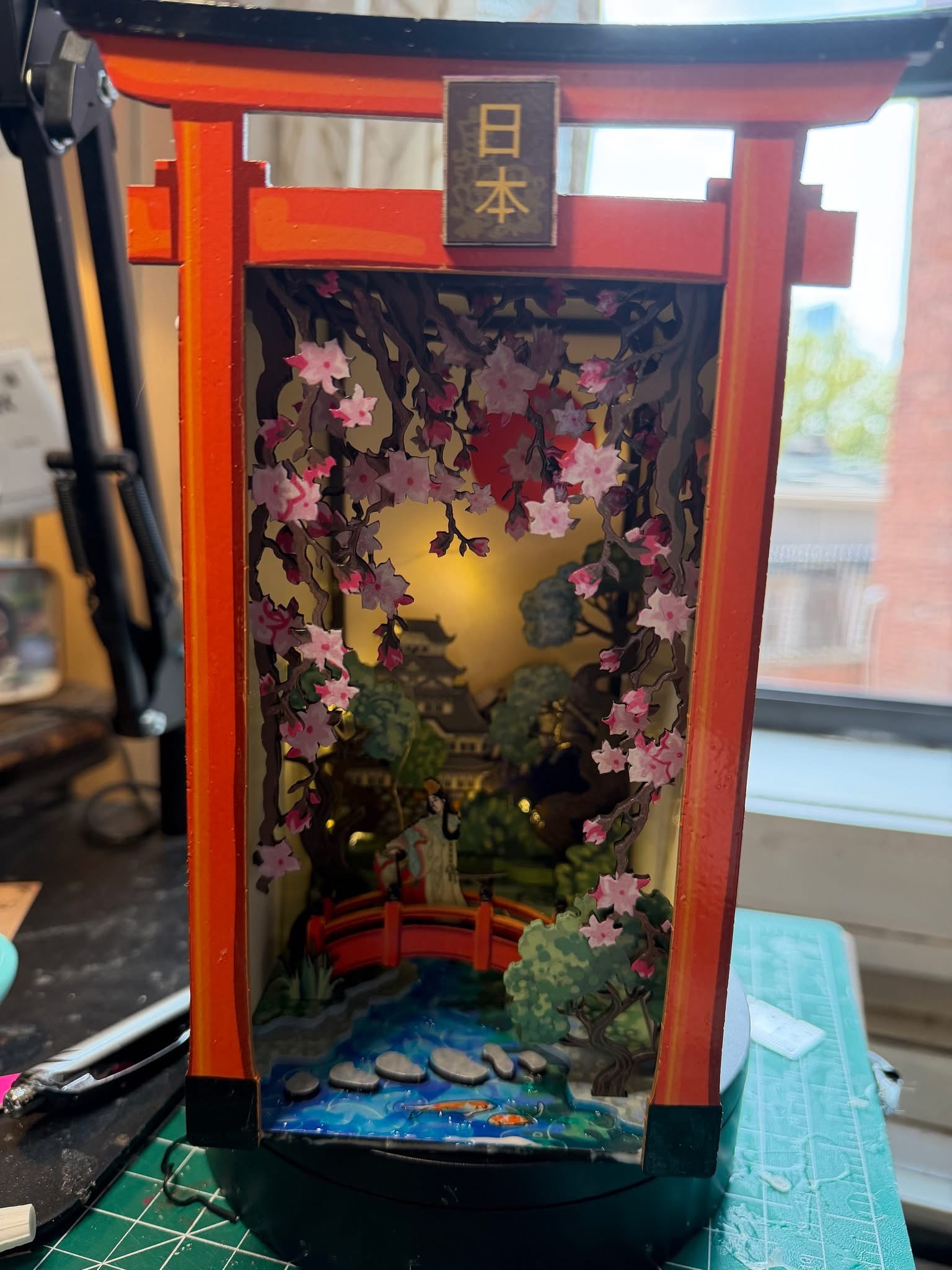
A Japanese Scene Beneath Mount Fuji

The finished composition is instantly recognisable as Japan.
At the centre is a Japanese woman standing on a bridge over a stream.
Behind her sits a Japanese castle, with Mount Fuji rising in the distance.
Above everything is an exuberant mass of sakura — cherry blossom — branches.
And those branches are arguably the strongest visual element in the entire design.
Their intricate laser cutting gives the foreground considerable depth and helps disguise what is otherwise a fairly sparse interior.
It is an effective piece of visual misdirection.
Your eye is drawn towards the blossoms, bridge and distant scenery rather than noticing how few structural elements actually make up the scene.
⸻
One Missed Opportunity
The interior walls feel rather underdeveloped.
They are largely white, with a Japanese rising-sun-style motif on the rear wall.
Considering how effective the UV printing is elsewhere, this seems like an obvious area where additional artwork could have transformed the finished appearance.
There are laser-burned images on the exterior surfaces too.
For this build, these were covered with more appropriate printed images to give the outside a more finished appearance.
That highlights another interesting characteristic of the kit.
It invites modification.
Rather than feeling like a completely finished design that should simply be assembled exactly as supplied, it feels like a starting point for personalisation.
⸻
Small Modifications Make a Big Difference

Two simple changes were made during this build.
First, many of the exposed MDF edges were coloured.
This makes a surprisingly large difference.
Raw laser-cut MDF edges can immediately reveal the construction method of a miniature. Darkening or colouring them helps the separate layers visually merge into a single scene.
Second, water-effect gel was added to the stream.
Again, it is a small alteration, but one that introduces another texture and a little extra depth.
Builders who enjoy modifying kits could easily take things much further.
Additional foliage, miniature plants, textured ground cover or even a more elaborate water effect could all be added without fundamentally changing the original design.
⸻
Lighting
Lighting comes from a simple strand of fairy lights threaded through the structure.
A small battery/control box hangs behind the book nook.
It isn’t particularly elegant engineering, but neither is it especially intrusive. It could easily be glued or otherwise secured behind the finished model.
The lighting itself isn’t dramatic.
Instead, the LEDs provide a gentle decorative glow throughout the scene.
It suits the simplicity of the model and earns a respectable 8/10 for Lighting & Electronics.
⸻
Smaller Than a Typical Book Nook
Don’t expect a full-size modern book nook.
This is noticeably smaller.
In overall scale it is closer to some of the smallest Cutebee-style book nooks or even certain Japanese miniature house kits.
That makes it particularly useful where shelf space is limited.
It could also make an interesting small project for someone who wants to try book nook construction without committing to a large multi-day build.
⸻
Simple Doesn’t Necessarily Mean Uninteresting
From a conventional book nook design perspective, there isn’t a huge amount happening here.
There are no elaborate architectural structures.
No complicated three-dimensional buildings.
No moving components.
No sophisticated electronics.
And relatively few parts.
That explains the 7/10 Design & Artistic Concept score.
Yet the method of construction may actually be more interesting than the design itself.
Layered laser-cut panels combined with direct UV printing provide a relatively accessible way of turning an illustration or concept into a three-dimensional miniature scene.
For anyone interested in designing their own book nook, that is food for thought.
What software is required?
What level of laser cutter?
How accessible has UV printing become?
Could talented hobbyists realistically design and sell small production runs themselves?
This modest little Japanese scene raises some surprisingly big questions.
⸻
The Potential of Small Independent Book Nook Makers
Perhaps that is the most important takeaway from this review.
Book nooks don’t necessarily have to originate from huge factories producing thousands of identical kits.
There could be another model.
Individual designers and small craft businesses could create relatively simple kits based on their own ideas, laser cut them locally and sell them directly to fellow hobbyists.
They might never compete with the engineering complexity of companies such as Rolife, Tonecheer or MiniCity.
They don’t necessarily need to.
Instead, they could produce the unusual subjects that larger manufacturers consider too niche to justify mass production.
And that could make the hobby considerably more diverse.
⸻
Value for Money
For the amount of material and the relatively short build time, this Japanese Book Nook does feel a little expensive.
Mass-production economics inevitably favour the much larger manufacturers.
But price isn’t the whole story.
Buying from a small independent company means supporting the people who are actually experimenting with producing these designs on a much smaller scale.
In this case, that felt worthwhile.
The finished model is attractive, the build was enjoyable, and it provided a welcome change after more complicated projects.
Sometimes that is enough.
⸻
Final Verdict – 79/100

The Cornel’s Creations Japanese Book Nook isn’t technologically advanced and it isn’t trying to be.
Its instructions could certainly be improved and the basic interior would benefit from more detail.
But the engineering is good, the UV printing is surprisingly effective and those delicate laser-cut cherry blossom branches give the finished scene considerably more character than its small number of pieces might suggest.
Most importantly, it represents something we don’t encounter very often:
a small UK craft business creating its own book nook kits.
That alone makes Cornel’s Creations worth watching.
For experienced builders, this could be an enjoyable quick project between larger builds. For modifiers, it provides an excellent base for additional detailing. And for anyone who has ever thought “I have an idea for a book nook — perhaps I could actually make it”, this little kit might prove unexpectedly inspirational.
Overall score: 79/100
Ian runs an Asian themed book nook group, feel free to join
https://www.facebook.com/groups/4192902354334902


Leave a Reply