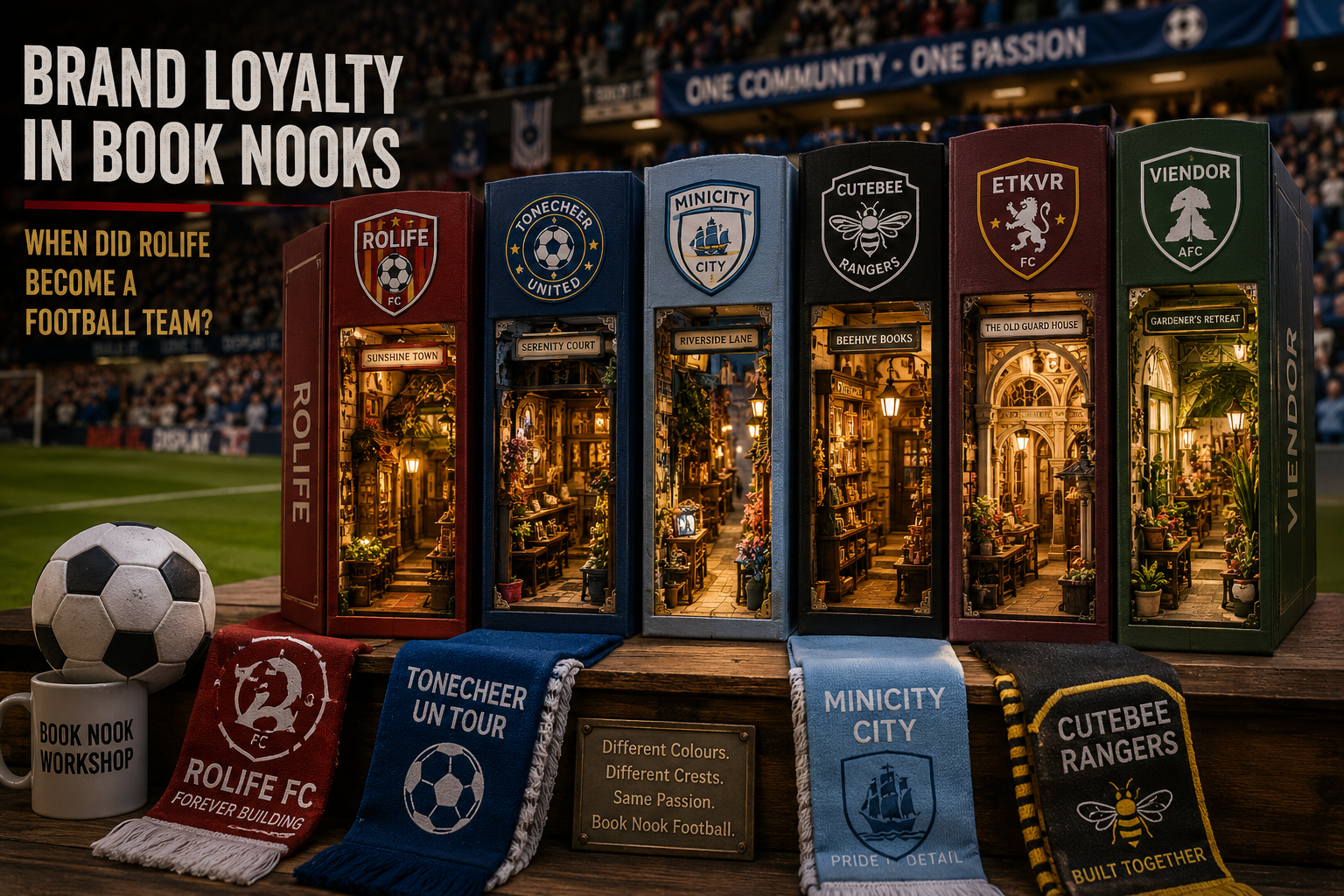
Spend enough time in a book nook Facebook group and sooner or later you will witness something rather familiar.
Someone posts that they have had a problem with a particular manufacturer’s kit.
Within minutes, the supporters arrive.
“I’ve built twelve of theirs and never had a problem.”
“They’re still the best manufacturer out there.”
“You must have got a bad one.”
And occasionally, you almost expect someone to appear carrying a scarf and start singing from the terraces.
Because there is something rather curious happening in the book nook community.
We are developing brand loyalty that sometimes looks remarkably like supporting a football club.
You Don’t Change Your Football Team
In Britain, supporting a football club is generally a lifetime commitment.
Your team can lose six matches in a row, sack another manager, sign somebody who couldn’t hit a barn door from six yards and charge you £70 for a shirt.
You may complain bitterly about all of it.
But you don’t suddenly announce:
“That’s it. I’m supporting Manchester City now.”
Football loyalty isn’t entirely rational. It is emotional.
And increasingly, I see a milder version of the same behaviour surrounding book nook manufacturers.
Some builders are Rolife people.
Others love Tonecheer.
Some will immediately investigate anything released by MiniCity, CUTEBEE, ETKVR or another favourite manufacturer.
There is absolutely nothing wrong with that. In fact, there are some very sensible reasons for it.
But occasionally we appear to cross the line between trusting a manufacturer and supporting one.
Those are two rather different things.
How Do We Become Supporters?
Imagine your first three book nooks all come from the same manufacturer.
The pieces fit.
The instructions make sense.
Nothing is missing.
The lighting works.
And when you finally switch the lights on, the finished model looks every bit as good as you hoped.
Naturally, when you start looking for kit number four, that manufacturer’s name means something.
It represents reduced risk.
You already understand how their kits are constructed. You recognise their instructions. You know roughly how difficult the build will be and what quality to expect.
That’s perfectly rational consumer behaviour.
But something else can then happen.
We stop saying:
“I’ve had good experiences with this manufacturer.”
And start saying:
“This is a good manufacturer.”
A subtle difference, but an important one.
Before long, we might even start recommending their kits that we haven’t actually built ourselves.
We’ve bought the shirt.
We’re in the supporters’ club.
Then Someone Criticises Our Team

This is where Facebook becomes particularly interesting.
If somebody says:
“I built this kit and the engineering was terrible,”
you would imagine the people most qualified to respond would be other people who had built that particular kit.
Not necessarily.
Sometimes people who have built completely different kits from the same manufacturer rush to its defence.
“I’ve built six Rolife kits and they’ve all been brilliant.”
That may be completely true.
But it doesn’t actually tell us whether the seventh kit has a badly designed roof.
It’s rather like somebody saying Liverpool played terribly on Saturday and responding:
“Nonsense. We won the European Cup in 2005.”
Both statements can be true.
A manufacturer can produce a magnificent kit and a dreadful one.
In fact, as the book nook industry grows, that is almost inevitable.
Do We Mark Our Favourite Teams More Generously?
This is where things become slightly uncomfortable for reviewers — including us at Book Nook Workshop.
If we love a particular manufacturer, do we subconsciously forgive them more easily?
Suppose a favourite brand produces a kit with light leakage, awkward wiring and several pieces that don’t fit properly.
Do we say:
“That’s unusual for them. Normally their engineering is excellent.”
Now imagine exactly the same faults appearing in a £25 kit from an unknown manufacturer.
Would we be quite so forgiving?
Perhaps not.
Brand reputation is valuable precisely because previous good experiences should give us confidence.
But reputation shouldn’t become immunity from criticism.
At Book Nook Workshop, the kit has to be reviewed, not the badge on the box.
If Manchester United play brilliantly, a Liverpool supporter is still allowed to admit it.
Painful though that may be.
Here’s the Really Strange Part: Does the Manufacturer Even Know You’re a Supporter?
There is another side to book nook brand loyalty that makes it quite different from football.
Imagine somebody who has purchased fifteen kits from the same company.
They regularly post photographs of their builds.
They recommend those kits when beginners ask what they should buy.
They answer questions from other builders.
Perhaps their recommendations have indirectly generated dozens of additional sales.
That person may be one of the manufacturer’s best unpaid ambassadors.
But does the manufacturer know who they are?
Quite possibly not.
And that makes book nook brand loyalty unusually one-sided.
Where Is Your Season Ticket?
Football clubs understand the commercial value of supporters.
They sell memberships.
They offer priority tickets.
They have supporter clubs.
They send newsletters.
They sell merchandise.
They recognise that someone who has supported the club for twenty years is considerably more valuable than somebody who happened to buy one ticket.
Other industries understand this too.
Airlines have frequent-flyer programmes.
Supermarkets have loyalty cards.
Coffee shops give you your tenth coffee free.
Yet someone can buy their tenth book nook from the same manufacturer and frequently receive exactly the same treatment as somebody buying their first.
No loyalty points.
No special recognition.
No early access.
No meaningful reward for recommending the products to hundreds or thousands of fellow enthusiasts.
There are manufacturers increasingly engaging directly with the community, and some are much better at it than others.
But as an industry, there appears to be an enormous opportunity here.
Perhaps Facebook Has Built the Supporters’ Clubs
This may be the most interesting part of all.
Book nook manufacturers haven’t necessarily created their own fan clubs.
We have.
Facebook groups, Reddit communities, YouTube channels, reviewers and websites have brought builders together.
One person posts a photograph of a beautiful finished kit.
Someone asks where it came from.
Three people recommend the manufacturer.
Another person posts their build.
Someone else buys it.
A brand reputation begins forming.
Thousands of pounds worth of future purchasing decisions can potentially be influenced by conversations the manufacturer never sees and hasn’t paid for.
The community is doing some of the manufacturer’s marketing for it.
And unlike conventional advertising, a recommendation from another builder carries enormous credibility.
Things Get Even Stranger With OEM Kits
There is another complication unique to this industry.
Sometimes we don’t actually know which team we’re supporting.
The book nook market contains OEM manufacturing, rebranding, resellers and kits appearing under different names in different countries.
A builder can therefore become loyal to what they believe is a brand when the actual manufacturer may be somewhere else entirely.
Conversely, somebody might own several kits produced by the same factory without realising it because different names appeared on the boxes.
Imagine buying Liverpool, Arsenal and Chelsea shirts only to discover they were secretly the same football team.
Welcome to parts of the book nook industry.
This is one reason why we have increasingly tried at Book Nook Workshop to identify the actual manufacturer behind the kits we review, because the same OEM kit can appear under different names, brands and prices.
But Brand Loyalty Isn’t Stupid
None of this means brand loyalty is a bad thing.
Quite the opposite.
A manufacturer earns loyalty by repeatedly producing good products.
If you’ve built eight kits from one company and every one has been enjoyable, buying number nine is a perfectly sensible decision.
You understand what you’re getting.
The danger comes when loyalty stops us judging the next kit objectively.
A football supporter can say:
“I love my club, but we were awful today.”
Book nook builders should be able to do the same.
“I love this manufacturer, but this particular kit isn’t very good.”
That doesn’t make you disloyal.
It makes you a customer.
Manufacturers Should Be Paying Attention
If I were running a major book nook manufacturer, this is something I would be looking at very carefully.
Because there are people in the book nook community who don’t merely purchase products.
They champion them.
They photograph them.
They discuss them.
They troubleshoot them.
They defend them.
And, most importantly, they persuade other people to buy them.
That is an extraordinarily valuable group of customers.
Perhaps the manufacturers that recognise this first — and start genuinely engaging with and rewarding their long-term builders — will gain an enormous advantage.
Because the book nook industry is reaching the point where manufacturers aren’t simply competing to sell individual kits.
They are competing for supporters.
So, Who Do You Support?
Here’s the test.
Imagine two brand-new book nooks appear tomorrow.
You know almost nothing about either one.
They cost exactly the same.
You love both designs equally.
But one carries the name of your favourite manufacturer and the other comes from a company you’ve never heard of.
Which one would you buy?
I suspect most of us already know the answer.
And if so, congratulations.
You may already be wearing the scarf.
Facebook Poll
Do you have a book nook brand you’re genuinely loyal to?
- Yes — I’ll actively look for their new releases
- I have favourite manufacturers, but I’m not loyal
- I buy the kit, not the brand
- Half the time I don’t know who actually made it
And perhaps the more interesting follow-up question:
Which manufacturer has actually earned your loyalty — and what did they do to earn it?
Copyright Book Nook Workshop 2026 – All rights reserved. (David Richards)
Leave a Reply