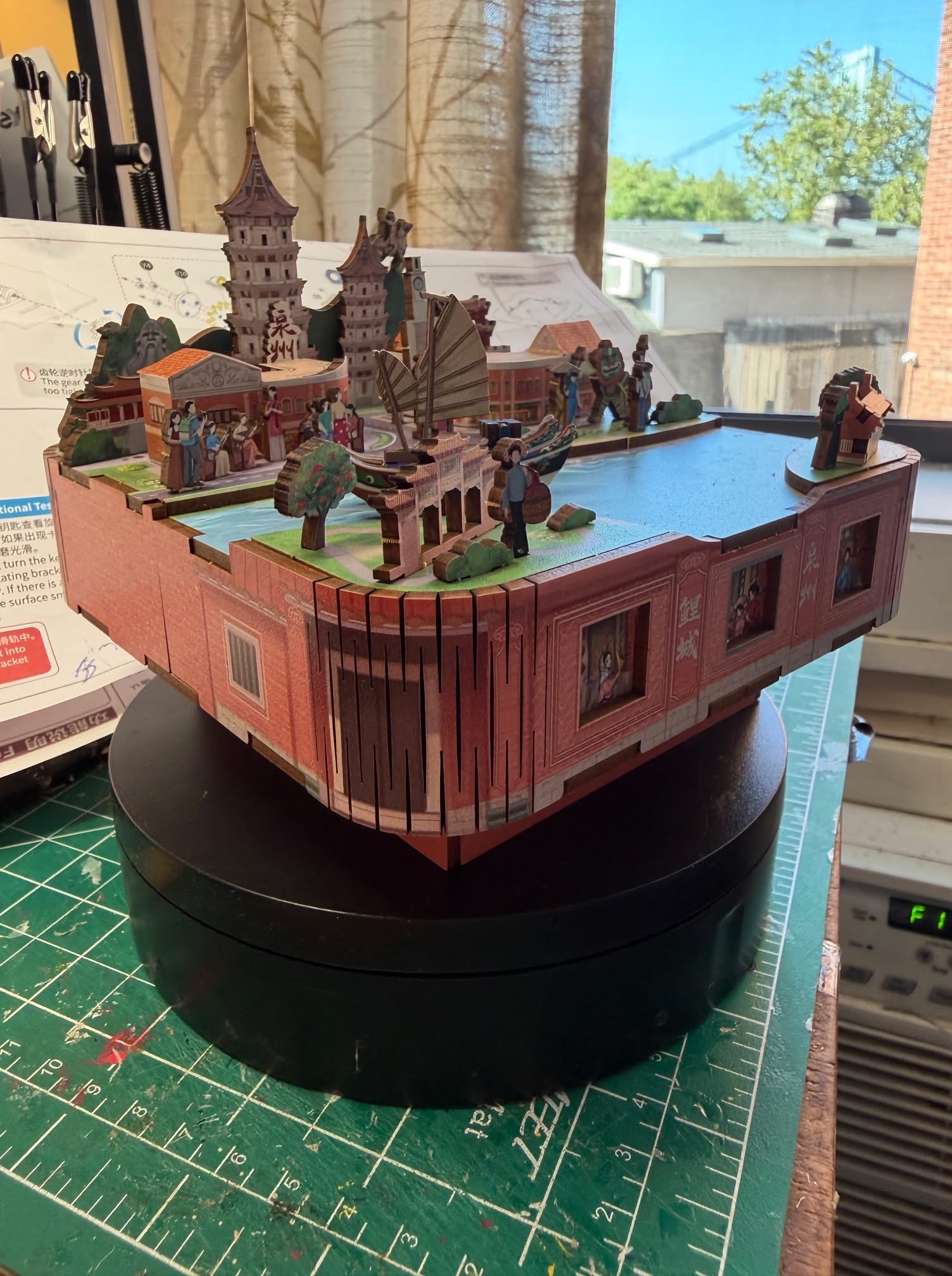
A Mechanical Journey Through Quanzhou
Built by Ian Scott Horst
Summary Table

Tonecheer has become well known among miniature builders for creating kits that combine architecture, storytelling and clever mechanical engineering. The Quan Zhou Music Box is an excellent example — a compact scenic model that captures the character of one of China’s historic cities while hiding a surprisingly sophisticated mechanism beneath the waterfront.
With around 125 pieces, it sits somewhere between a traditional wooden music box and a small book nook in terms of the building experience. But the real attraction isn’t simply the scenery. It’s the little boat travelling backwards and forwards across the waterfront — and the ingenious mechanical system underneath that makes it happen.
A Miniature View of Quanzhou
Summary Table

Quanzhou is an ancient port city in Fujian Province, China, with a history stretching back more than a thousand years. Once an important maritime trading centre, its historic monuments and sites form part of the UNESCO-listed Quanzhou: Emporium of the World in Song-Yuan China.
Tonecheer’s model turns that heritage into a wonderfully cinematic miniature scene.
Historical buildings and landmarks rise behind a modern waterfront, while around a dozen tiny figures populate the banks. Across the water, a traditional Chinese junk moves slowly backwards and forwards.
The combination makes the model feel less like a static architectural miniature and more like a snapshot from a much larger city.

There is even an amusing example of just how cinematic the design can appear. Promotional material for the kit on AliExpress has used AI animation to bring the miniature inhabitants and waterfront scene to life. Once you’ve built the physical model, it’s easy to understand why — the original design already feels like a frozen frame from an animated film.
A Small Kit With a Surprisingly Serious Mechanism
At approximately 125 pieces, the Quan Zhou Music Box is roughly comparable with one of the smaller book nook kits.
What makes the build considerably more interesting is what happens underneath it.
Many Tonecheer mechanical music boxes use a relatively straightforward magnetic system to create movement. A magnet mounted on a rotating paddle underneath the scene follows a circular path as the music-box mechanism unwinds.
A smaller magnet hidden inside a boat, duck, vehicle or other moving object is then pulled around the scene above.
It’s simple, clever and effective.
The Quan Zhou Music Box presents a different engineering problem.
The boat isn’t travelling around a circular route.
It needs to travel backwards and forwards.

Turning Circular Motion Into Linear Movement
This is where the engineering becomes particularly interesting.
The music-box mechanism naturally produces rotational movement. Tonecheer’s designers therefore needed to take that circular motion and convert it into a reciprocating movement capable of pulling the boat from one side of the waterfront to the other and then returning it.
The solution uses a combination of wooden gears, mechanical linkages and metal pins.
The rotating music-box mechanism drives the gear system underneath the model. That motion is transferred through the mechanism until the large magnet responsible for moving the boat travels backwards and forwards beneath the surface.
The boat itself contains two smaller magnets.
As the larger magnet moves underneath the model, the boat follows it above.
For anyone interested in mechanical models, it becomes an unexpected little lesson in physics and mechanical engineering.
More importantly, you actually get to build the mechanism yourself.
It Looks More Daunting Than It Is

Opening the kit and seeing the mechanical components could easily make some builders wonder what they have got themselves into.
Fortunately, this is where Tonecheer’s engineering quality becomes particularly important.
The parts are accurately designed and the instructions are extremely clear. Once construction begins, something that initially appears complicated becomes surprisingly achievable.
Rather than simply assembling decorative buildings, you’re constructing a functioning mechanical system and gradually discovering how each component interacts with the next.
That makes this a much more involved build than some of Tonecheer’s other geography-inspired music boxes.
For builders who enjoy understanding why something works rather than simply putting pieces together, this is probably one of the most satisfying parts of the kit.

Entirely Mechanical – No Batteries Required
There are no electronics, batteries, USB cables or lighting in the Quan Zhou Music Box.
Everything is mechanical.
A traditional key winds the music-box mechanism, which simultaneously produces the music and powers the moving waterfront scene.
The tune itself is the familiar delicate, tinkling sound associated with traditional mechanical music boxes. The melody may well be recognisable to somebody with a better musical ear than this reviewer!
The absence of electronics actually suits the model.
There’s something particularly satisfying about watching movement being created entirely through springs, gears, magnets and mechanical linkages.
One Small Mechanical Limitation
There is one issue worth mentioning.
The boat is relatively heavy for the mechanism moving it.
As the music-box spring gradually loses energy, there comes a point where there is still enough power to continue playing the music but not quite enough to keep pulling the boat.
Consequently, the boat can stop moving before the music finishes.
Remove the boat and the mechanism will continue until the remaining music has played out.
It’s not a major problem, and it doesn’t detract significantly from the finished model, but it does highlight just how much more demanding this mechanism is compared with Tonecheer’s simpler rotating magnetic systems.
More Than Just a Music Box
Tonecheer produces several different styles of mechanical miniature.
Some are inspired by Chinese history, mythology and legends, while others recreate particular places and regions of China.
The Quan Zhou Music Box belongs firmly in the latter category.
Yet this is considerably more involved than simply assembling a miniature skyline.
Between the architecture, figures, waterfront, traditional boat and mechanical movement, the completed model manages to tell a surprisingly convincing little story.

And that may be the greatest appeal of Tonecheer’s scenic music boxes.
They don’t offer quite the same immersive enclosed environment as a full book nook, but they provide something slightly different: a miniature scenic snapshot.
Rather than looking down an alleyway or into a fantasy world between books, you’re looking across a tiny landscape.
The more of these kits you build, the easier it becomes to appreciate them as their own category of miniature modelling rather than simply smaller alternatives to book nooks.
Final Verdict
The Quan Zhou Music Box by Tonecheer is a lovely combination of miniature architecture and mechanical engineering.
At around 125 pieces it isn’t an enormous project, but the unusual mechanism makes it substantially more interesting than the piece count might suggest.
The conversion of the music box’s rotating movement into the boat’s backwards-and-forwards journey is particularly clever, and being able to see and assemble the mechanism makes the construction almost as interesting as the finished scene.
Tonecheer’s excellent engineering and clear instructions prevent that complexity from becoming frustrating.
There is a minor limitation in the weight of the boat causing it occasionally to stop before the music has completely finished, but that’s unlikely to spoil what is otherwise an extremely satisfying mechanical miniature.
Most importantly, the finished model is simply lovely to look at.
For builders who enjoy book nooks but are beginning to explore mechanical miniatures and music boxes, the Quan Zhou Music Box demonstrates why Tonecheer’s scenic models deserve attention in their own right.
Purchased from AliExpress.
Copyright Book Nook Workshop 2026 – All rights reserved. (Ian Scott Horst)
Leave a Reply