Built & reviewed by D.J. Gibson Build #170
Buy this kit on Amazon UK: Check current price and availability →
As an Amazon Associate, Book Nook Workshop may earn from qualifying purchases at no extra cost to you.

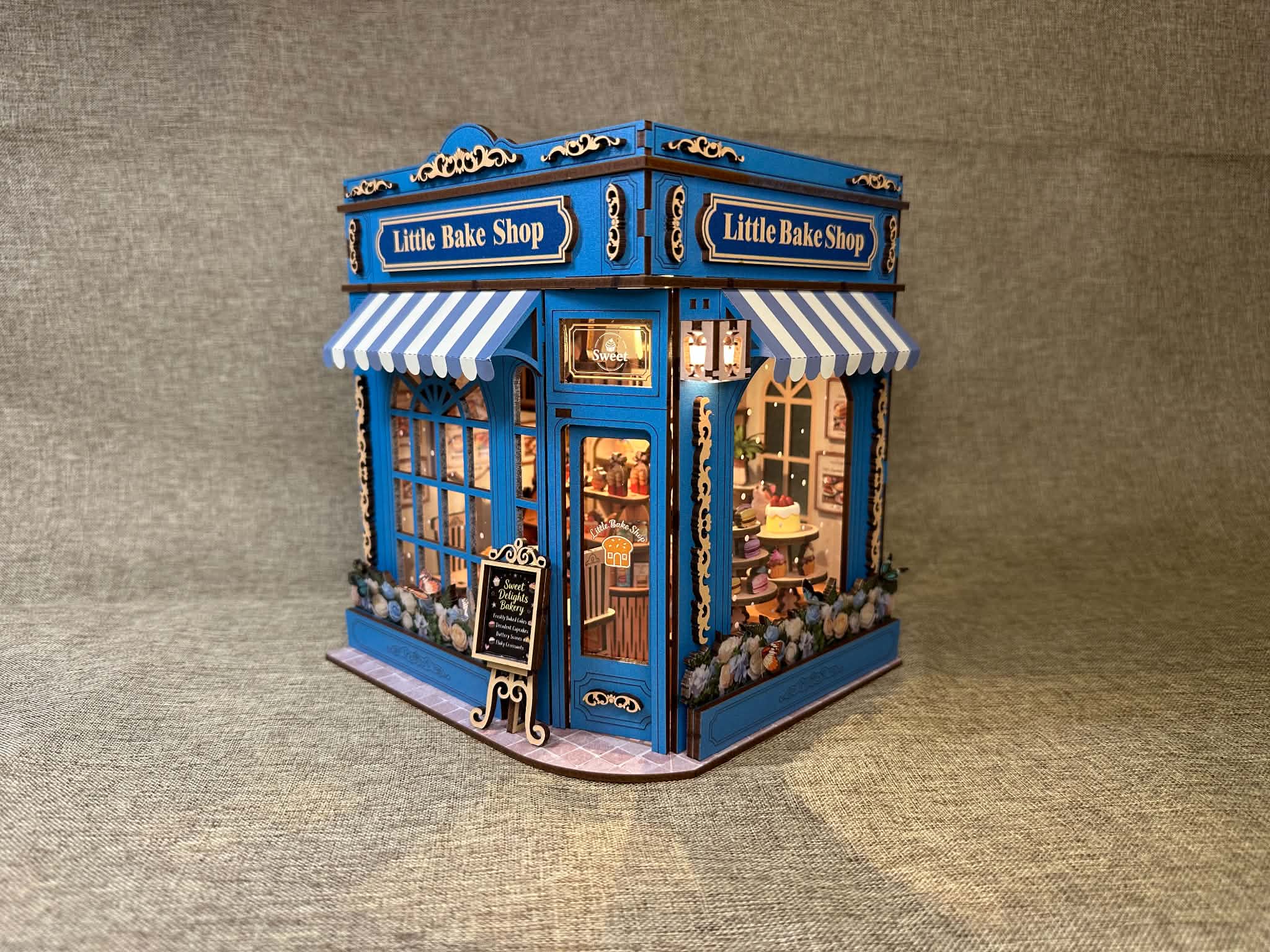
There is something particularly appealing about miniature cafés, bakeries and shops, and TOYQI’s Little Bake Shop fits comfortably into that category. With two floors, display cases, shelving, tiny furniture and warm LED lighting, the finished model creates an attractive little bakery that would sit particularly well alongside other storefront miniatures.
Purchased from Amazon from TOYQI, this is primarily a printed MDF build, with only limited use of thin acrylic for the windows. The construction is relatively conventional, but good print quality, accurate laser cutting and some clever lighting integration make it an enjoyable build.
First Impressions and Materials

The Little Bake Shop is constructed almost entirely from printed MDF.
The print quality is excellent. Colours are clean with no noticeable bleeding, while the laser cuts remain correctly positioned within the printed areas. Pieces are also easy to remove from their boards without excessive force.
Fit is generally very good, with most components sitting snugly in their intended locations.
Thin acrylic is used for some of the larger windows, although there is one slightly puzzling omission that becomes apparent later in the build.
Building the Little Bake Shop


Assembly begins with many of the smaller components that will eventually populate the shop.
These include:
- display cases and shelving
- tables and chairs
- a cat tower
- various decorative elements
- exterior embellishments
There are quite a few exterior details to glue into place, helping give the finished bakery considerably more character than a simple box-style miniature.
The full-colour instructions are clear and easy to follow, and the generally accurate fit of the MDF makes the early stages straightforward.
Adding the Second Floor

Once the ground-floor components are installed, construction moves upwards to the second level.
This is also where the first part of the lighting system is introduced.
The wiring is cleverly routed along the bottom of the banister and then behind the second-floor bookcase, helping keep it hidden when the model is complete.
This kind of cable management makes a noticeable difference to a finished miniature. Visible wires can quickly spoil the illusion of scale, so integrating them into the structure is a welcome piece of engineering.
Three-LED Lighting System

The Little Bake Shop uses three LED bulbs of different lengths, controlled through a touch-sensitive panel.
Each has a separate purpose:
- One LED illuminates the rear display case on the second floor.
- A second provides the main interior shop lighting.
- The longest LED runs to the exterior lamp.
The battery pack is concealed within the base of the rear display case.
Overall, it is a nicely designed system that provides lighting in several areas rather than relying on a single central LED.
The Trickiest Part of the Build

The most awkward stage comes when fitting the ceiling and exterior light.
Before the ceiling panel can be permanently installed, the longest LED must be routed over it, down through the structure and into the side wall where it illuminates the exterior lamp.
At this point the wall is still somewhat unstable and the ceiling panel remains loose.
That leaves you simultaneously trying to:
- hold the ceiling panel
- position the LED
- manage the wire
- install the wire clamp
It feels like a stage designed for somebody with an additional pair of hands.
It isn’t particularly difficult, but it is unnecessarily awkward. Taking your time — and possibly temporarily supporting the ceiling panel — should make the process considerably easier.
Once the LED is secured, the ceiling can be connected to the exterior walls and the remaining interior light installed. Wire clamps then keep everything neatly positioned.
A Strange Window Omission

One unusual design decision concerns the windows.
The larger openings receive the expected acrylic coverings. However, two tall window openings on the front and rear walls are left completely open.
There are no acrylic panels supplied for these openings and the instructions don’t indicate that anything should be installed.
Whether this is intentional or simply an omission is unclear, but it does feel slightly inconsistent when the other windows are glazed.
It isn’t enough to spoil the model, but builders who prefer a fully enclosed appearance may want to consider adding their own thin transparent acrylic.
Finishing the Roof
With the major structure assembled, the final stages are mostly decorative.
Short wall panels are fitted around all four sides of the ceiling section before the touch-control panel is glued into position. The sensor corresponds with the light-bulb symbol on the opposite side of the board, allowing the lighting to be controlled without an obvious physical switch.
The roof panel is then installed and surrounded by its final decorative pieces.
At this point the Little Bake Shop really comes together.
Build Quality and Experience
The Little Bake Shop doesn’t rely on elaborate mechanisms or unusually complicated construction techniques.
Instead, its strengths are much simpler:
accurate parts, attractive printing, sensible construction and a charming finished design.
The instructions are particularly good, and the snug fit of most components means there is relatively little frustration during assembly.
The ceiling-light installation is the only stage that stands out as unnecessarily fiddly.
Who Is Little Bake Shop Suitable For?
This looks like a particularly approachable kit for somebody who already has a little miniature-building experience.
There are enough small decorative elements and lighting components to make it more involved than the simplest beginner kits, but nothing described in the build suggests a particularly demanding construction.
It should appeal especially to builders who enjoy:
- miniature shops and street scenes
- bakery and café themes
- detailed interiors
- two-storey miniatures
- illuminated storefronts
- printed MDF construction
It could also work particularly well as part of a larger miniature shopping street.
Final Verdict
TOYQI’s Little Bake Shop is an adorable little model.
The high-quality printing and accurate laser cutting make construction enjoyable, while the three-LED lighting arrangement adds considerably to the finished display.
There are a couple of quirks. The open window sections are difficult to explain, and installing the exterior-light LED while the upper structure is still loose is more awkward than it needs to be.
Neither issue significantly detracts from the finished model.
Once complete, the Little Bake Shop becomes a warm and characterful miniature bakery that should appeal to anyone who enjoys detailed storefront scenes.


Copyright Book Nook Workshop 2026 – All rights reserved. (D.J. Gibson)
Leave a Reply