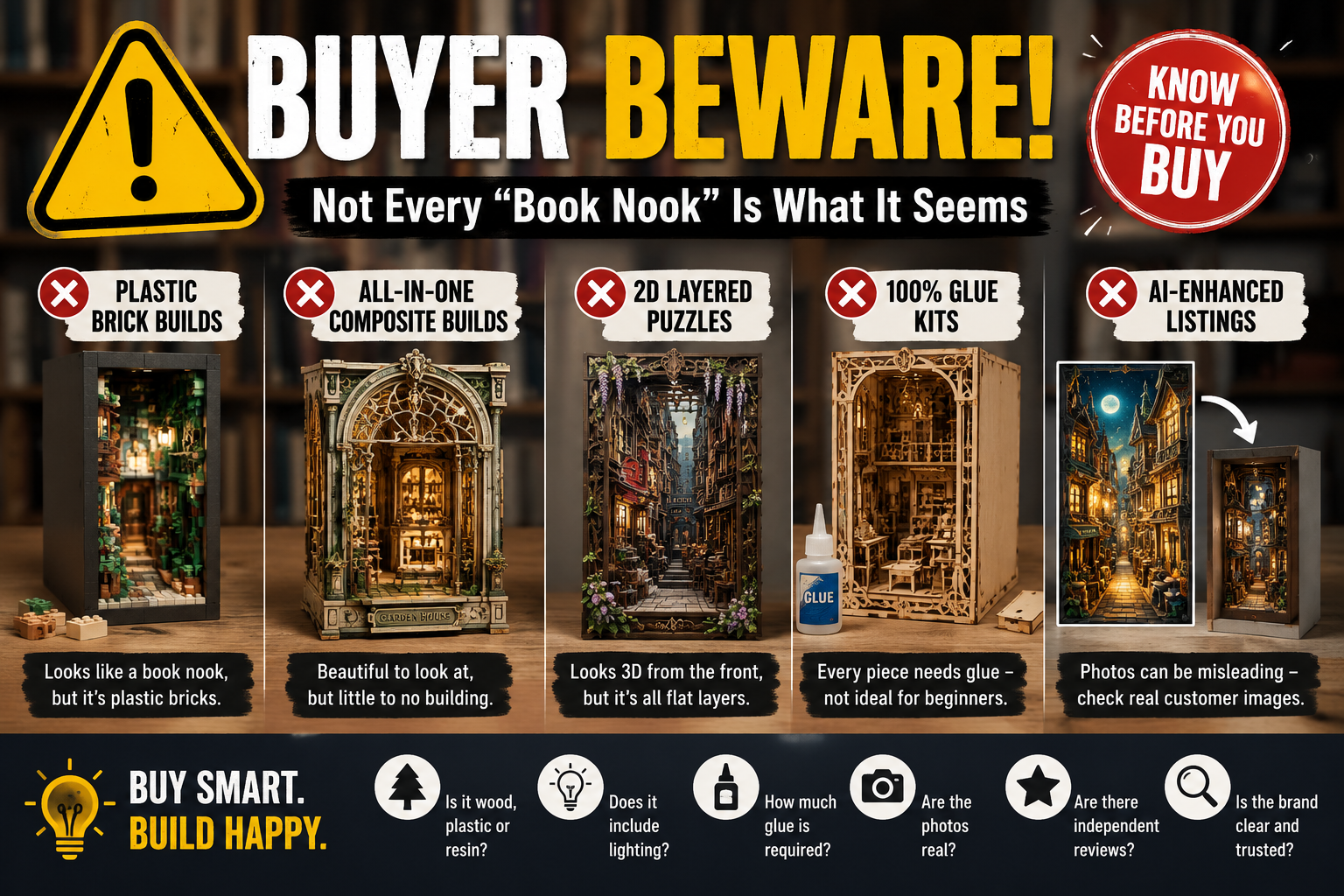
Buyer Beware! Not Every “Book Nook” Is What It Seems
If you’ve recently searched online for a book nook kit, you’ve probably noticed something confusing. Search results are now filled with products that are advertised as book nooks but, once they arrive, turn out to be something completely different.
Thanks to AI-generated listings, automated translations and sellers using “book nook” as a catch-all search term, it’s becoming increasingly difficult to know exactly what you’re buying.
Before you click Buy Now, here are some of the most common surprises.
1. Plastic Brick Builds
At first glance these often look fantastic. The product photos show an impressive miniature scene sitting between books, but when the parcel arrives you discover it’s actually a set of hundreds (or thousands) of tiny plastic bricks.
There’s nothing wrong with plastic brick models if that’s what you’re looking for, but they offer a completely different building experience from a traditional wooden book nook. If you enjoy painting, lighting and wooden craftsmanship, you may be disappointed.
How to spot them:
- The description mentions “building blocks” or “micro bricks.”
- The parts count is extremely high.
- No wooden MDF is mentioned.
2. One-Piece Composite Models
Some products are advertised as book nooks but are actually pre-moulded resin or plastic decorations.
They look attractive on a bookshelf, but there’s very little building involved. If you’re expecting several evenings of relaxing construction, these are unlikely to satisfy.
How to spot them:
- Very low assembly time.
- Terms like “finished model” or “assembled display.”
- Few or no construction photographs.
3. 2D Layered Puzzles
These are becoming increasingly common.
From the front they look remarkably three-dimensional, but in reality they’re made from a series of flat laser-cut layers stacked together. The illusion is clever, but there is very little depth compared with a true book nook.
Many buyers don’t realise the difference until they open the box.
4. 100% Glue Kits
Not all wooden book nooks are created equal.
Some modern kits use clever tab-and-slot construction with very little glue required. Others rely almost entirely on glue for every component.
For experienced builders this may not be a problem, but beginners often find these kits frustrating. Parts can shift while drying, alignment becomes more difficult, and mistakes are harder to correct.
If you’re new to the hobby, look for kits described as slot-together, tab construction, or minimal glue required.
5. AI-Enhanced Product Images
Perhaps the biggest change over the past year has been the use of AI-enhanced marketing images.
Some sellers now use heavily edited or entirely AI-generated artwork that makes a kit appear brighter, more detailed or larger than the finished product actually is.
That doesn’t necessarily mean the kit is poor quality—but it does mean you should be cautious.
Look for:
- Photographs of the completed model.
- Customer review images.
- Videos showing the real build.
- Independent reviews from trusted websites.
So, How Do You Buy with Confidence?
Before purchasing any book nook kit, ask yourself these questions:
- ✔ Is it made from wood, plastic bricks or resin?
- ✔ Does it include lighting?
- ✔ How much glue is required?
- ✔ Are the product photographs genuine?
- ✔ Are there independent reviews available?
- ✔ Is the manufacturer clearly identified?
A few minutes of research can save hours of disappointment.
Final Thoughts
The book nook hobby has never been more popular, and that’s wonderful to see. Unfortunately, its popularity has also led to confusing product listings and misleading marketing.
At Book Nook Workshop, our aim is to help you understand exactly what you’re buying before you spend your money. Whether you’re looking for a relaxing beginner-friendly build or an advanced challenge, knowing the difference between the various types of “book nook” kits is the first step towards choosing one you’ll genuinely enjoy.
Leave a Reply