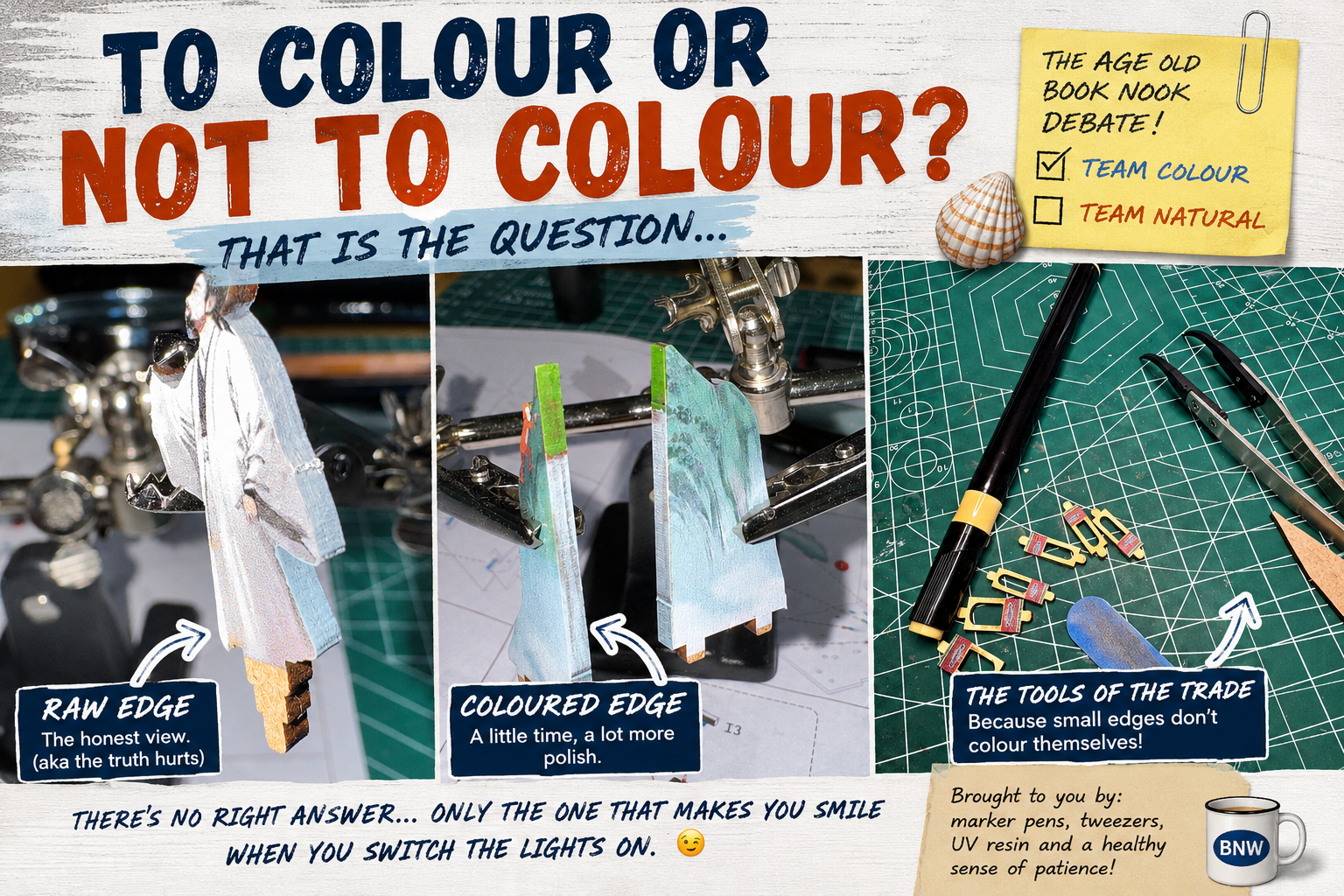
John MacInnes, one of the professional build team here at Book Nook Workshop, in his own inimitable manner, is looking at the subject of colouring edges.
There are two types of book nook builders in this world.
Those who religiously colour every exposed edge with military precision, matching shades as if they’re restoring the Sistine Chapel…
…and those who think, “Och, it’ll be fine once the lights are on.”
The problem is, both camps are absolutely convinced they’re right.
So, in the interests of world peace—or at least preventing another heated Facebook debate—I decided it was time to tackle one of the hobby’s most divisive questions.
Should you colour the edges of your book nook components?
I’m John MacInnes, one of the professional build team here at Book Nook Workshop, and after more than 60 builds I’ve seen just about every argument imaginable. So grab a coffee, put the marker pens within easy reach (or deliberately hide them if you’re in the “leave them alone” camp), and let’s settle this once and for all.
Well… probably not. But we might all have a laugh trying.
There are certain topics in the book nook world guaranteed to spark more debate than whether B7000 is better than PVA, or whether instruction manuals are actually worth reading. One of those is the age-old question…
“Should you colour the edges of your kit components?”
Now, before you answer, let me just move behind this sturdy table and don my tin hat.
I’ve seen perfectly civil Facebook discussions descend into the sort of heated exchanges normally reserved for politics and football. It’s amazing how a humble felt-tip pen can divide a community.
Personally? I sit somewhere in the middle.
When it all started
When I first started building, I didn’t colour a single edge. Why would I? The manufacturer hadn’t, so clearly they weren’t meant to be coloured. Besides, I was too busy trying to work out which end of the tweezers to hold.
Then, after a few builds, I noticed something.
No matter how beautifully printed the kit was, those dark MDF edges had an uncanny ability to catch your eye. You’d spend hours creating a stunning brick wall only for the exposed edges to shout, “Excuse me… I’m made of wood!”
Once you’ve seen it…
…you can’t unsee it.
The slippery slope of edge colouring
Of course, colouring every single edge is a slippery slope.
You start by thinking, “I’ll just do the obvious bits.”
Three hours later you’re sitting there with four different marker pens, carefully matching the grain on a microscopic window frame while your family wonders if you’ve finally lost the plot.
It becomes an obsession.
You’ll find yourself looking at real buildings thinking, “That brickwork could really do with a bit of edge colouring.”
There is, however, another school of thought.
Some builders argue that once the lighting is installed and the book nook is sitting on a shelf, nobody notices those edges anyway.
And they’re not entirely wrong.

Be honest, or just use an excuse!
Ask yourself honestly… how often have you picked up someone else’s finished build, squinted at a door frame from three inches away and declared, “Tut… should’ve coloured that edge.”
Probably never.
Most visitors are too busy saying, “Wow, that’s incredible!”
They’re not conducting a forensic inspection worthy of CSI: Book Nook Scotland.
The truth is, I think it depends entirely on the kit.
If it’s a light interior with lots of LED’s, those MDF edges can stand out like a Scotsman wearing Hawaiian shorts and a pair of Wellington boots in December.
On a brightly coloured seaside build or rustic cottage? They often blend in remarkably well.
The other thing to consider is time.
Edge colouring can easily add several hours to a build.
If you enjoy that process, fantastic.
If, however, you’re the sort of builder who gets twitchy after spending ten minutes folding miniature books together, then adding another three hours with marker pens may not be your idea of fun.
And here’s a controversial thought…
There isn’t actually a right answer.
Some of the finest builders I’ve seen colour every single exposed edge.
Others don’t colour any.
Both produce stunning finished models.
The only opinion that really matters is the one you have every time you look at your completed build.

So, should you colour the edges?
My answer is…
Maybe.
Helpful, aren’t I?
Perhaps the best advice I can give is this. Build one kit without colouring anything. Build the next one with carefully coloured exposed edges.
Sit them side by side.
If you genuinely prefer one over the other, you’ve found your answer.
Just don’t let anyone tell you you’re doing it wrong.
After all, this hobby is supposed to reduce stress—not create arguments over the colour of a 2mm piece of MDF.
Pros of Edge Colouring
- Gives a more realistic, professional finish.
- Hides those MDF edges that can spoil the illusion.
- Particularly effective on light interiors.
- Can make photographs look noticeably better.
- Adds another level of craftsmanship for those who enjoy the extra detail.
Cons of Edge Colouring
- Can add several hours to a build.
- Requires a growing collection of pens and paints to match different colours.
- It’s surprisingly easy to colour the wrong edge… ask me how I know.
- In many finished models the difference is barely noticeable once the lighting is on.
- You may disappear down a rabbit hole where every exposed edge suddenly becomes “just one more to do.”
What type of builder are you?
As with most things in the world of book nooks, there are two types of builders. Those who religiously colour every exposed edge… and those who insist it makes no difference whatsoever.
The funny thing is, both groups usually produce absolutely gorgeous builds.
So perhaps the real answer is this: build it the way that makes you smile every time you switch the lights on.
Copyright Book Nook Workshop 2026 – All rights reserved. (John A. MacInnes)

Leave a Reply