Build Time: Approximately 10 Hours
Difficulty: High Intermediate to Expert
Power Source: 2 × AAA Batteries
Materials: Printed MDF, plastic components, acrylic pieces, stickers
Buy this kit on Amazon UK: Check current price and availability →
As an Amazon Associate, Book Nook Workshop may earn from qualifying purchases at no extra cost to you.
Built & reviewed by D.J. Gibson
Introduction
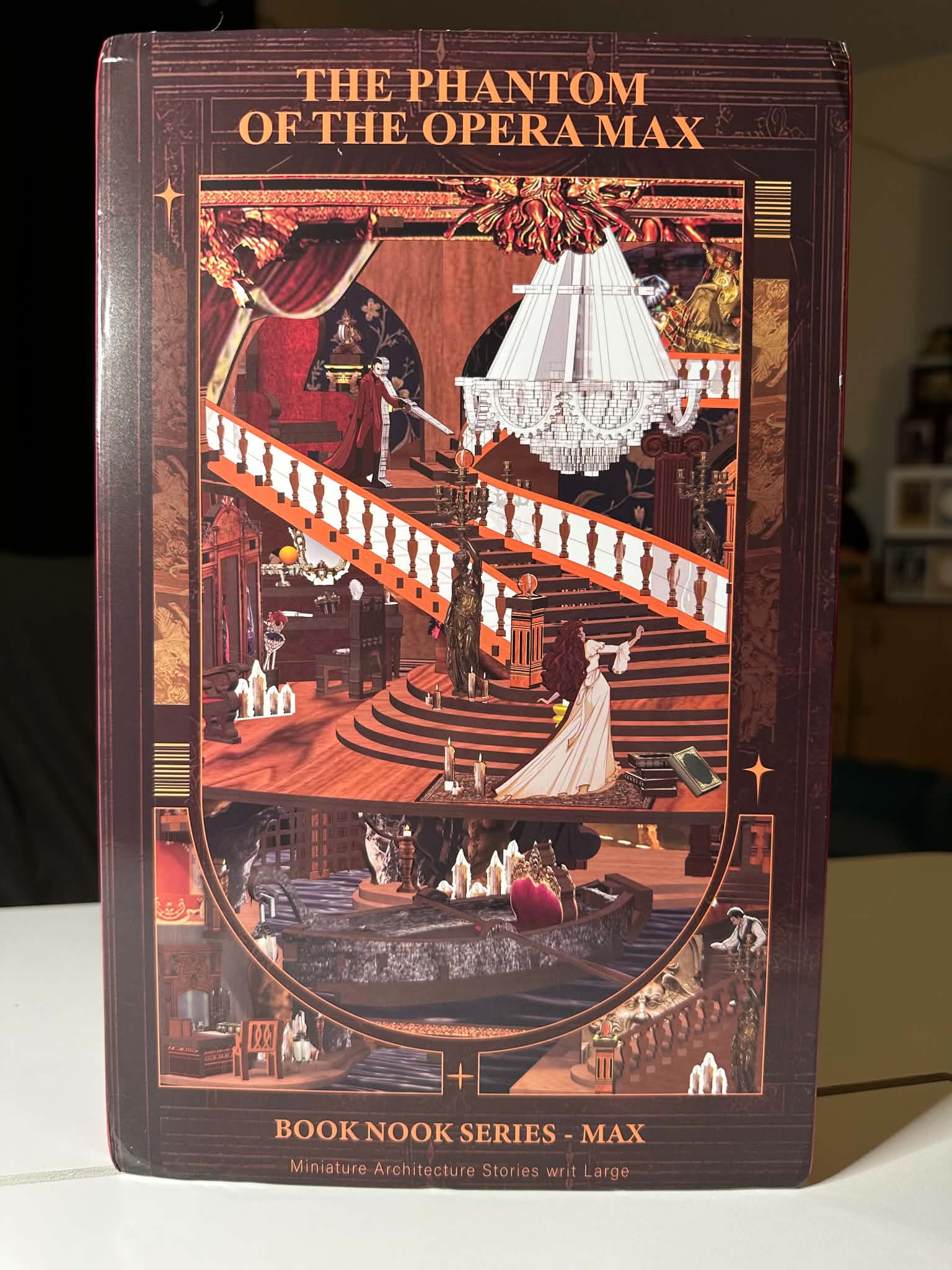
The MiniCity Phantom of the Opera Max is a visually impressive book nook inspired by the famous musical and novel. Featuring multiple levels, extensive lighting, a grand chandelier, and the Phantom’s underground lair, this kit aims to recreate the atmosphere of the Paris Opera House in miniature form.
While the finished model is undeniably beautiful, the journey to completion presents several challenges that place it firmly in the high intermediate to expert category.
What’s in the Box?
The kit is made primarily from printed MDF and includes numerous small and sometimes minuscule plastic components, limited acrylic pieces, and a few stickers.
The print quality throughout the kit is excellent. However, some MDF parts were cut slightly outside their printed areas, leaving visible white edges that either required colouring or careful positioning to hide.
Instructions are provided in full colour and are generally easy to follow. A QR code is included, allowing builders to download a digital version of the manual if preferred.
Building the Phantom’s Lair

Construction begins with the Phantom’s underground lair beneath the stage.
This section immediately feels different from a traditional book nook build. Several components on this level fit less securely than expected and required glue to achieve a satisfactory hold.
Numerous tiny torches are included throughout the lair, although the area is ultimately illuminated by four static orange LEDs. While the addition of flickering LEDs could potentially enhance the atmosphere, the reviewer decided against modifications due to the kit being powered by only two AAA batteries.
Constructing the Stage

Once the base level is complete, attention shifts to the stage section.
The instructions allow builders to either construct this directly on top of the first level or build it separately and install it later. The reviewer chose the latter option to avoid accidental damage to the completed lower section.
The stage ultimately consists of three levels and includes several delicate construction stages involving:
- The grand staircase
- Decorative architectural details
- Stair railings
- Upper-level balcony railings
One challenge encountered during this stage is that not all levels connect securely together. As a result, sections of the stage can move unexpectedly while working on other areas, making assembly more difficult than expected.
Lighting Installation

After completing the main stage structure, lighting installation begins.
One lamp is installed during stage construction, although the reviewer felt this step was ultimately unnecessary. Additional lamps are placed within the Phantom’s bed chamber and other areas before wiring is routed throughout the model.
The kit includes:
- Eight LEDs
- One LED strip
- Battery operation via two AAA batteries
During this stage, it becomes apparent that the stage section does not physically connect to the base level. Instead, it is supported only by the kit’s outer walls once assembly is complete.
This design choice complicates wire routing because the stage section continues to move while attempting to secure wiring underneath. Although the lighting was successfully installed, the reviewer questioned some of the lighting placement decisions.
Walls, Chandelier and Roof Construction

Once the wiring is complete, the wall sections are installed, significantly increasing the overall rigidity of the structure.
Construction then moves on to one of the most impressive features of the kit: the chandelier.
The chandelier is made entirely from acrylic components and requires protective film removal from both sides of every piece. Assembly is complex enough to feel like a miniature puzzle in its own right.
Builders must install the LED strip within the chandelier before completing final assembly. Once finished, the chandelier is mounted into the roof panel, which features an ornate ceiling design.
Lighting Performance
The lighting system offers three operating modes:
- Chandelier lighting
- Stage lighting
- Phantom’s lair lighting
As each additional lighting section is activated, the previously illuminated sections become noticeably dimmer.
According to the reviewer, this suggests that the two AAA batteries struggle to adequately power the full lighting system, making battery capacity one of the kit’s more noticeable shortcomings.
Final Assembly
With the roof installed, builders add the decorative front frame and signature angel ornament before attaching the dust cover.
One disappointment noted during this final stage is that the rear side of the angel decoration is left unfinished. While not visible from the front, it can be clearly seen when viewing the model from the back.
Overall Impression
The Phantom of the Opera Max is a visually stunning and highly ambitious book nook. Its multi-level design, dramatic architecture, and extensive lighting create an impressive display piece that successfully captures the atmosphere of The Phantom of the Opera.
However, several design decisions increase the difficulty of the build:
- Inconsistent part fitment
- A floating stage section that is not attached to the base
- Challenging wire management
- Questionable lighting placement
- Limited battery capacity for the number of lights included
Despite these concerns, the finished model remains a beautiful homage to the source material and is capable of making a striking display piece once completed.
Verdict
Pros
- Excellent visual impact
- High-quality printed components
- Colour instructions with downloadable manual
- Impressive chandelier feature
- Unique multi-level design
Cons
- Some poorly fitting components
- White MDF edges visible on certain parts
- Stage section lacks direct support from the base
- Lighting placement issues
- Two AAA batteries struggle to power all lighting effects
- Rear of angel decoration left unfinished
Book Nook Workshop Rating: Recommended for experienced builders who enjoy complex architectural builds and intricate lighting installations.


Copyright Book Nook Workshop 2026 – All rights reserved. (D.J. Gibson)
Leave a Reply