Every book nook builder eventually reaches the same moment:
You line up the tab perfectly.
Apply gentle pressure.
Nothing happens.
So you push a little harder.
And suddenly you are either:
- fighting the laws of physics
- bending the entire structure
- or holding two separate pieces that used to be one piece.
Tight-fitting slots are incredibly common in book nook kits, especially with MDF designs and laser-cut parts. Fortunately, they are usually easy to fix with patience and a little preparation.
Why Slots Become Too Tight
Book nook kits are often designed with extremely precise tolerances.
But real-world factors interfere:
- Humidity can swell MDF
- Burn residue narrows slots
- Paint adds thickness
- Glue seepage reduces space
- Manufacturing tolerances vary slightly
A slot that worked perfectly in the factory may become frustratingly tight by the time it reaches your desk.
How to Fix Tight Slots Safely
1. Never Force the Piece
This is the most important rule.
If a part requires serious force:
- something is wrong
- or the slot needs adjustment
Forcing pieces together usually causes:
- broken tabs
- cracked trim
- warped walls
- alignment problems later
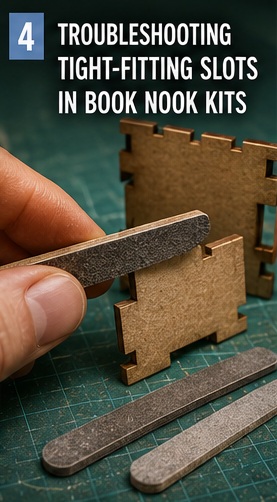
2. Sand the Tab Lightly
Usually the easiest solution.
Use:
- Fine-grit sandpaper
- Nail file
- Sanding stick
Remove only a tiny amount at a time.
You are aiming for:
“firm fit”
not
“falls out immediately.”
3. Clean the Slot Itself
Laser cutting often leaves burnt residue inside slots.
Carefully remove:
- Charred edges
- Loose fibres
- Glue blobs
- Paint buildup
A craft knife or needle file works well for this.
4. Test Fit Repeatedly
Do not sand aggressively all at once.
Better approach:
- Sand lightly
- Test fit
- Repeat gradually
Tiny adjustments make a huge difference with laser-cut MDF.
5. Watch Out for Painted Parts
Paint adds thickness surprisingly quickly.
Even thin paint layers can make precision slots impossible to fit.
Helpful trick:
Avoid painting tabs and slot interiors when possible.
Or sand painted connection points before assembly.
6. Slightly Angle the Insertion
Sometimes the issue is not the slot size but the insertion angle.
Try:
- inserting one side first
- rocking gently into place
- supporting surrounding pieces evenly
Twisting aggressively is what usually breaks tabs.
7. Use Wax for Stubborn Fits
Some experienced builders lightly rub:
- candle wax
- beeswax
- graphite
onto tabs to reduce friction.
Only use tiny amounts.
This can help with extremely tight MDF joints.
When the Slot Is Actually Too Small
Occasionally the manufacturing is genuinely off.
In that case:
- widen the slot carefully with a file or knife
- remove material gradually
- keep edges square
Many builders quietly modify kits more than they admit.
Common Mistakes
The biggest errors are:
- forcing dry MDF
- sanding too much too quickly
- twisting long delicate pieces
- ignoring paint thickness
- trying to assemble while frustrated
Tiny parts somehow detect emotional instability immediately.
Prevention Tips
To avoid slot problems:
- Dry fit constantly
- Sand early
- Build in a moderate humidity environment
- Keep paint away from joints
- Test before gluing
A few seconds of preparation can save major repairs later.
The Important Truth
A perfectly fitting slot is deeply satisfying.
But after your tenth overly tight connection, successfully sanding a piece by exactly the right amount starts to feel like achieving enlightenment.
Leave a Reply