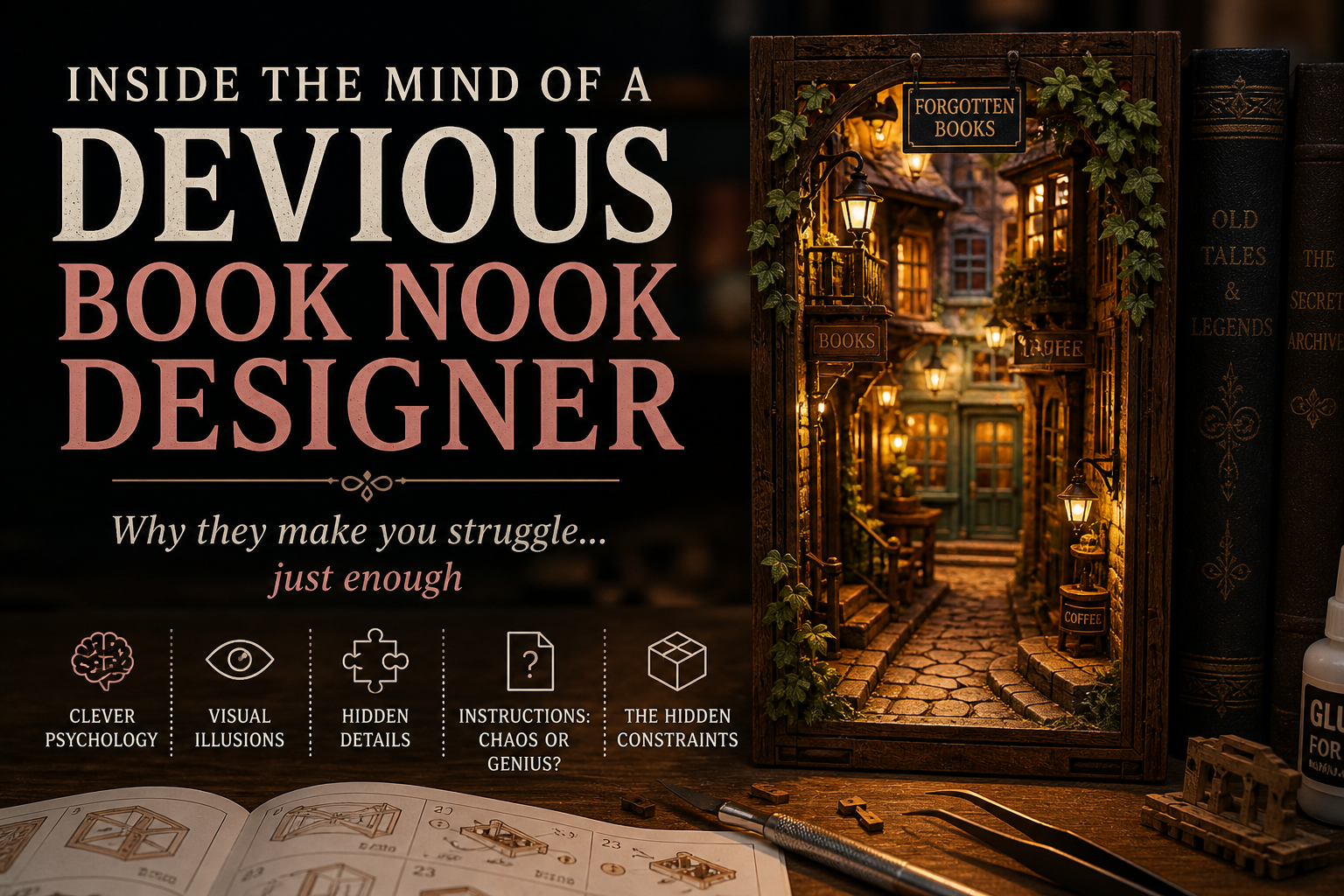
Why they make you struggle… just enough
Introduction
At some point during a build, every book nook creator has the same thought:
“Why on earth would they design it like this?”
A wire that’s just a bit too short.
A piece that only fits one way—but doesn’t look like it should.
Instructions that feel more like a suggestion than a guide.
It’s tempting to think it’s poor design.
But what if it isn’t?
What if, behind every fiddly step and head-scratching moment, there’s a designer who intended you to struggle—just enough to make the end result feel extraordinary?
Welcome to the mind of a devious book nook designer.
They Design for Struggle, Not Ease


A completely smooth build might sound ideal—but it’s actually less satisfying.
The best kits create what psychologists call “controlled frustration”:
- Moments where you pause
- Think harder
- Try again
That tiny bit of resistance makes the final reveal feel earned.
A devious designer doesn’t want you to fail.
They want you to feel clever.
The Details You’ll Probably Never See


Ever noticed:
- Fully printed book spines you can barely read
- Objects hidden behind walls
- Tiny details that disappear once assembled
That’s not inefficiency—it’s obsession.
Designers often include details for themselves, not just for you.
It’s a quiet signature:
“I know it’s there… and that’s enough.”
Masters of Illusion


That deep alleyway?
That endless library corridor?
Chances are, it’s only a few centimetres deep.
Designers use:
- Forced perspective
- Layering
- Strategic lighting
- Mirrors
It’s controlled deception—and it’s what turns a simple box into a scene you can fall into.
Instructions: Accident or Intentional Chaos?


Let’s address the elephant in the room.
Instructions.
We’ve all had that moment where:
- Steps feel slightly out of order
- Diagrams leave just enough ambiguity
- You double-check everything… twice
Is it bad design?
Sometimes.
But often it’s something else: assumed knowledge.
Many kits—especially from brands like Rolife or ROKR—are designed with returning builders in mind.
The result?
A learning curve that can feel… optimistic.
A devious designer might not be trying to confuse you.
They just expect you to keep up.
The Constraints You Never See


8
Every design decision sits inside a box of limitations:
- Parts must fit on flat laser-cut sheets
- Everything has to survive shipping
- Costs need to stay reasonable
- Assembly must be possible without specialist tools
So when you think:
“Why didn’t they just do it this way?”
There’s usually a hidden answer:
“Because they couldn’t.”
Confessions from the Workbench
Spend five minutes in any book nook Facebook group and you’ll see patterns:
- “The wiring nearly broke me…”
- “Those stairs were brutal!”
- “Worth it in the end though.”
That last line is the key.
The struggle becomes part of the story.
And whether they admit it or not, designers rely on that moment—
when frustration flips into pride.
So… Are They Devious or Brilliant?
Probably both.
Because the truth is:
- If it’s too easy, it’s forgettable
- If it’s too hard, it’s abandoned
- But right in the middle… that’s where the magic happens
A well-designed book nook doesn’t just build a scene.
It builds an experience.
And somewhere, behind the scenes, there’s a designer quietly smiling when you finally slot that last piece into place.
Final Thought
Next time you hit a frustrating step, pause before blaming the instructions.
You might just be exactly where the designer wanted you to be.
Copyright Book Nook Workshop 2026 – All rights reserved. (David Richards)


Leave a Reply