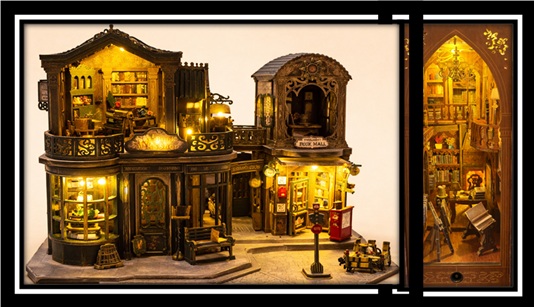
If you’ve recently discovered the world of miniatures, you’ve probably come across both book nooks and dioramas.
At first glance, they can look very similar — both are detailed miniature scenes, often with lighting, furniture, and incredible craftsmanship.
But once you dig a little deeper, you’ll realise they are very different styles of build, each with their own strengths, challenges, and purpose.
In this guide, I’ll break down the key differences between book nooks and dioramas, so you can decide which one is right for you.
📚What is a Book Nook
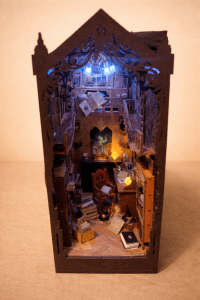
A book nook is a narrow miniature scene designed to sit between books on a shelf.
Think of it as a tiny world hidden inside your bookshelf.
Key Features:
- Typically fits between books (standard width)
- Designed with forced perspective (depth illusion)
- Usually built at 1:24 scale
- Often includes LED lighting
- Viewed from the front only
Book nooks are all about creating depth in a confined space — a magical alleyway, library, or hidden world that draws your eye in.
🌍 What is a Diorama?
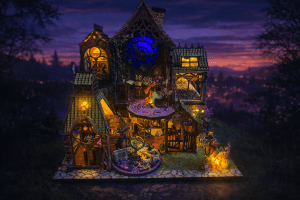
A diorama is a miniature scene that represents a moment in time — often more open, wider, and more realistic than a book nook.
Instead of being confined to a narrow space, a diorama allows you to build an entire environment.
Key Features:
- Open or wide format (not limited to bookshelf width)
- Viewed from multiple angles
- Focus on realism and storytelling
- Often built at smaller scales (around 1:36 or even smaller)
- Common in railway modelling and display scenes
Dioramas are less about illusion and more about recreating a real-world scene in miniature form.
⚖️ The Key Differences
1. 📏 Scale
This is one of the biggest differences — and often overlooked.
- Book Nooks: Usually around 1:24 scale
- Dioramas: Often smaller scale (≈1:36 or smaller)
👉 This allows dioramas to include larger scenes in the same physical space, making them feel more expansive and realistic.
2. 📐 Shape & Structure
- Book Nooks:
Narrow, vertical, and enclosed
Designed to fit between books - Dioramas:
Open, wide, and flexible
No strict size or shape limitations
3. 👀 Viewing Experience
- Book Nooks:
Viewed from one angle (front)
Relies on depth illusion - Dioramas:
Can be viewed from multiple angles
Focus on true spatial realism
4. 🛠️ Build Style
- Book Nooks:
Often kit-based
Structured and guided - Dioramas:
More scratch-built
Requires planning, creativity, and layout design
5. 🎯 Purpose
- Book Nooks:
Decorative pieces for bookshelves
“Wow factor” in small spaces - Dioramas:
Display models or storytelling scenes
Often used in exhibitions or collections
🧠 Which One Should You Choose?
✅ Choose a Book Nook if:
- You’re a beginner – buy from major reseller
- You want a contained, manageable project
- You like quick wins with strong visual impact
- You want something that fits neatly on a shelf
- Check out my beginner recommendation here
✅ Choose a Diorama if:
- You want full creative freedom
- You enjoy planning and designing scenes
- You prefer realism over illusion
- You’re happy working at smaller, more detailed scales
- Check out my recommended first diorama here
🔥 My Take (From Experience)
From building both styles, the biggest difference is this:
👉 Book nooks create depth — dioramas create space.
Book nooks are brilliant for instant impact and display, while dioramas allow you to build an entire world without limitations.
Interestingly, because dioramas often use a smaller scale (around 1:36), they can actually feel more realistic, even though they are physically larger scenes.
🏁 Final Thoughts
Both book nooks and dioramas are incredibly rewarding — it really comes down to what you enjoy most:
- Structured creativity → Book Nook
- Unlimited creativity → Diorama
If you’re just starting out, I’d always recommend beginning with a book nook, then moving into dioramas as your skills and confidence grow.
📌 What Do You Prefer?
Do you prefer the magic of a book nook or the realism of a diorama?
Let me know in the comments — I’d love to see what you’re building!
 Book Nook Workshop
Leave a comment