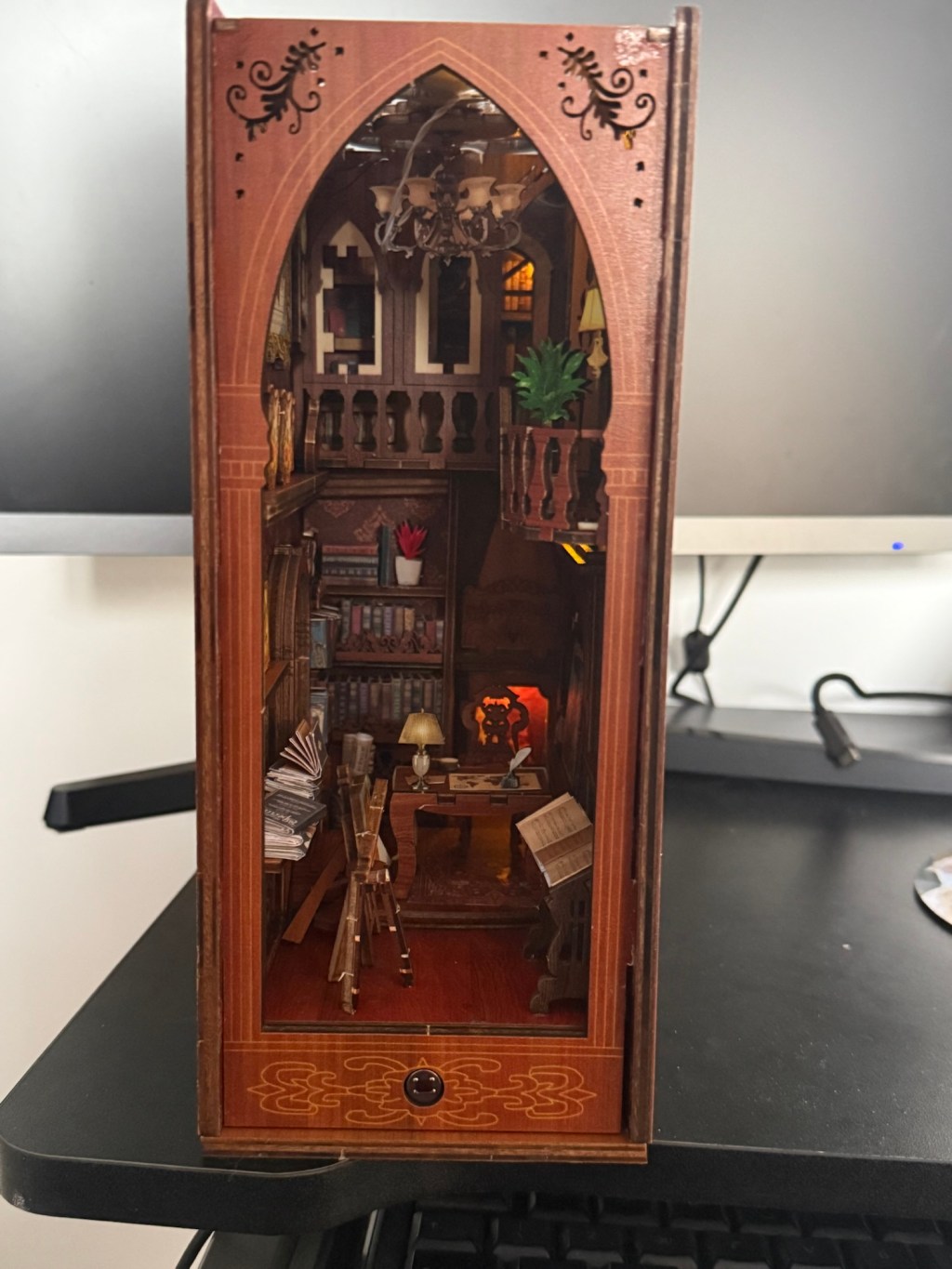
If you’ve ever seen a tiny glowing street hidden between books on a shelf, you’ve probably discovered a book nook.
Book nooks are miniature scenes built inside a narrow upright box designed to sit between books on a bookshelf. When viewed from the front, they reveal a detailed world — anything from a cosy library or tavern to a magical forest or old European street.
Most book nooks include:
• Miniature furniture and accessories
• Decorative architectural details
• Tiny books and props
• LED lighting to bring the scene to life
When placed between real books, they create the illusion of looking into another world hidden inside your bookshelf.
The History Behind Miniature Worlds
The fascination with miniatures isn’t new.
In fact, it dates back hundreds of years. Victorian households often had elaborate dollhouses, which were not toys but detailed displays of craftsmanship and interior design.
Over time, miniature hobbies expanded into areas such as:
• Model railways
• Airfix aircraft models
• Shipbuilding kits
• Architectural dioramas
Book nooks are essentially a modern evolution of these miniature traditions, combining craftsmanship, storytelling, and display.
How Big Is a Book Nook?
Most book nooks are built at a 1:24 scale, meaning everything inside is roughly twenty-four times smaller than real life.
That means:
• A chair might only be 2–3 cm tall
• Books are tiny replicas
• Doors and windows are only a few centimetres high
Despite the small size, the level of detail can be extraordinary.
Types of Book Nook Kits
Not all kits are the same. They generally fall into three levels of complexity.
Beginner Kits
These are often plug-and-play designs where many parts slot together without glue.
They typically include:
• Pre-coloured wooden pieces
• Simple lighting systems
• Clear instructions
These kits can usually be completed in 4–6 hours and are perfect for learning the basics.
Intermediate Kits
Intermediate kits require more patience and skill.
You’ll usually need to:
• Glue most components
• Assemble furniture pieces
• Install LED lighting
• Carefully align walls and structures
These builds typically take 20–40 hours depending on how detailed the design is.
Advanced Builds
Some models go far beyond traditional book nooks.
Large builds may include:
• Multiple rooms or floors
• Complex lighting systems
• Mechanical elements
• Custom modifications
Examples include elaborate street scenes, magical houses, or mechanical wooden models such as ships or space vehicles.
These projects can take weeks to complete.
Advanced Builds
Some models go far beyond traditional book nooks.
Large builds may include:
• Multiple rooms or floors
• Complex lighting systems
• Mechanical elements
• Custom modifications
Examples include elaborate street scenes, magical houses, or mechanical wooden models such as ships or space vehicles.
These projects can take weeks to complete.
A Few Popular Examples
Some well-known builds include:
• The Magic Forest fantasy scene
• Multi-room street scenes like Mall of Books
• Mechanical wooden models such as the Space Shuttle
• Detailed ship models like the Titanic
Each offers a completely different building experience.
My Advice for Beginners
If you’re new to book nooks, start simple.
Choose a plug-and-play kit so you can learn:
• how the pieces fit together
• how miniature lighting works
• how to handle delicate components
Once you’ve completed a couple of builds, you can move on to more complex designs.
The most important thing to remember is that this hobby isn’t a race.
Take your time, enjoy the process, and focus on building something you’re proud to display.
Why People Love Book Nook
For many builders, book nooks combine several hobbies into one:
• modelling
• crafting
• storytelling
• interior design
• miniature engineering
But most importantly, they create something magical — a tiny world hidden quietly between the books on your shelf.
 Book Nook Workshop
Leave a comment